
Version 2.5

Cohort report with more metric options
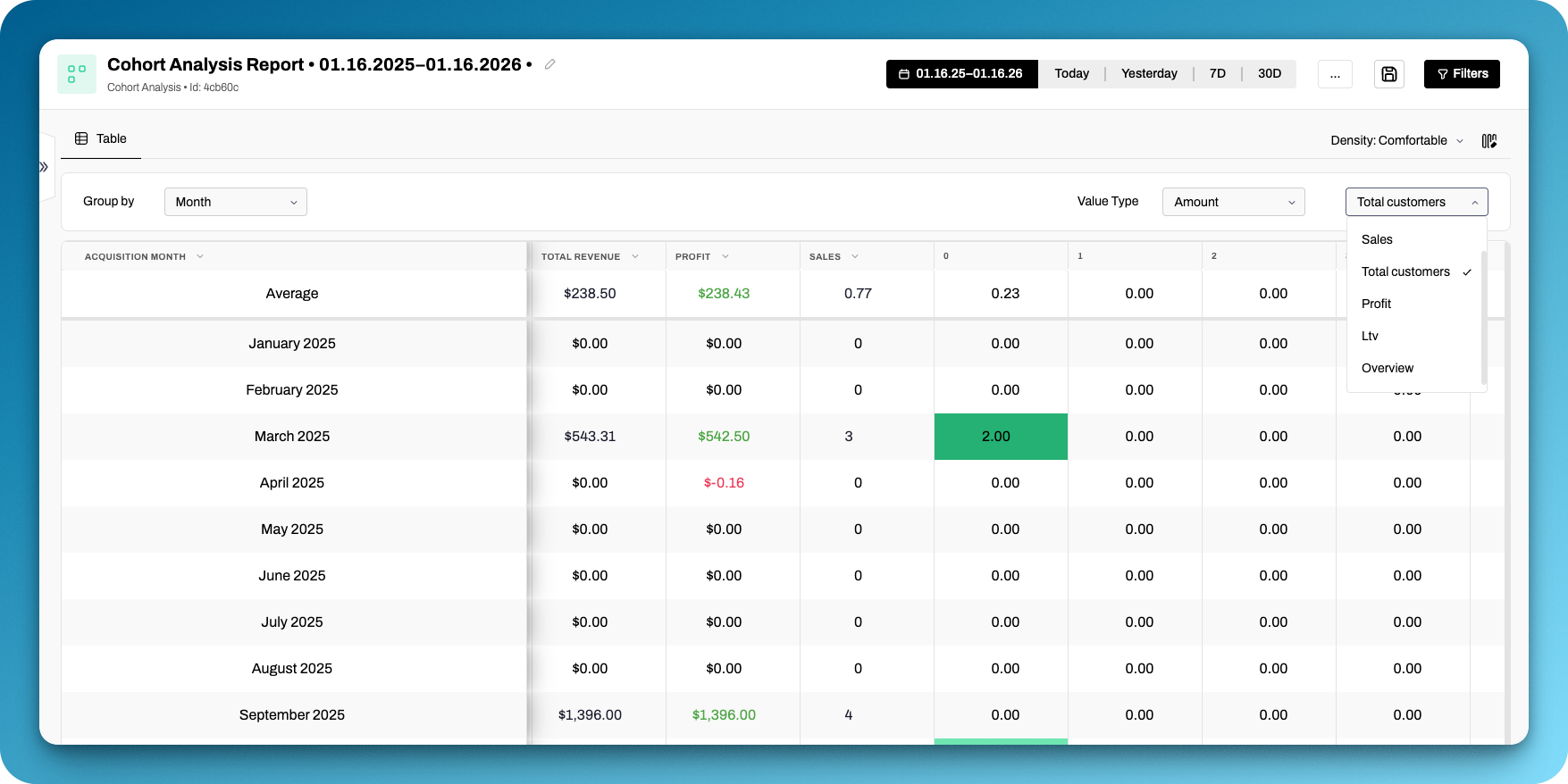
The Cohort report now supports more primary metrics, similar to the Performance report. This gives you more flexibility to analyze retention and performance over time using the metrics that matter most to your business. Metrics added were Total Customers and Profit.
Improvements & Bug Fixes
Zapier: create orders with only a phone number
In the Zapier “Create Order” action, you can now create sales using just a phone number if an email isnât available. At least one email or phone is required; if both are missing, the API returns a clear error message explaining whatâs needed.
Consistent Total Sales exports
We fixed a mismatch between the Total Sales report in the UI and the exported CSV. Exported data now aligns with what you see on-screen, ensuring you can trust downloaded reports for analysis or sharing.
More accurate “Returning customer” metrics
We resolved discrepancies between the “Returning customer” metrics shown in widgets and in related reports for certain date ranges. Returning customer counts and rates are now consistent, and missing descriptions for these metrics have been added.
Faster SourceBoard and performance-heavy queries
We reworked several backend queries that were causing slow performance in high-volume scenarios:
These changes result in faster response times and more stable performance when working with large datasets.
Better handling of custom metrics and widgets
We extended the custom metrics deletion flow so that related widgets are also removed when a custom metric is deleted, preventing broken widgets and improving dashboard hygiene.
More descriptive integration error messages
When an integration or token fails (for example, due to permissions or expired credentials), users now see more descriptive messages, including relevant information from the third-party app when possible. This makes it easier to diagnose and fix issues without needing support.
Pipedrive: automatic migration from API key to OAuth
We completed a migration of Pipedrive integrations from API keys to OAuth and updated them to use the latest webhooks. Active users have been moved to the new, more secure authentication method, and deprecated configurations have been cleaned up.
Google Ads API upgrade and click IP support
We upgraded our Google Ads integration to the latest supported API version before the upcoming deprecation. As part of this work, we now send the click IP to Google in ClickConversion, improving attribution quality and future-proofing the integration.
More robust public API rate limiting
We replaced the old, per-instance in-memory rate limiter with a centralized solution This:
- Applies global limits per user/endpoints across all instances.
- Supports both per-minute and per-second bandwidths.
- Includes safe fallbacks for brief Redis connectivity issues.
The result is fairer, more predictable rate limiting while maintaining high availability.
More reliable sales imports
We fixed an issue that caused some rows to be incorrectly marked as duplicates during sales imports, leaving imports incomplete and stuck at a percentage. Sales imports are now more accurate and resilient.