
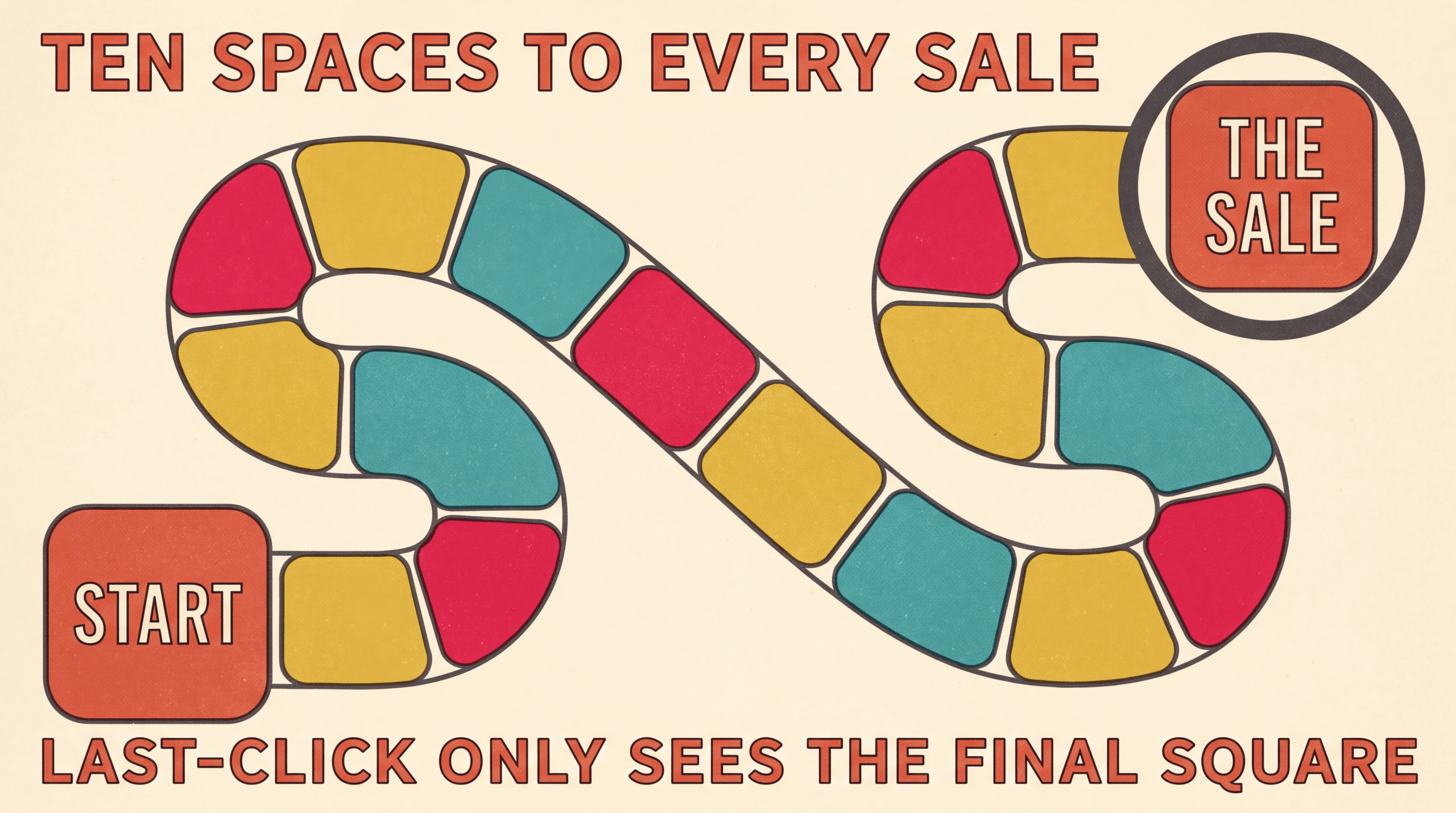

Multi-Touch Attribution vs. Last-Click: Which Model Actually Grows Revenue?
Multi-touch attribution grows revenue more reliably than last-click for any funnel with more than one touchpoint per customer, which in 2026 is nearly every paid media funnel. Last-click gives 100% credit to the final ad before purchase; multi-touch distributes credit across every touchpoint. The choice determines budget allocation and whether your growth compounds or stalls.
Last-click works fine if your customers see exactly one ad and buy from it. In that scenario, the last click and the first click are the same. But the typical 2026 buyer journey involves 10 or more touchpoints across multiple platforms, devices, and weeks, especially after iOS 14.5 fragmented cross-platform tracking. Last-click misses every touchpoint except the final one.
Multi-touch attribution typically grows revenue 15% to 30% faster than last-click over the same ad spend.
What’s the Actual Difference in How Multi-Touch and Last-Click Assign Credit?
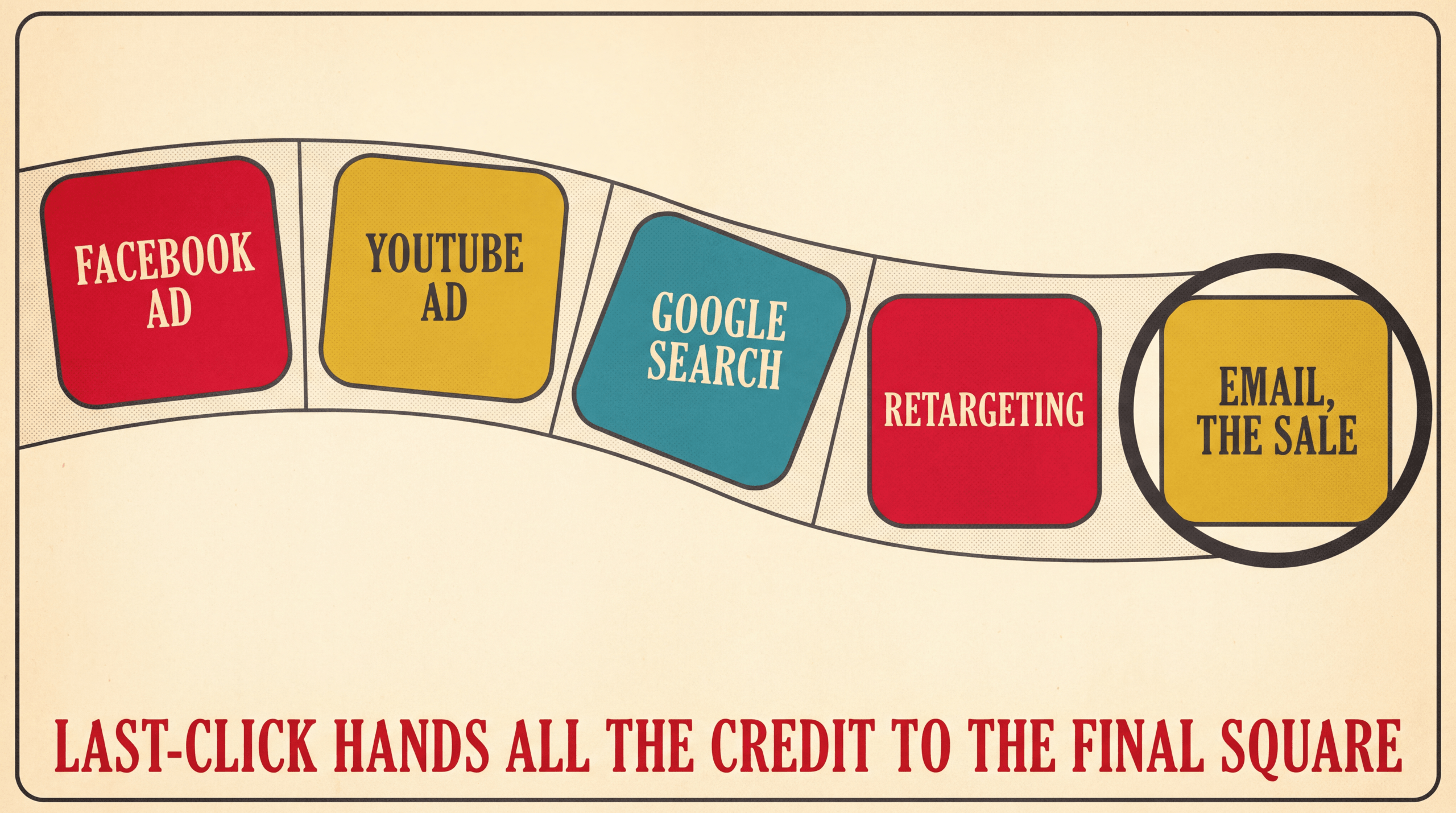
Multi-touch and last-click attribution differ in one core mechanic: last-click gives 100% of the credit to one touchpoint, while multi-touch attribution splits credit across all touchpoints in the conversion path. The split ratio depends on which multi-touch model you choose (linear, time-decay, U-shaped, or data-driven), but the fundamental difference is that multi-touch refuses to ignore the journey before the final click.
Consider a customer who sees:
- A Facebook ad (awareness)
- A YouTube ad (consideration)
- A Google search ad (intent)
- A retargeting banner (nurture)
- An email link that closes the sale (conversion)
Last-click credits only the email; 100% of the revenue goes to the email campaign. The Facebook, YouTube, Google, and retargeting ads receive zero credit despite being central to the journey.
Linear multi-touch gives each of the five touchpoints 20% credit. Time decay weights recent touchpoints heavier, perhaps 35% to email, 25% to retargeting, 20% to Google, 15% to YouTube, and 5% to Facebook. U-shaped gives 40% to Facebook (first), 40% to email (last), and 20% split across the middle three.
Key Takeaway: Multi-touch models acknowledge the full journey; last-click pretends only the last click mattered.
Why Does Last-Click Feel Accurate When It Isn’t?
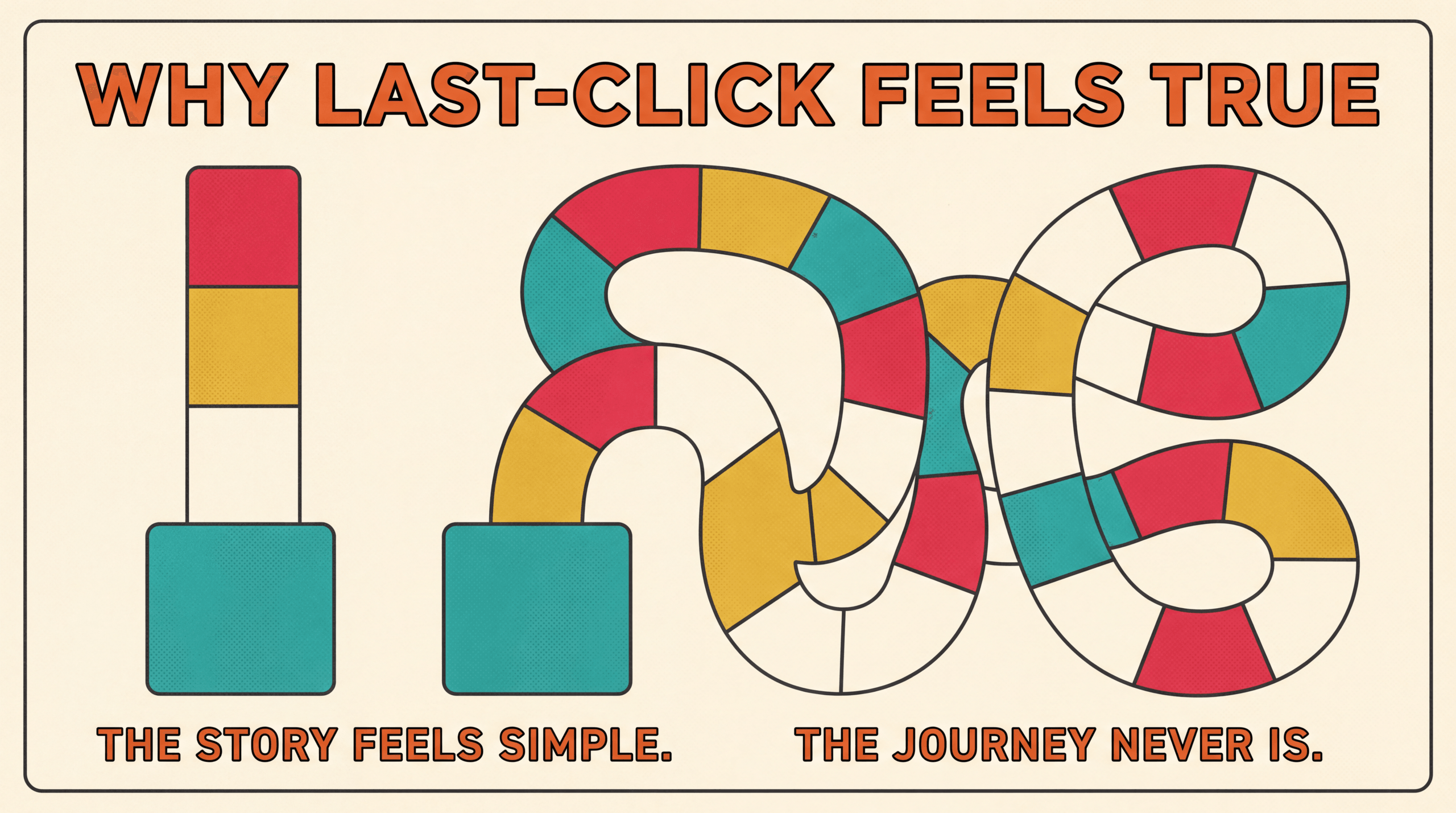
Last-click feels accurate because it produces clean, binary answers that match how human cognition processes cause and effect: ad X got the sale, ad Y didn’t. The problem is that buying decisions aren’t binary in modern funnels. Multiple touchpoints contribute to every non-impulse purchase, and last-click hides that contribution by design.
The psychological traps:
- Simple stories feel true: “This Facebook ad made the sale” is easier to understand than “five touchpoints contributed to the sale.”
- Recency bias: The last touchpoint is what the customer was doing when they bought, so it feels most causative.
- Platform reporting reinforces it: Facebook, Google, and other platforms default to last-click views, training marketers to trust them.
- Attribution models feel abstract: Splitting credit feels arbitrary, even when the underlying data supports it.
- Short-term metrics flatter last-click: Today’s conversions look “caused” by today’s retargeting, hiding last month’s awareness work.
Every one of these biases pushes toward under-investing in upper-funnel ads and over-investing in retargeting. The consequence is predictable: retargeting audiences dry up because the upper funnel never refilled them.
Last-click’s simplicity is also its lie.
How Does the Attribution Model You Choose Affect Budget Allocation?
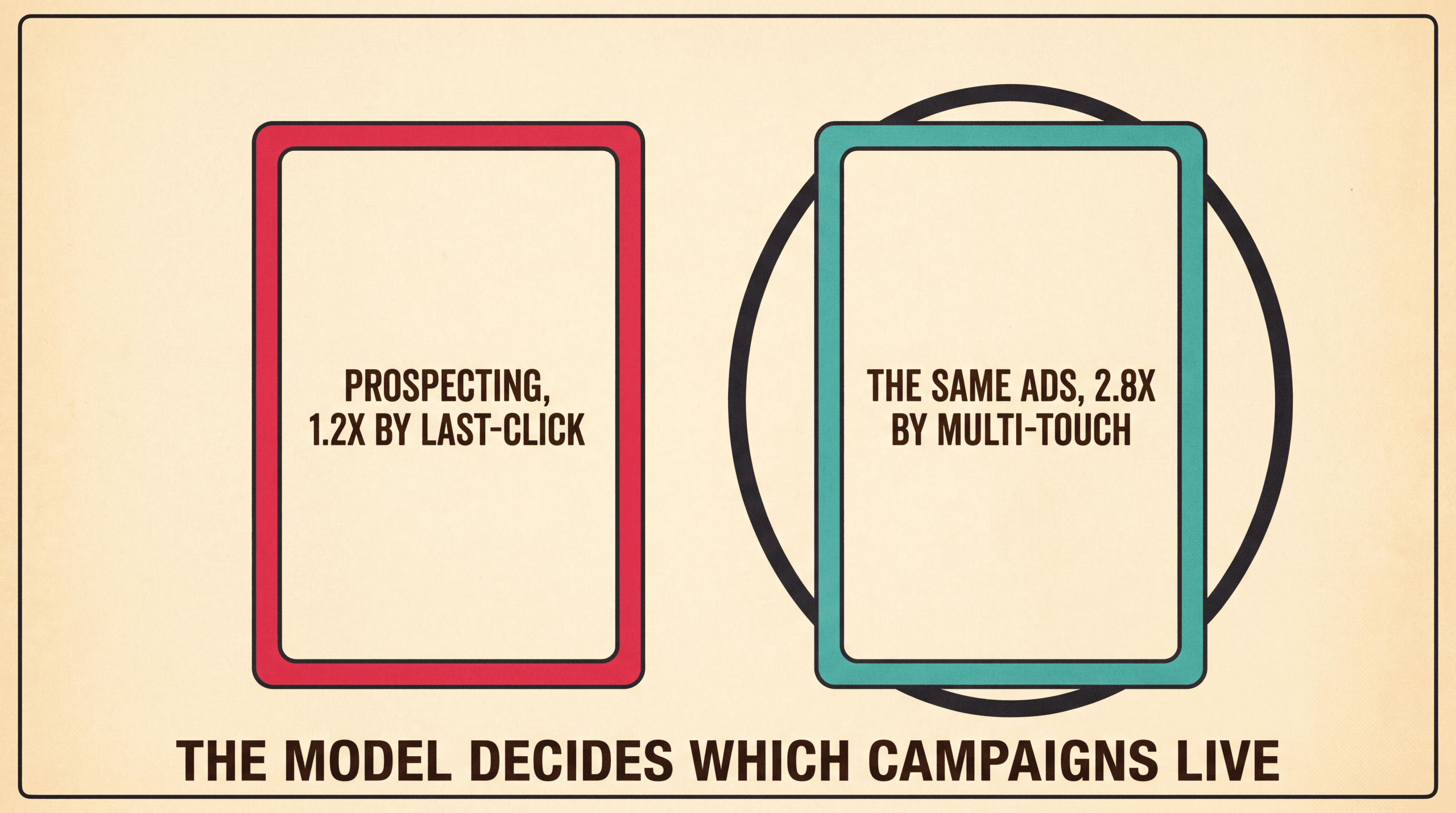
Your attribution model directly determines which campaigns get budget and which get cut, often with multi-million-dollar consequences. A campaign that looks unprofitable under last-click may be highly profitable under multi-touch, and vice versa. Most last-click brands underinvest in upper-funnel prospecting and overinvest in retargeting, creating a slow demand-generation crisis.
A real budget impact example:
| Campaign Type | Last-Click ROAS | Multi-Touch ROAS | Actual Contribution |
|---|---|---|---|
| Facebook Prospecting | 1.2x | 2.8x | Drives majority of new demand |
| YouTube Awareness | 0.8x | 2.1x | Builds consideration funnel |
| Google Brand Search | 8.5x | 4.2x | Harvests existing demand |
| Facebook Retargeting | 6.2x | 3.1x | Closes existing leads |
| Email Conversion | 12.0x | 4.8x | Finalizes near-ready buyers |
Under last-click, the brand would kill Facebook prospecting and YouTube awareness (ROAS under 1.5x) while doubling down on brand search and email (ROAS over 8x). Within six months, retargeting audiences shrink because awareness stopped feeding the funnel.
Under multi-touch, the brand sees that prospecting and awareness are profitable at true contribution, just not at the moment of sale. Budget stays balanced and growth compounds.
Last-click budget allocation starves the top of your funnel over time.
When Does Last-Click Attribution Still Make Sense?
Last-click attribution still makes sense in a narrow set of cases where the customer journey is genuinely one touchpoint long. If your customers see one ad and buy, last-click isn’t inaccurate; it’s just simple. The question is whether your actual customer journeys match that assumption, which most don’t in 2026.
Scenarios where last-click remains defensible:
- Single-session, single-platform funnels: Direct response ads that drive immediate checkout, especially low-ticket impulse products.
- Search-driven intent capture: Google brand search campaigns where the customer already knew the brand and was closing a decision.
- Email-only conversion journeys: Existing customers clicking through an email to reorder.
- Very high conversion volume: Accounts with millions of conversions where data-driven attribution models need more training data than available.
- Simple e-commerce under $50 AOV: Impulse purchases where consideration is minimal.
Even in these cases, last-click reports benefit from a multi-touch sanity check every quarter. Campaigns that look fine under last-click often reveal hidden dependencies through a multi-touch lens.
Last-click is defensible only when journeys are genuinely simple.
What Multi-Touch Attribution Model Should Most Brands Use?
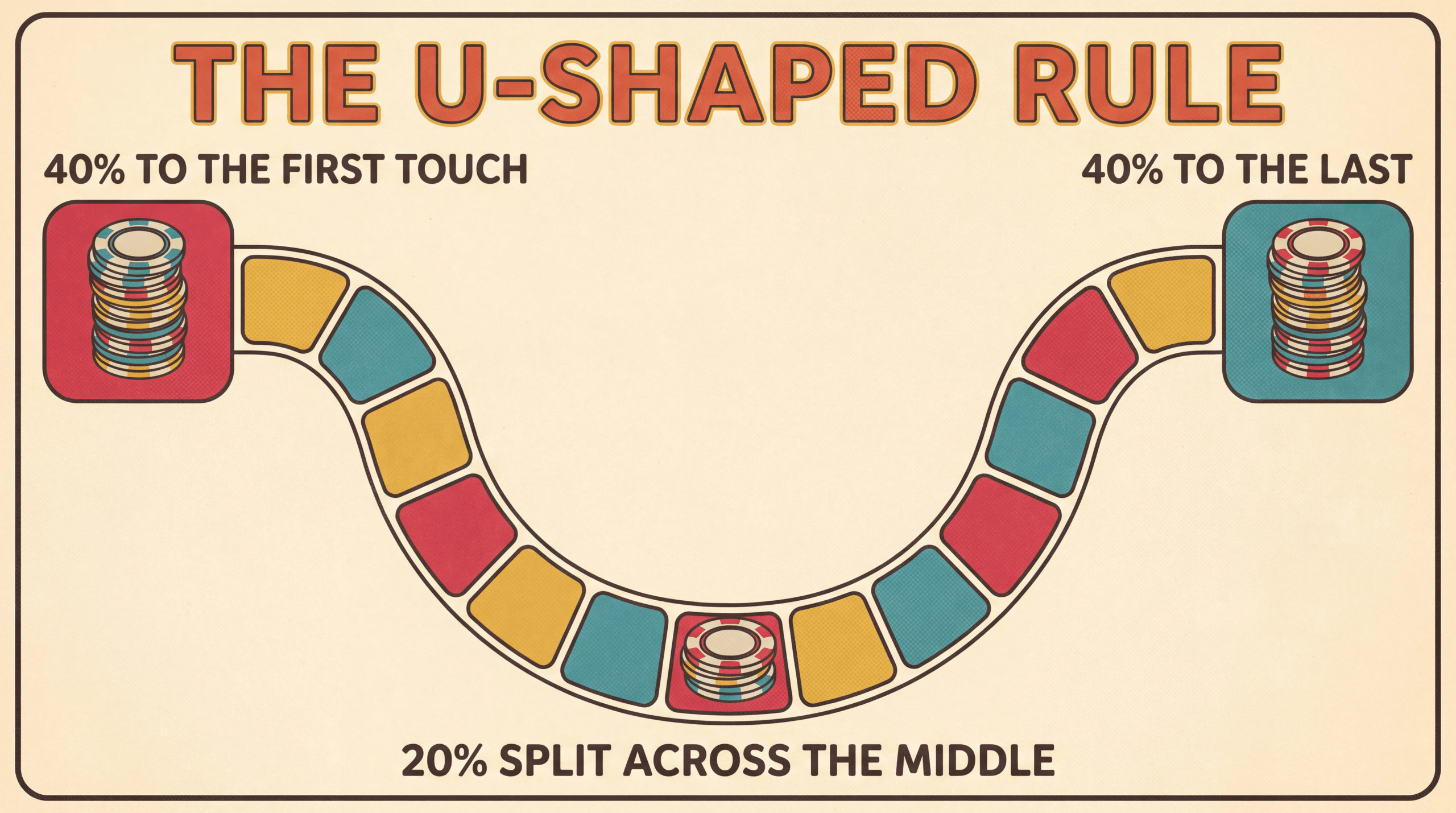
Most brands should start with data-driven attribution where available (Google Ads’ DDA model and Meta’s experimental versions), fall back to position-based (U-shaped or W-shaped) for complex B2B funnels, or use time decay for short-cycle e-commerce. Linear is useful as a sanity check but rarely optimal as a primary model.
Model-to-funnel fit recommendations:
- Data-driven: Best for accounts with at least 3,000 ad interactions and 300 conversions within 30 days. Google Ads’ default for most advertisers.
- U-shaped (position-based): Best for lead generation and B2B where first touch (awareness) and last touch (conversion) matter most.
- W-shaped: Best for B2B SaaS with explicit lead, MQL-to-SQL handoff, and closed-won stages in the funnel.
- Time-decay: Best for short-cycle e-commerce where recent touchpoints matter more than older ones.
- Linear: Best as a simple baseline or sanity check against more complex models.
For multi-platform advertisers, the model also needs to work across platforms, not just within one. This is where dedicated tools like Hyros, Triple Whale, and Northbeam become necessary. They apply consistent multi-touch logic across Meta, Google, TikTok, YouTube, and email simultaneously.
Key Takeaway: Match your attribution model to your funnel structure and conversion volume.
How Do You Transition From Last-Click to Multi-Touch Attribution?
You transition from last-click to multi-touch by running both models in parallel for 60 to 90 days, comparing budget allocation recommendations, and gradually shifting decisions to the multi-touch view. A hard cutover shocks teams and obscures which performance changes came from the model switch versus other variables.
The 90-day transition plan:
- Month 1 – Setup: Deploy a multi-touch attribution tool or configure data-driven attribution in Google Ads. Keep last-click reporting live as the default.
- Month 2 – Parallel run: Teams report using both models, noting where they disagree. Identify campaigns where the two models give conflicting signals.
- Month 3 – Pilot reallocation: Shift 10% to 20% of budget based on multi-touch signal where the models strongly disagree.
- Month 4+ – Multi-touch as primary: Switch decisions to multi-touch. Keep last-click visible as a secondary view for legacy reporting.
Organizational challenges usually exceed technical challenges. Marketing, executive leadership, and finance stakeholders all need retraining on the new numbers because multi-touch produces different-looking reports than last-click. Brands that skip stakeholder education often revert to last-click under pressure.
Multi-touch transitions fail more often from organizational resistance than from technical problems.
Picking the Right Attribution Model for Revenue Growth
Multi-touch attribution grows revenue more reliably than last-click for nearly every modern advertiser because it surfaces the upper-funnel work that last-click systematically hides. Last-click’s simplicity is also its blind spot. It over-credits closers and under-credits generators, training marketers to cut the campaigns that refill the funnel.
In our work with performance marketers, brands that scale sustainably run multi-touch attribution through tools like Hyros, Triple Whale, or data-driven models inside ad platforms. If you’re still making budget decisions on last-click in 2026, you’re scaling on a model that rewards demand harvesting over demand generation, and eventually you’ll run out of demand to harvest.
Frequently Asked Questions
Which attribution model is most accurate: multi-touch or last-click?
Multi-touch attribution is more accurate than last-click for any customer journey with multiple touchpoints, which describes most funnels in 2026. Last-click ignores everything that happened before the final click, which systematically underestimates upper-funnel value. Multi-touch distributes credit across touchpoints, giving a truer picture of what actually caused each conversion.
Does Facebook use last-click attribution by default?
Facebook (Meta) uses last-click attribution by default in Ads Manager with a current 2026 window of 7-day click, 1-day engage-through, and 1-day view (updated in March 2026). Meta also offers first-click, linear, time-decay, position-based, and data-driven attribution models in Attribution Settings and the Attribution comparison tool. Note that 7-day view and 28-day view options were permanently removed from Meta in January 2026.
Can Google Ads do multi-touch attribution?
Google Ads supports multi-touch attribution through its data-driven attribution (DDA) model, which uses machine learning to assign credit across touchpoints. As of September 2025, Google Ads deprecated all other attribution models (first-click, linear, time-decay, and position-based), leaving only DDA and Last Click. Smaller accounts that don’t meet DDA’s data thresholds default to last-click until volume grows.
Is multi-touch attribution worth the complexity?
Multi-touch attribution is worth the complexity for brands spending $10,000+/month on paid ads with sales cycles longer than a single session. Below that threshold, last-click simplicity often outweighs the analytical benefits. Above it, the 15% to 30% revenue uplift from better budget allocation justifies the tool cost and learning curve.
What’s the best tool for multi-touch attribution?
The best tool for multi-touch attribution depends on your business model and ad spend. Hyros suits performance marketers running multi-platform paid media with long sales cycles. Triple Whale suits Shopify e-commerce brands. Northbeam suits scaled DTC brands. Google Ads’ native data-driven attribution suits Google-dominant accounts. Most mid-market brands evaluate 2 to 3 tools before deciding.
Can I switch back to last-click if multi-touch doesn’t work for me?
You can switch back to last-click at any time since ad platforms retain conversion data regardless of the reporting model used. Most brands that implement multi-touch don’t switch back because the broader visibility into upper-funnel performance is hard to unsee. The few that revert usually do so due to organizational resistance rather than measurement concerns.