
How to Scale from $50K to $500K/Month Without Losing Attribution Accuracy
A 10 percent attribution error at $50K per month costs $5,000. The same error at $500K per month costs $50,000, and that is before you account for what the bad data does to your bidding algorithms. Attribution gaps do not stay fixed as you scale paid advertising budget. They scale with your spend, and they compound through every dollar you add.
Key Takeaways
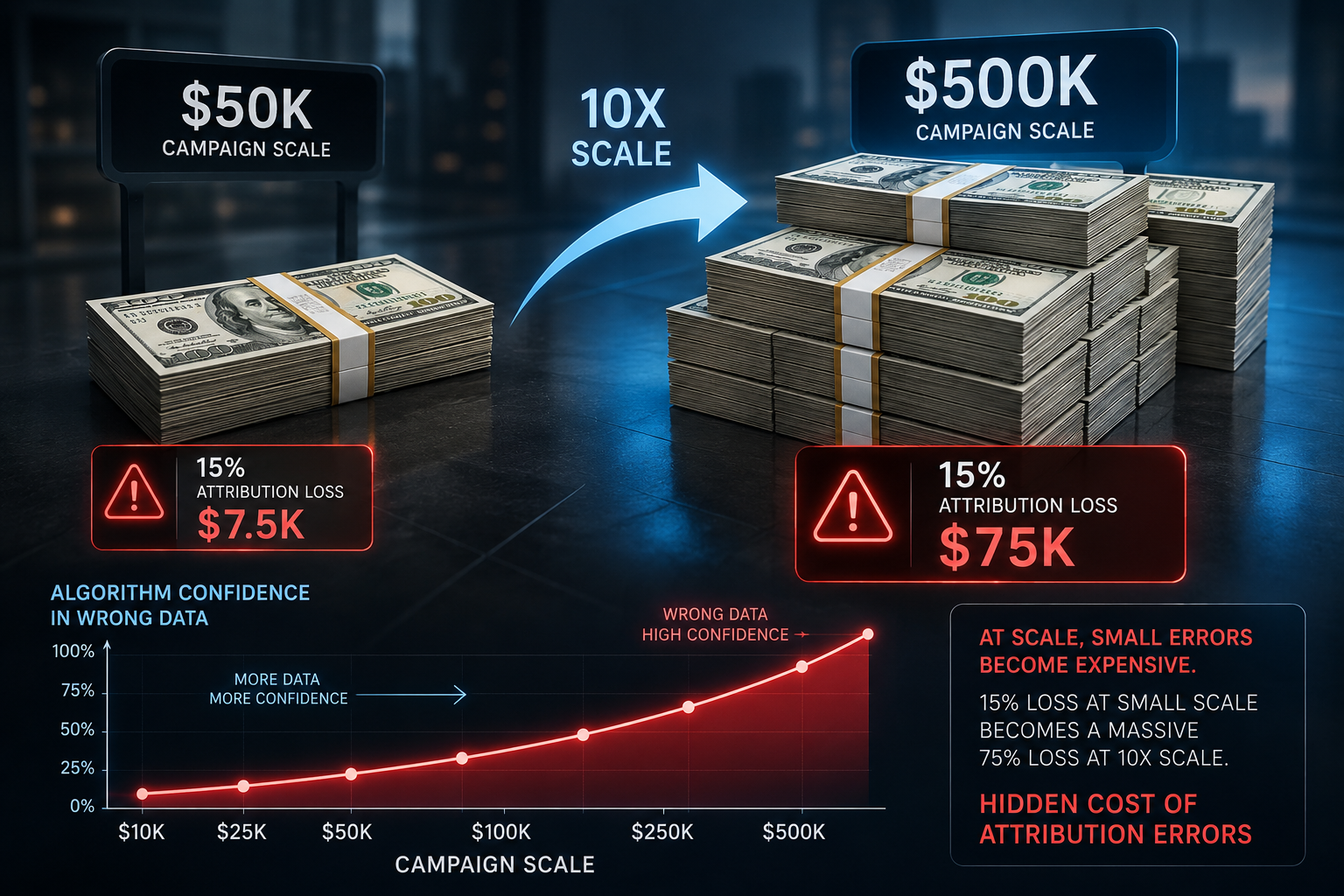
- A 15 percent attribution error costs $7,500 per month at $50K in spend. The same error at $500K costs $75,000 per month, or $900,000 per year.
- Meta Advantage+ Shopping crossed a $20B annual run rate in Q4 2024 (Meta Q4 2024 Earnings, via Nasdaq, 2024). Google Performance Max has more than 1 million advertisers worldwide (GROAS analysis, 2025). Both systems learn from the conversion signals you feed them. Wrong signals produce wrong learning, faster.
- Three requirements must be in place before you scale: server-side tracking with cross-channel deduplication, attribution windows matched to your actual funnel, and LTV visibility so you scale customer quality and not just volume.
- Solve attribution before you scale. Scaling first and fixing later does not work. The algorithm has already been trained on corrupted data.
Table of Contents
- Why Attribution Errors Get More Expensive as You Scale
- The $50K Problem vs. the $500K Problem
- Three Attribution Requirements Before You Scale
- How to Maintain Attribution Accuracy as You Scale
- Frequently Asked Questions
Why Attribution Errors Get More Expensive as You Scale
Attribution error is a percentage of spend, not a fixed dollar figure. That is the mechanic that sneaks up on operators moving from $50K to $500K per month. A 20 percent misattribution rate at $50K equals $10K lost. At $500K, it equals $100K. The error rate did not change. The exposure did.
This matters more in 2026 than it did three years ago because the way scaled advertisers deploy budget has changed. Meta Advantage+ Shopping crossed a $20B annual run rate in Q4 2024, a 70 percent year-over-year increase (Meta Q4 2024 Earnings, via Nasdaq). Google Performance Max now has more than 1 million advertisers globally as of April 2025 (GROAS, 2025). If you are scaling Meta or Google spend in 2026, you are almost certainly inside one or both of these systems. Both optimize from conversion signals fed to them. When those signals are wrong, the algorithm trains on wrong data at scale.
The auction environment around you is also getting more wasteful. The ANA’s Q2 2025 Programmatic Transparency Benchmark put ad waste at $26.8B annually, a 34 percent increase in two years (eMarketer / ANA, 2025). Only $0.439 of every programmatic dollar actually reaches a consumer (Marketing Dive / ANA, 2024). At $50K per month, that floor is expensive. At $500K, it is structural.
The compounding problem: how bad signals get worse at scale
 At $50K per month, bad attribution produces mildly suboptimal bids. The system makes small mistakes on a small base. You absorb it. At $500K per month, the same percentage error trains the algorithm at 10x the volume. Consolidated campaign structures (Advantage+, PMax) make this worse, not better.
Advertisers who moved to fewer, larger Advantage+ campaigns saw a 32 percent CPA drop versus fragmented setups when signal quality was clean (bir.ch / Meta Ads Optimization, 2025). That consolidation cuts both ways. Clean signal into a consolidated structure produces a 32 percent gain. Dirty signal into the same structure concentrates the error.
This is the part most articles miss. Wasted money is the obvious cost. The hidden cost is that a sophisticated AI bidding system is being trained on wrong data, at scale, by signals you provided. It is not failing randomly. It is succeeding confidently at the wrong objective. The more you spend, the more confident it gets.
Channel mix complexity grows with spend
Below $100K per month, the right move is usually one-channel depth before adding another. Above $100K per month, the optimal mix shifts. A common allocation among scaled operators looks like 70 percent to a proven core channel, 20 percent to growth tests, and 10 percent to experiments. Without attribution that surfaces which channels belong in which bucket, you are expanding channels blind.
The HexClad case study shows what data-driven concentration looks like at scale. The cookware brand scaled ad spend 83 percent in 2022 and then 213 percent in 2023 while improving Marketing Efficiency Ratio in both years, with 70 percent of budget concentrated in Meta based on Media Mix Modeling output (Northbeam, 2024). The lesson is not “diversify.” It is “concentrate where the model gives you confidence.” That decision is only available to operators with attribution that can produce model confidence in the first place.
When you do not have that, the framework for cut-or-scale decisions at scale breaks down. You are working from platform-reported ROAS, and platform-reported ROAS is exactly what overstates results in consolidated systems.
The $50K Problem vs. the $500K Problem
Run the math on a single attribution scenario. An operator’s tracking system misattributes 15 percent of ad spend, crediting the wrong campaigns with conversions.
- At $50K per month: $7,500 misallocated per month. Painful, survivable.
- At $500K per month: $75,000 misallocated per month. $900,000 per year.
That is the same error rate. The dollar exposure is 10x. And the misallocation does not just sit there. It tells the algorithm that the wrong campaigns are working, so the algorithm pushes more budget toward them, and the misallocation widens.
One Hyros customer reported this exact problem in concrete dollars. After implementing Hyros, the CEO of Regenalight identified between $80,000 and $100,000 per month in wasted Facebook ad spend that platform-native tracking had been crediting incorrectly. Revenue grew from $1M to $3M monthly in the following quarter after that spend was reallocated (Hyros published results, self-reported). The wastage was not a rounding error. It was 8 to 10 percent of monthly revenue, hiding inside Facebook’s own conversion reports.
If you want to see the math behind running this scaling decision yourself, the prerequisite is measuring true ROAS before you scale. Platform-reported ROAS double-counts view-through credit, ignores cross-channel attribution, and rewards retargeting for buyers who would have returned anyway. Without a clean ROAS number, none of the cut-or-scale logic works.
Want to see what your attribution actually looks like? Book a Hyros demo.
Three Attribution Requirements Before You Scale
Three things have to be in place before you push budget. Treat these as non-negotiable. If any one is missing, the next budget increase compounds error rather than revenue.
Requirement 1: Server-side tracking with cross-channel deduplication
Browser pixels lose data at scale. iOS signal loss, ad blockers, and cross-device journeys all degrade what the pixel can capture. Meta’s Andromeda architecture (introduced late 2024) drives real-time bid predictions across all Meta surfaces, and its performance is tied directly to the quality of signal fed via CAPI and Pixel (bir.ch / Meta Marketing Updates, 2025). Practitioner data suggests Event Match Quality improvements of 2 to 3 points correlate with 15 to 25 percent better ROAS, and poor EMQ can increase acquisition costs by 40 to 60 percent (Madgicx / CustomerLabs, 2025).
Server-side tracking recovers the lost signal. But it has to be implemented with cross-platform deduplication. Solve under-counting without creating a double-counting problem, or you have traded one attribution failure for another.
Requirement 2: Attribution windows matched to your actual funnel
Platform default windows are set for the platform’s benefit. Meta defaults to 7-day click and 1-day view. Google Ads defaults to 30-day click. If your consideration cycle is 30 days and your window is 7, the campaigns actually driving buyers get undercredited. You then reallocate budget away from those campaigns, confidently funding the wrong ones. The platform reports look fine the entire time.
Match the window to the funnel. Read more on the mechanics of how attribution reduces customer acquisition cost when windows are tuned correctly.
Requirement 3: LTV visibility, not just CPA optimization
As spend scales, customer quality matters more, not less. A campaign scaling to $100K per month at a $150 CPA looks efficient on a CPA report. If those customers churn at three times the rate of a competing campaign running at a $200 CPA, you are scaling churn. CPA reports do not show this. LTV reports do.
The Wicked Reports case study with Wise Pelican is the proof point for what clean attribution does at this spend level. At $100K per month in ad spend, Wise Pelican cut new customer acquisition cost by 30 percent, increased new customers by 50 percent, and reduced wasted ad spend by 20 percent using first-party attribution and Click Date insights (Wicked Reports, 2024). Those are not small gains. They are the difference between the next scaling increment working and burning cash.
How to Maintain Attribution Accuracy as You Scale
If the problem is cross-channel, multi-touch, high-volume attribution failure, the answer has to be a tool built for that problem. That is what Hyros does, and it is how operators scale spend without losing data accuracy.
Hyros is built for operators running $20K to $1M+ per month in paid spend. The architecture handles the failures that emerge at scale:
- Pixel-independent tracking captures conversions that platform pixels miss. Hyros reports up to 50 percent more ad attribution on call-based funnels (Hyros call tracking, self-reported).
- Multi-touch attribution across channels that platform-native models cannot cross. Meta cannot credit Google. Google cannot credit Meta. A third-party layer can credit both.
- Configurable attribution windows matched to your actual funnel length rather than the platform default.
- LTV tracking that connects post-acquisition revenue back to the original ad source, so you can see which campaigns produce churners and which produce repeat buyers.
- Verified ROAS reporting independent of any platform’s self-reported numbers. This is the layer that makes how to calculate verified ROAS across all channels operationally possible.
Hyros reports at least a 15 percent ad ROI increase on average across customers (Hyros, company-reported). The Tony Robbins organization scaled ad spend 43 percent for Business Mastery within 6 months of implementation (documented Hyros results, self-reported). The pattern in the customer reports is consistent. Clean data enables confident scaling. Confident scaling is not the same as blind growth.
This is not a tool that drops in and runs by itself. It is built for operators who are serious about their data. The implementation requires aligning conversion events, server-side feeds, and LTV inputs to your actual funnel. The payoff is that the next scaling increment is informed rather than speculative.
Frequently Asked Questions
How do I scale ad spend without losing accuracy?
Three requirements have to be in place before you scale. Server-side tracking with cross-platform deduplication so conversion data does not degrade as complexity grows. Attribution windows matched to your actual funnel length rather than platform defaults. LTV visibility so scaling campaigns produce quality customers and not just low-cost ones. Solve these before you scale, and every additional dollar deploys cleanly.
At what ad spend level does attribution become critical?
Attribution errors become material above $20K to $50K per month. At $50K per month, a 15 percent tracking error costs $7,500 per month. At $500K per month, the same rate costs $75,000 per month. Attribution investment returns more than its cost at any meaningful spend level, but the math becomes undeniable above $50K.
What happens to attribution accuracy as ad spend scales?
Attribution complexity grows with spend. More channels create more double-counting opportunities. More campaign types create attribution model conflicts. Longer consideration cycles create window mismatches. Platform-native attribution does not scale gracefully because it was built for simpler campaigns. The gap between what platforms report and what actually happened widens as spend increases.
How do agencies maintain attribution accuracy for large ad budgets?
Agencies managing large budgets consistently implement server-side tracking and third-party attribution. Platform-native reporting becomes less reliable as spend grows because no single platform sees the full conversion path. A third-party layer provides the cross-channel view that individual platform dashboards cannot, and it makes reconciliation against back-end revenue systematic rather than ad hoc.
When should I invest in a third-party attribution tool?
When the cost of attribution errors exceeds the cost of the tool, which at $50K per month in ad spend happens quickly. A 10 percent tracking error at $50K per month costs $5,000 per month. Most third-party attribution tiers cost a fraction of that. Beyond $50K per month, accurate attribution is the minimum requirement for informed scaling decisions, not a nice-to-have.
Stop Optimizing for What the Platforms Tell You
Stop optimizing for what the platforms tell you. Start optimizing for what is actually driving revenue.