

What is Ad Attribution? The Complete Guide for Marketers in 2026
Ad attribution is the process of identifying which ads, campaigns, and touchpoints caused a customer to convert, using tracking data to assign credit and optimize future ad spend.
Ad attribution is the process of identifying which ads caused a customer to buy, sign up, or convert. Marketers use attribution to assign credit across the touchpoints that influenced a sale, the first ad that generated awareness, the retargeting ad that brought the visitor back, and the final ad that closed the deal. Without attribution, ad spend becomes guesswork.
Attribution answers the single most important question in paid media: which ad produced this revenue? Get it right, and you scale winning campaigns profitably. Get it wrong, and you kill campaigns that were actually working while scaling campaigns that only appeared to work.
In 2026, ad attribution is the foundation of every profitable paid media operation.
Why Does Ad Attribution Matter More in 2026 Than Ever?
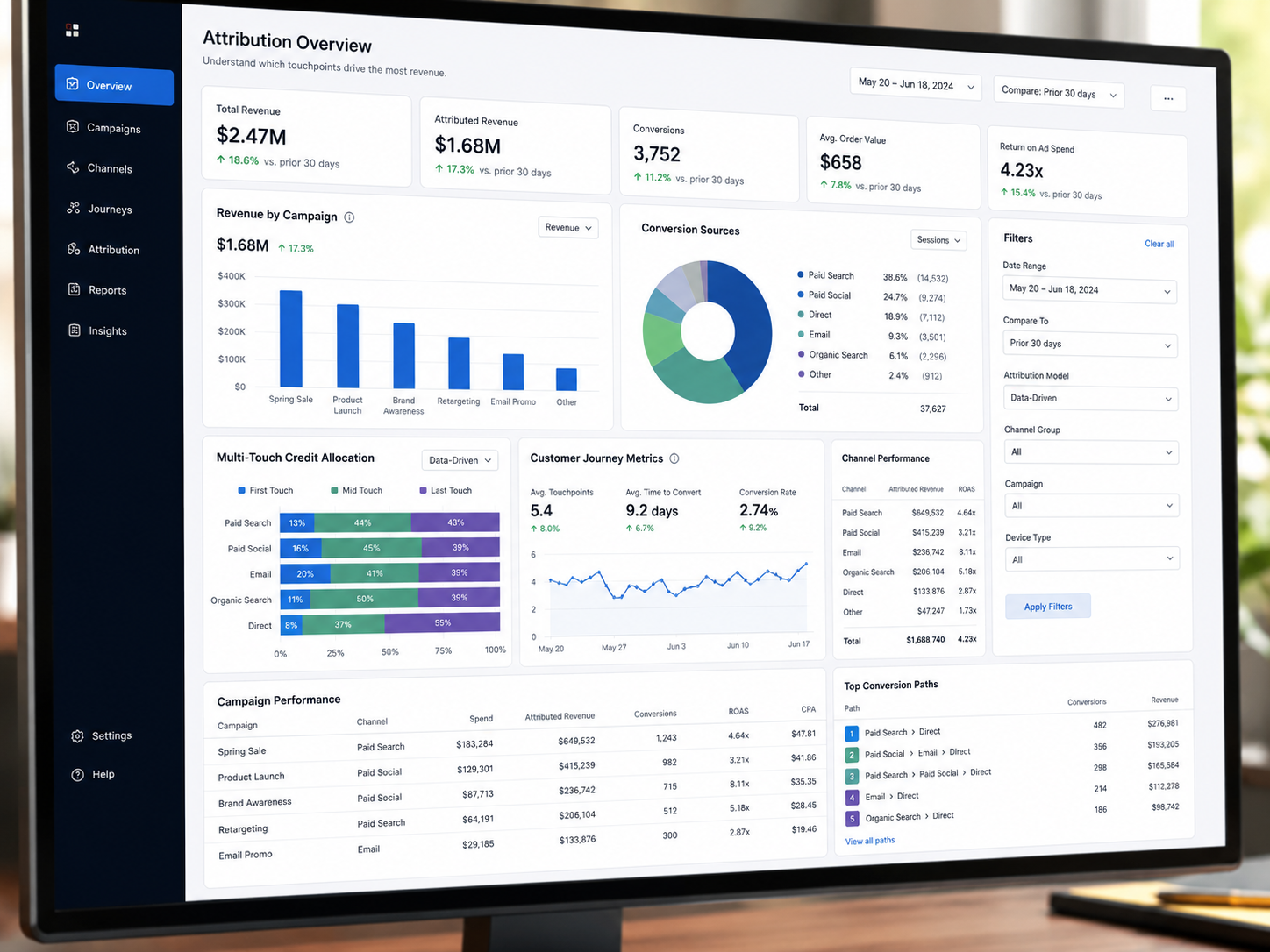 Ad attribution matters more in 2026 because privacy changes have made traditional tracking unreliable while ad costs keep rising. Apple’s iOS 14+ App Tracking Transparency, Safari’s Intelligent Tracking Prevention, and Chrome’s ongoing cookie deprecation have reduced the signal quality ad platforms receive. Meta and Google now see less of what happens after the click.
The consequences compound. Weaker attribution signals lead to worse ad platform optimization, which leads to higher CPAs, which lead to lower margins, which force brands to scale back ad spend right when competitors with better attribution are scaling up. According to industry analyses, brands without server-side attribution typically underreport 20% to 40% of their paid conversions.
- Privacy regulations (GDPR, CCPA, CPRA) restrict cookie-based tracking.
- Browser changes (Safari ITP, Chrome cookie deprecation) break pixel reliability.
- Platform fragmentation spreads customers across Meta, Google, TikTok, YouTube, and email.
- Rising ad costs make every attribution error more expensive.
Key Takeaway: Attribution is no longer a nice-to-have dashboard; it’s the infrastructure that determines whether ads stay profitable.
How Does Ad Attribution Actually Work?
Ad attribution works by placing tracking codes on ads and conversion points, then matching the two using identifiers like cookies, device IDs, email hashes, or server-side parameters. When a user clicks an ad, the tracking system stores a reference. When that user converts, the system matches the conversion back to the original click.
Modern attribution systems use one or more of these identifier layers:
- Browser cookies: First-party and third-party cookies store click IDs in the user’s browser.
- URL parameters: UTM codes and platform-specific click IDs (fbclid, gclid) travel with the click.
- Server-side events: Conversion APIs like Meta CAPI send data directly from your server to the ad platform.
- Identity resolution: Email hashes, phone hashes, and device fingerprints match users across devices.
- Print tracking: Patented methods (used by platforms like Hyros) combine multiple signals into a persistent user fingerprint.
The quality of attribution depends on how many of these layers a system uses and how well they work together. Single-layer attribution (cookies only) fails under modern privacy restrictions. Multi-layer attribution survives.
Attribution accuracy scales with the number of identifier layers your tracking uses.
What Are the Main Types of Ad Attribution Models?
There are seven main ad attribution models, each assigning credit to touchpoints differently. The model you choose determines which campaigns look successful and where you allocate budget. Choosing the wrong model distorts every downstream decision.
Last-click remains the default in most ad platforms because it’s simple, but it over-credits bottom-of-funnel campaigns and under-credits the ads that generated awareness. Multi-touch attribution gives a more complete picture at the cost of complexity.
Most brands running ads longer than a year outgrow last-click attribution within 18 months.
What’s the Difference Between Attribution and Analytics?
Attribution answers which ad caused this sale, while analytics answers what happened on my website. The two tools serve different purposes and use different methodologies. Marketers who treat them interchangeably make expensive decisions with the wrong data.
Google Analytics, for example, reports how visitors behaved on your site: pages viewed, time on site, bounce rate, and funnel drop-offs. That’s analytics. Hyros reports which specific ads generated which specific revenue. That’s attribution.
Analytics tools usually:
- Focus on on-site behavior and user flow.
- Use browser-based session tracking.
- Report aggregated patterns across traffic sources.
- Serve product and UX teams more than media buyers.
Attribution tools usually:
- Focus on ad-to-conversion matching.
- Use multi-layer identifier resolution.
- Report revenue and LTV by individual campaign and ad.
- Serve performance marketers and growth teams.
Key Takeaway: Analytics tells you what happened. Attribution tells you who caused it.
What Is Multi-Touch Attribution and Why Is It Replacing Last-Click?
Multi-touch attribution assigns credit across every touchpoint in a customer journey rather than giving 100% credit to the final click. It replaces last-click because modern customer journeys involve multiple ads, multiple platforms, and multiple sessions, often spanning weeks. Last-click ignores 80% of that journey.
A typical B2B software buyer in 2026 might see a LinkedIn ad, search the brand on Google, click a YouTube pre-roll, read an email sequence, and finally convert through a retargeting ad. Last-click attribution credits only the retargeting ad and hides the work the other four touchpoints did.
 Multi-touch attribution reveals:
- Which ads generate qualified new awareness.
- Which mid-funnel touchpoints move prospects forward.
- Which closers the bottom-funnel ads actually close.
- How long the typical buyer journey takes from first click to purchase.
Brands running multi-touch attribution typically reallocate 15% to 30% of their ad budget within 90 days as hidden winners become visible and hidden losers become obvious.
Multi-touch attribution is the default model for growth-stage and enterprise brands in 2026.
How to Choose the Right Ad Attribution Strategy
Ad attribution is the process of connecting every conversion to the ads that caused it, and in 2026 it determines which brands scale profitably and which burn cash on broken data. Last-click attribution misses most of the journey. Multi-touch attribution with server-side tracking reveals the real picture. If you spend meaningful money on ads, the question isn’t whether to invest in better attribution; it’s how fast you can deploy it before competitors outbid you with cleaner data.
Hyros makes this easy — server-side tracking, zero changes to your ads, and setup in minutes. Ready to stop guessing? Get in touch, and we’ll show you how it works.
Frequently Asked Questions
What does ad attribution mean in simple terms?
Ad attribution means figuring out which ad made someone buy. When a customer clicks your Facebook ad, comes back through Google, and finally purchases from an email, attribution tells you how much credit each touchpoint deserves. It’s how marketers know where to spend more money and where to cut spending.
What’s the best attribution model to use?
The best attribution model depends on your sales cycle and funnel complexity. Last-click works for simple e-commerce with same-day purchases. Multi-touch attribution works better for SaaS, info products, high-ticket services, and anything with a sales cycle longer than a week. Data-driven models work best when you have enough conversion volume to train them.
Why is my Facebook reporting different from my Shopify revenue?
Facebook reporting differs from Shopify because Facebook’s pixel misses conversions from cross-device journeys, iOS users, ad blockers, and long sales cycles. Facebook often under-reports by 20% to 40%. Shopify sees every completed purchase but doesn’t know which ad caused each one. Server-side attribution tools reconcile the gap.
Can I do ad attribution without a third-party tool?
You can do basic ad attribution using UTM parameters, Google Analytics 4, and the native conversion APIs from Meta and Google. This works for low ad spend and simple funnels. Once you run ads across multiple platforms with sales cycles over a week, native tools break down and third-party attribution becomes necessary.
How much does ad attribution software cost?
Ad attribution software ranges from free (GA4, native pixels) to several thousand dollars per month for enterprise platforms. Mid-market tools like Hyros, Triple Whale, and Northbeam typically price based on ad spend tracked and feature tier. Most brands spending $10K+/month on ads see the tool pay for itself within 60 to 90 days through better scaling decisions.
Is ad attribution still accurate with iOS 14 privacy changes?
Ad attribution accuracy depends entirely on your tracking method after iOS 14. Browser-based pixels lost 20% to 40% of signal from iOS users. Server-side attribution using conversion APIs, first-party data, and print tracking maintains near-full accuracy because it runs outside the browser. This is why server-side tracking has become the 2026 standard.