

What is Visitor Identification and Why It Can Add 3% to 7% More Sales to Your Funnel
Visitor identification is a technology that reveals the identities and contact information of anonymous website visitors using first-party data matching against identity graphs, enabling direct email, SMS, and sales outreach to high-intent prospects who didn't convert on their first visit. Top providers identify 15% to 40% of US-based visitors and typically add 3% to 7% more sales to existing marketing funnels.
Visitor identification (sometimes called anonymous visitor identification or website visitor tracking) is a technology that reveals who your anonymous website visitors are (their names, emails, and sometimes phone numbers) by matching their browsing activity against first-party identity graphs. Roughly 95% to 98% of website visitors leave without identifying themselves. Visitor identification recovers a meaningful portion of that lost audience by matching behavioral signals to contact records.
The technology exists because the average e-commerce conversion rate sits around 2% to 3% and B2B site conversion rates are often under 2%. For every customer who fills out a form, 30 to 50 qualified visitors browse and leave anonymously. Visitor identification turns some of those anonymous sessions into actionable leads.
Visitor identification typically adds 3% to 7% more sales to existing marketing funnels.
How Does Visitor Identification Actually Work?
Visitor identification works by collecting deterministic and probabilistic signals from website visitors, then matching those signals against identity graphs built from first-party data. When a match succeeds, the system reveals the visitor’s name, email, and other contact details, usually within seconds of the visit.
The technology uses three primary matching approaches:
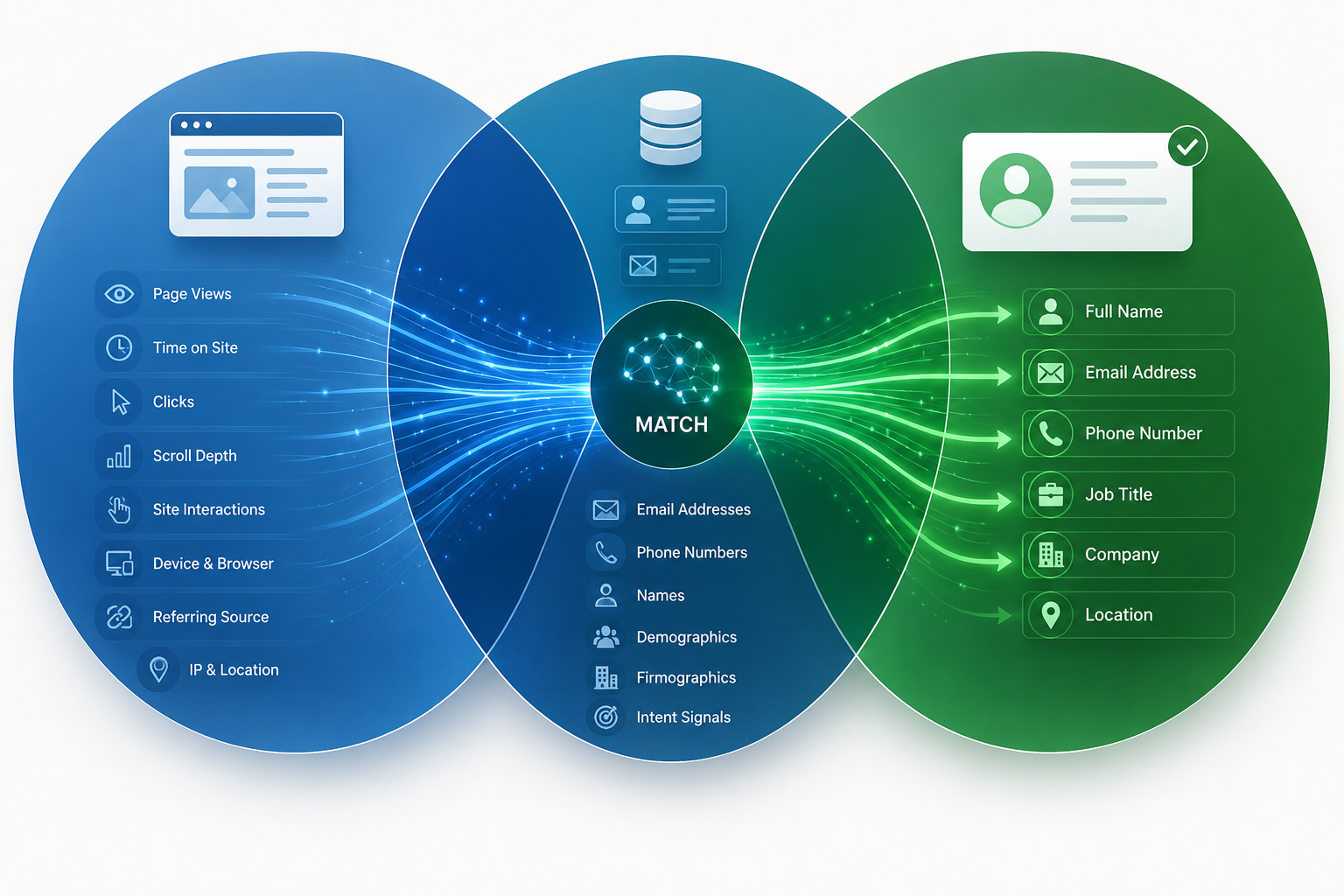 Email-match networks. Identity graphs built from consented first-party data across partner websites. When a user logs in or submits a form on any partner site, their identifiers become available for matching across partners.
- IP and behavioral matching. B2B providers match IP addresses to company databases, revealing which organizations visit your site even when individuals remain anonymous.
- AI-powered fingerprinting. Modern platforms combine deterministic signals (hashed emails from past sessions) with probabilistic fingerprints (device, behavior, timing) to recognize returning visitors.
Hyros’s AIR (AI Remarketing) agent uses the third approach, combining your first-party data with AI pattern matching to recognize anonymous visitors and obtain their contact info automatically. The system then learns what each visitor cares about and reaches out with relevant outreach.
Visitor identification accuracy depends on the size and quality of the identity network powering it.
Why Can Visitor Identification Add 3% to 7% More Sales?
Visitor identification adds 3% to 7% more sales because it unlocks an audience that was previously invisible: high-intent visitors who didn’t convert on their first visit. These prospects already demonstrated interest by landing on your site, reading content, or viewing products. They’re warmer than cold traffic but were lost because they never submitted a form.
The 3% to 7% uplift comes from three sources:
- Direct email follow-up. Reaching identified visitors who browsed but didn’t buy, using their interest signals to personalize outreach.
- Sales team enablement. Feeding B2B identifications to sales development reps who can call or email qualified accounts that visited pricing or demo pages.
- Remarketing to known identity. Running ads targeted at known email lists is substantially cheaper and more effective than blind retargeting.
According to Hyros‘s reported metrics, brands adding the AIR remarketing agent see an average 3% to 7% more sales on top of baseline attribution gains. The uplift compounds with accurate ad attribution because you’re both saving lost conversions and buying more of the ads that work.
Key Takeaway: Visitor identification converts browsing into a follow-up opportunity instead of a lost session.
What’s the Difference Between Visitor Identification and Traditional Remarketing?
The difference between visitor identification and traditional remarketing is that visitor identification gives you the visitor’s actual contact information (email, phone, sometimes name), while remarketing only gives you the ability to show them ads. That difference changes what you can do with the audience, from passive ad exposure to active, personalized outreach.
Traditional remarketing wastes impressions on users who will never return. Visitor identification lets you contact identified prospects through owned channels (email, SMS, sales calls), where the contact cost is minimal, and the personalization can be much stronger than a banner ad.
The two approaches work best together. Retargeting keeps your brand visible; visitor identification lets you actually reach out.
Visitor identification moves prospects from ad audiences to addressable contacts.
What Does the Hyros AIR Remarketing Agent Do?
The Hyros AIR remarketing agent combines attribution data with AI-powered visitor identification to recognize anonymous visitors, learn their interests, and automatically reach out. It sits on top of Hyros’s tracking infrastructure and uses the same first-party data to power identification and outreach.
AIR operates through four sequential functions:
- Recognize. AIR identifies visitors using your data and obtains their contact info.
- Learn. AIR tracks what each visitor is most interested in and builds a profile of their buying signals.
- Reach out. AIR initiates contact through relevant channels with messaging tailored to the visitor’s demonstrated interest.
- Interact. AIR continues the conversation, qualifying interest and handing warm leads to your sales workflows.
The system is designed for brands with reliable attribution infrastructure. AIR works best when your tracking is already clean, because it uses that data as fuel for identification and personalization. Hyros reports that brands adding AIR on top of baseline tracking see an additional 3% to 7% in sales.
Hyros AIR extends attribution tracking into active visitor re-engagement.
Who Benefits Most From Visitor Identification?
Visitor identification benefits brands with high-traffic websites, considered purchases, and long sales cycles. The math is straightforward: the more anonymous visitors you have and the higher each potential conversion is worth, the more valuable each identified visitor becomes. Low-traffic sites or low-AOV impulse products see less upside.
Strong fits include:
- B2B SaaS companies where one identified visitor from a target account can be worth thousands in pipeline.
- High-ticket coaching and education brands where a single recovered lead can mean a $5,000+ program sale.
- Considered-purchase e-commerce ($200+ AOV) where buyers research across multiple sessions before committing.
- Professional services (law, finance, consulting) where a lead is worth a direct sales conversation.
- Subscription businesses where the LTV of an identified lead exceeds the cost of identification.
Weak fits include sites with fewer than a few thousand monthly visitors (not enough volume for meaningful identification), low-margin impulse products (LTV too low to justify outreach cost), and businesses without the operational capacity to follow up on identified leads.
Key Takeaway: Visitor identification pays off most when each recovered lead is worth meaningful revenue.
What Are the Privacy Considerations for Visitor Identification?
Visitor identification raises specific privacy considerations under GDPR, CCPA, and CPRA because it reveals contact information for visitors who didn’t voluntarily submit a form. Legitimate providers operate within these frameworks, but the specific compliance depends on which jurisdiction the visitor is in, how the identity data was originally collected, and how the receiving business uses it.
Compliance best practices include:
- Use consented identity networks. Providers should source their identity graph from users who consented to first-party data collection on partner sites.
- Honor opt-outs immediately. Every outreach should include clear unsubscribe mechanisms, and opt-outs should propagate across your platform.
- Respect jurisdictional restrictions. Many visitor ID providers exclude EU traffic by default because GDPR is stricter than CCPA.
- Use first-party data. Identifying visitors through your own first-party data (hashed emails from past interactions) is safer than third-party identity networks.
- Document your data flows. Maintain clear records of where identity data comes from and how you use it, in case of regulator inquiry.
Platforms like Hyros AIR are designed around first-party data, which reduces compliance complexity compared to third-party identity networks. Specific compliance obligations depend on your jurisdiction and should be reviewed with a privacy lawyer.
Visitor identification requires deliberate privacy engineering to operate safely.
Turning Anonymous Visitors Into Revenue
Visitor identification reveals who your anonymous website visitors are by matching their activity to first-party identity data, typically adding 3% to 7% more sales to existing marketing funnels.
In our work with performance marketers, it works best for brands with considered purchases, long sales cycles, and traffic volume to make identification economical. Paired with accurate attribution, visitor identification turns every lost session into a potential second chance, which in 2026, with ad costs rising and conversion rates plateauing, is one of the most cost-effective growth levers available.
Frequently Asked Questions
What is visitor identification on a website?
Visitor identification is technology that reveals who your anonymous website visitors are (their names, emails, and sometimes phone numbers) using first-party identity matching. Instead of only knowing that someone visited your pricing page, visitor identification tells you exactly which person visited, so you can follow up with personalized email, sales outreach, or targeted advertising.
How accurate is visitor identification?
Visitor identification accuracy varies widely based on the provider’s identity network size and your traffic type. Top providers identify 15% to 40% of US-based visitors on sites with consistent traffic. International identification rates are typically lower due to GDPR and similar privacy regulations and smaller identity graphs. B2B identification (using IP-to-company matching) tends to be more reliable than individual consumer identification.
Is visitor identification legal?
Visitor identification is legal in most jurisdictions when implemented properly. Providers must source identity data through consented first-party collection, honor opt-outs, respect GDPR restrictions on EU traffic, and provide transparent privacy notices. Always consult a privacy lawyer for compliance specific to your business and jurisdictions you operate in.
What’s the difference between Hyros AIR and standard visitor identification tools?
Hyros AIR combines visitor identification with attribution data and AI-powered personalization. Standard visitor identification tools only reveal contact information. Hyros AIR reveals the visitor, learns what they’re interested in based on behavior, and automatically initiates personalized outreach, integrating with the same tracking infrastructure used for ad attribution.
How much does visitor identification cost?
Visitor identification cost ranges from about $0.50 per identified visitor for basic B2B tools to several thousand dollars per month for full-service platforms. Pricing models include per-identification, monthly flat rates, and tiered plans based on visitor volume. ROI depends heavily on conversion rate from identified leads. Brands with strong follow-up processes see the highest returns.
Do I need high website traffic for visitor identification to work?
Visitor identification works best with at least a few thousand monthly visitors because the 15% to 40% identification rate needs meaningful volume to produce enough leads to justify the cost. Sites with under a thousand monthly visitors may find that native email capture and retargeting are more cost-effective than dedicated visitor identification tools.