

First-Click vs Last-Click Attribution: Which Model to Use
TL;DR
- First-click attribution credits the channel that brought a customer to your brand for the first time; last-click attribution credits the final channel before the sale.
- First-click gives you discovery signal for top-of-funnel campaigns; last-click gives you closing-power signal for retargeting and direct-response campaigns.
- Neither model accounts for the touchpoints in between, so any business spending more than $100K/month in ads should use multi-touch or data-driven attribution instead.
- Google deprecated first-click attribution entirely in 2023, which signals how limited the model has become for modern advertisers.
What Are First-Click and Last-Click Attribution?
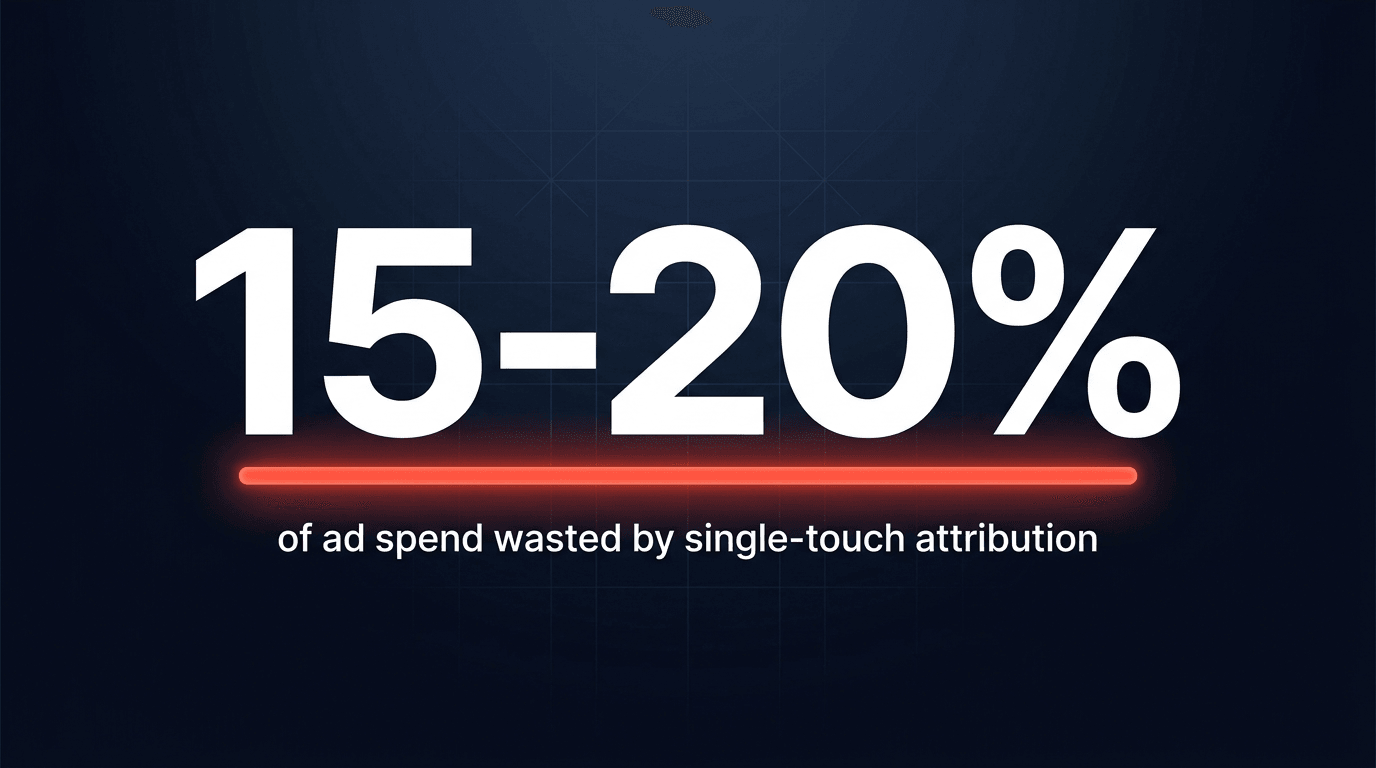
Most marketers I talk to are stuck in the wrong debate. They argue “first-click or last-click?” like the choice matters, when the real problem is that leaning on either one as your sole source of truth is how you accidentally burn 15 to 20 percent of your ad budget without ever knowing it. I’ve looked at the data across thousands of accounts. The model error isn’t subtle. It’s expensive.
Attribution is the process of assigning credit for a sale or conversion to the marketing channels that contributed to it. Every attribution model answers the same question differently: which ad, email, or click deserves the credit when a customer finally buys?
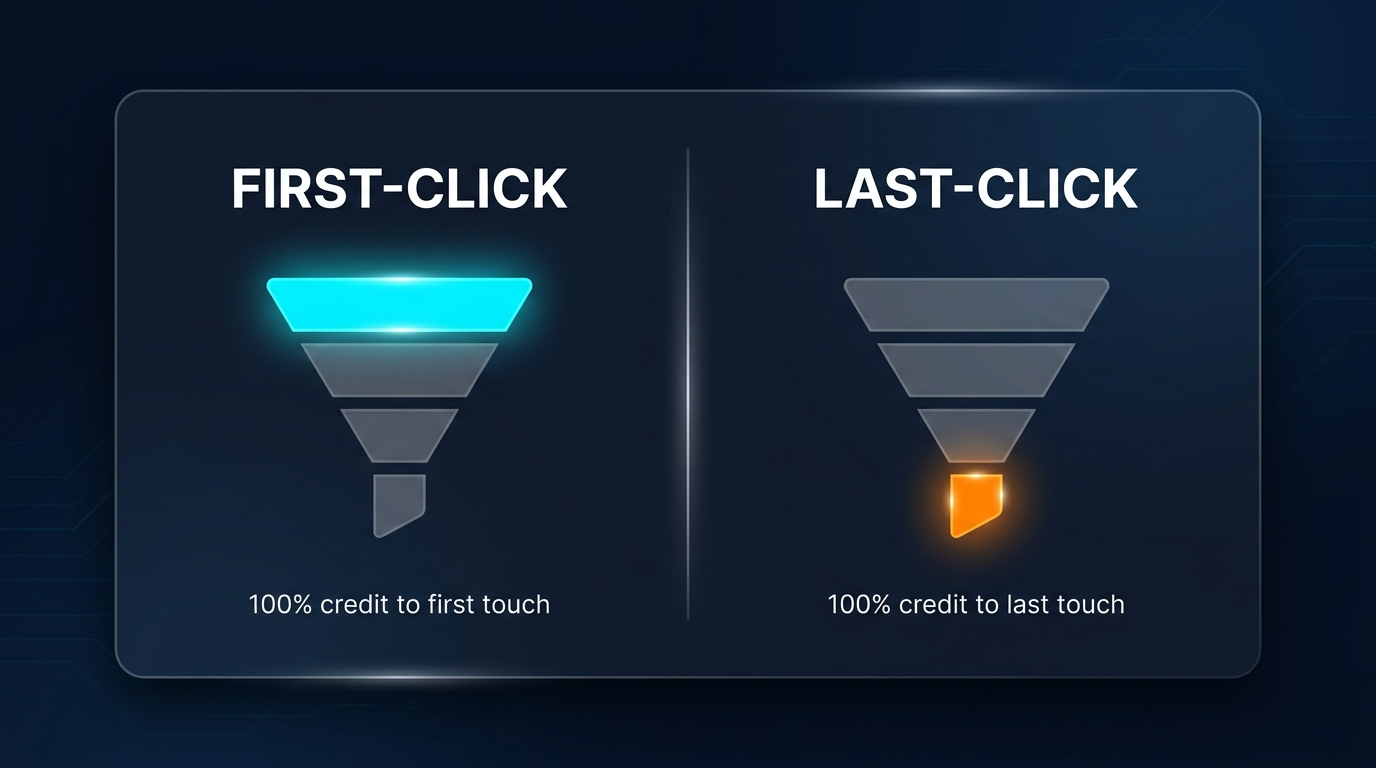
First-click attribution gives 100% of conversion credit to the first ad or marketing channel a customer interacted with. Last-click attribution gives 100% of the credit to the final touchpoint before the sale. First-click rewards channels that introduce new buyers to a brand. Last-click rewards channels that close deals. Neither model reflects the full customer journey, which is why most teams above $100K/month in ad spend use multi-touch or data-driven attribution instead.
Both models are called “single-touch” because they assign all credit to one touchpoint and ignore the rest. A customer might click a Facebook ad, read three blog posts, open two emails, and then convert through a Google search ad. First-click says Facebook did all the work. Last-click says Google did all the work. The blog posts and emails get zero credit in either model.
According to LayerFive, nearly half of marketing spend is wasted due to poor attribution. That is half of every dollar going to ads, allocated based on incomplete data.
This article breaks down how each model works, when each one is the right fit, why both are increasingly unreliable in 2026, and what to use if you need accuracy at scale.
What Is First-Click Attribution?
First-click attribution assigns 100% of conversion credit to the very first marketing interaction a customer has with your brand. If someone clicks a YouTube ad on March 1, then visits your site through an email on March 5, then clicks a retargeting ad on March 12 and buys, first-click attribution gives the YouTube ad full credit for the sale.
The logic behind this model is simple: without that first interaction, the customer would never have entered your funnel. The YouTube ad did the hard part by introducing a stranger to your brand. Everything after that was just follow-up.
First-click is sometimes called “first-interaction” or “first-touch” attribution. The terms mean the same thing.
How it works in practice:
- A customer clicks a Facebook ad and lands on your site for the first time.
- They leave without buying.
- Over the next two weeks, they interact with your brand through email, organic search, and a retargeting ad.
- They buy through the retargeting ad.
- First-click attribution records the sale as coming from Facebook.
What first-click measures well:
- Which channels bring new people to your brand
- Which campaigns are best at generating awareness
- Where your top-of-funnel spend is producing results
What first-click misses:
- Every interaction between the first click and the sale
- The channel that actually triggered the purchase
- Whether the first click would have led to anything without the follow-up touches
What Is Last-Click Attribution?
Last-click attribution assigns 100% of conversion credit to the final marketing interaction before a sale or conversion. If a customer found your brand through a podcast ad, then clicked an Instagram ad, then searched your brand name on Google and clicked a paid search ad before buying, last-click gives all credit to the Google paid search ad.
The logic here is equally simple: the last click was the one that actually led to the purchase. Whatever happened before that point, the customer had not yet converted. The final touchpoint is what pushed them over the line.
Last-click has been the default attribution model across most analytics platforms for over a decade. Google Analytics used last non-direct click as its default model from the earliest versions through GA4. Google Ads used last-click as its default until switching to data-driven attribution in 2021.
How it works in practice:
- A customer sees a TikTok ad and visits your site.
- They leave without buying.
- A week later, they click a retargeting ad on Facebook and browse your product page.
- They leave again.
- Two days later, they Google your brand name, click a paid search ad, and buy.
- Last-click attribution records the sale as coming from branded paid search.
What last-click measures well:
- Which channels close sales
- Which campaigns drive direct conversions
- Bottom-of-funnel performance
What last-click misses:
- The channels that built awareness and interest before the final click
- Top-of-funnel campaign performance
- The true cost of acquisition (because it ignores all the money spent on earlier touchpoints)
How Do First-Click and Last-Click Attribution Compare?
| Feature | First-Click | Last-Click |
|---|---|---|
| What gets credit | First interaction in the customer journey | Last interaction before the sale |
| Best for | Measuring awareness and discovery channels | Measuring closing and conversion channels |
| Blind spot | Ignores everything after the first touch | Ignores everything before the last touch |
| Default platform | No major platform uses this as default in 2026 | GA4 offers it as an alternative to data-driven |
| Bias | Overvalues top-of-funnel, undervalues retargeting | Overvalues retargeting, undervalues prospecting |
| Campaign optimization risk | Shifts budget toward broad awareness even when it doesn’t convert | Shifts budget toward branded search and retargeting, starving the funnel |
| Customer journey visibility | Single touchpoint only | Single touchpoint only |
| Setup complexity | Simple | Simple |
| Accuracy for long sales cycles | Poor | Poor |
| Accuracy for short sales cycles | Acceptable if most buyers convert on first visit | Acceptable if most buyers convert in one session |
What the Wrong Model Choice Actually Costs You
Here’s the number that nobody talks about when they debate first-click versus last-click: if you’re over-reporting ROAS because your attribution model is giving you a distorted picture (and you almost certainly are), you’re going to lose 15 to 20 percent of your ad spend to pure waste. Those are the campaigns that look unprofitable on paper but are actually funding the rest of your funnel. You scale the wrong ones. You turn off the right ones.
Think about what that means in real dollars. Let’s say you’re running 20 ad campaigns. If your single-touch attribution model is misreading the data, somewhere between three and five of those campaigns are probably missing credit for sales they helped drive, and another three to five are getting credit for sales they didn’t really close on their own. You’ll trim the misrepresented campaigns in your next budget review because the numbers say to. And when you do, you’re not cutting dead weight. You’re cutting 15 to 20 percent of your potential scale.
This isn’t a theoretical failure. I’ve reviewed accounts where that’s exactly what happened. The model made campaigns look dead that were quietly generating 200 to 500% ROI through touchpoints the single-touch report couldn’t see. The fix wasn’t creative. It wasn’t targeting. It was attribution.
What Does Attribution Look Like in a Real Customer Journey?
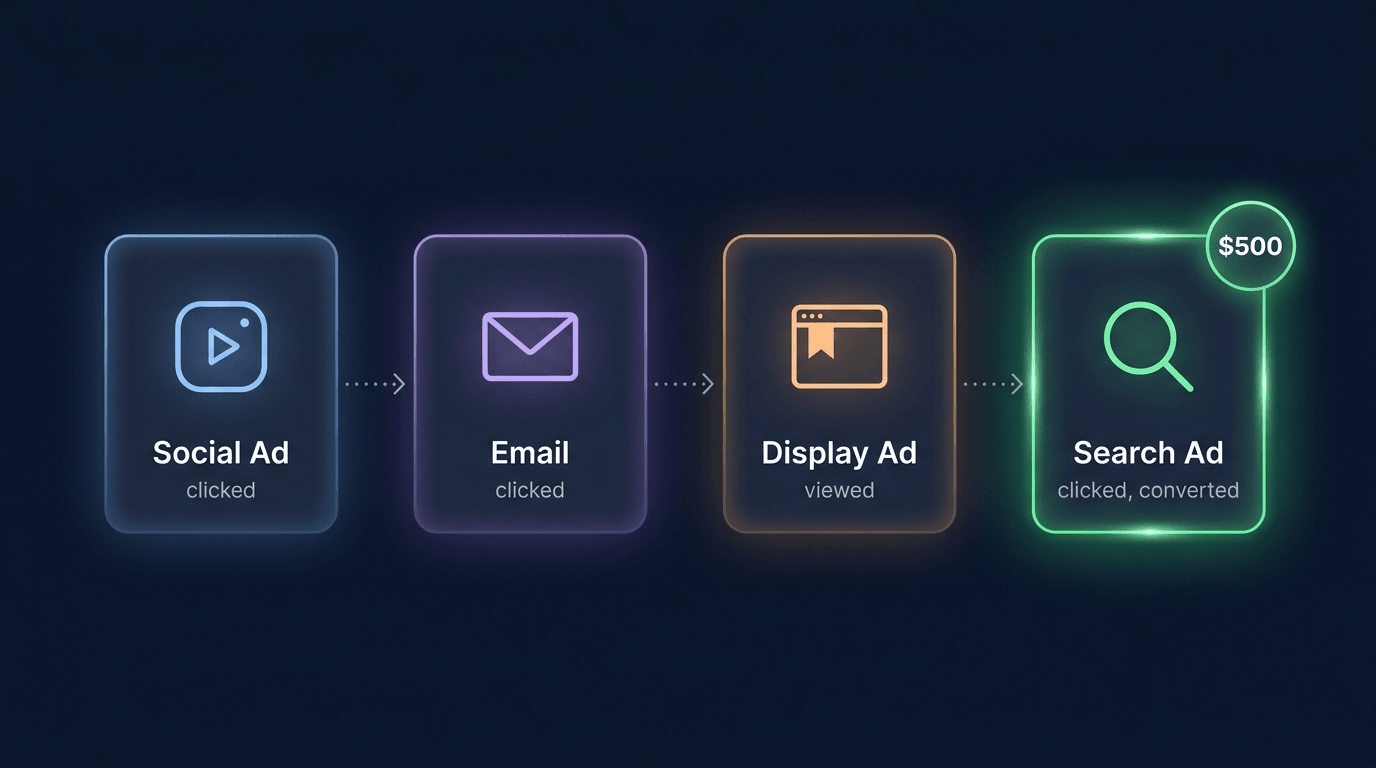
Sarah sees a Facebook prospecting ad for a skincare brand while scrolling her feed on April 1. She clicks the ad and browses the product page but doesn’t buy. Three days later, the brand sends her an email with a 10% discount. She clicks the email, adds a product to her cart, but gets distracted and closes the tab. On April 7, she sees a Google Display ad for the same brand while reading a recipe blog. She doesn’t click it but remembers the brand. On April 10, she searches the brand name on Google, clicks the top paid search result, and buys a $500 skincare set.
Four touchpoints in order:
- Facebook prospecting ad (April 1) – clicked
- Email with discount (April 4) – clicked
- Google Display ad (April 7) – viewed, not clicked
- Google paid search ad (April 10) – clicked, converted
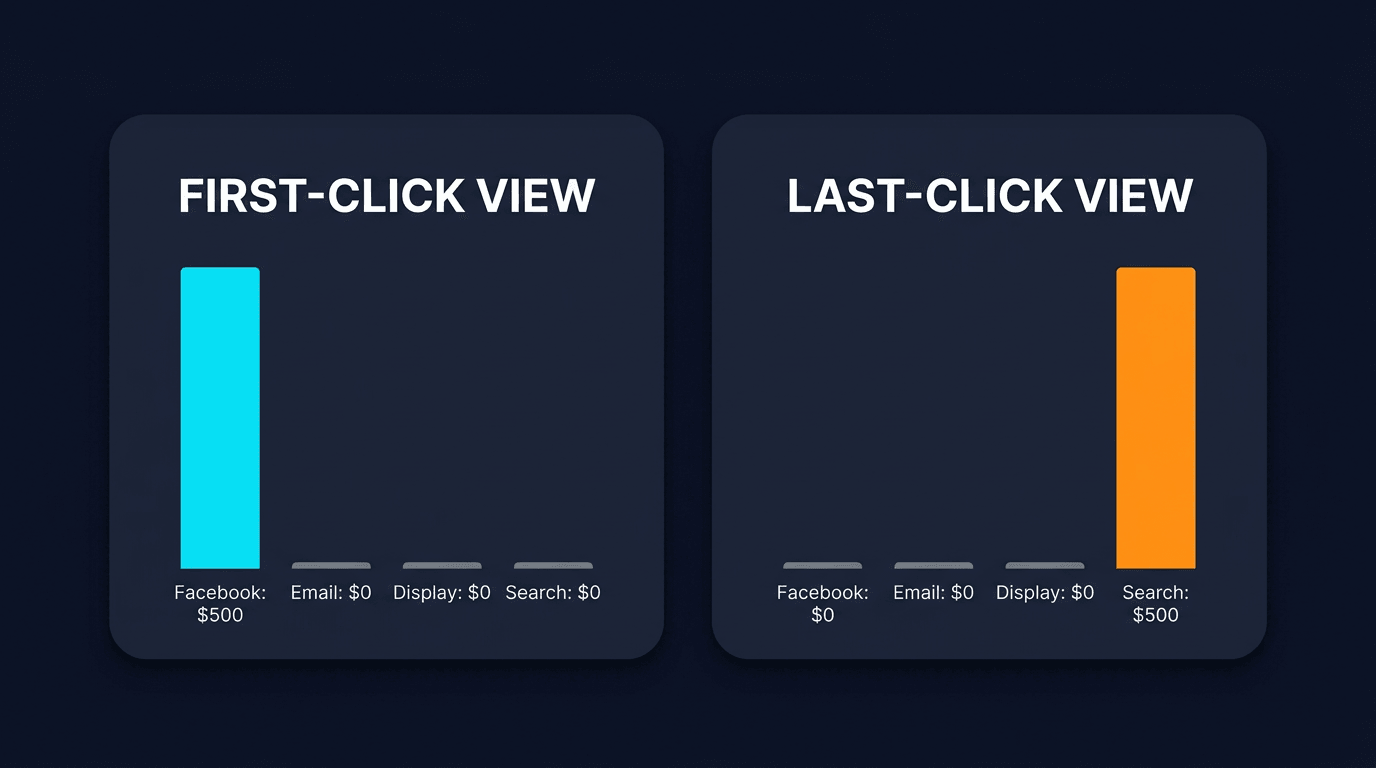
Under first-click attribution:
Facebook gets $500 in attributed revenue. The email, display ad, and paid search ad get $0. The marketing team concludes Facebook prospecting is their best channel and increases budget there. Paid search looks like it contributes nothing.
Under last-click attribution:
Google paid search gets $500 in attributed revenue. Facebook, the email, and the display ad get $0. The marketing team concludes branded search is their best channel. Someone suggests cutting the Facebook prospecting budget since it “isn’t converting.” If they do that, fewer new customers enter the funnel, and eventually the branded search conversions dry up too.
This isn’t a hypothetical risk. I’ve seen it firsthand across hundreds of ad accounts. In the accounts I’ve reviewed using server-side tracking, 25% of the campaigns that had been turned off based on platform data were actually producing 200-500% ROI. Last-click couldn’t see them because the conversions were happening through different final touchpoints. The campaigns looked dead in the platform dashboards, but they were feeding the entire funnel.
Under multi-touch attribution (for comparison):
Credit is split across all clicked touchpoints based on their role. Facebook gets credit for introduction, the email gets credit for re-engagement, and paid search gets credit for closing. The display ad may or may not receive credit depending on whether the model accounts for view-through impressions. No single channel looks like it does everything. The budget allocation reflects reality.
This example shows why single-touch models create a distorted picture. The sale required all four touchpoints. Crediting only one creates a false narrative that leads to bad budget decisions.
For a deeper explanation of how attribution works across the full funnel, see our guide on what is ad attribution.
When Should You Use First-Click Attribution?
First-click attribution is the right model in a narrow set of circumstances. If your primary marketing goal is top-of-funnel growth and you need to know which channels bring the most new buyers into your ecosystem, first-click gives you a clean signal.
Brand awareness campaigns. When you’re spending money specifically to get in front of people who have never heard of your brand, first-click tells you which channels are doing that job. If you’re running YouTube pre-roll ads, podcast sponsorships, and TikTok campaigns all aimed at cold audiences, first-click shows you which of those channels is generating the most first interactions.
New market entry. If you’re launching in a new geography or vertical and need to build an audience from scratch, knowing where first touches come from helps you allocate awareness spend.
Prospecting campaign evaluation. When you need to compare the discovery performance of different prospecting campaigns, first-click isolates the introduction. This is useful for creative testing at the top of funnel.
Short purchase cycles with a single touchpoint. If your product has a simple purchase path where most customers buy on their first visit, first-click and last-click converge into the same data point. In this case, first-click is accurate by default.
The catch: Even in these cases, first-click should be one data point, not your only data point. You still need to know which channels close sales. Running first-click in isolation leads to overspending on awareness and underspending on conversion.
When Should You Use Last-Click Attribution?
Last-click attribution fits a different set of scenarios. If you need to know which channels are directly responsible for closing sales, last-click gives you that answer.
Direct response campaigns. When you run ads with a direct “buy now” call to action and a short decision window, last-click reflects the actual conversion event. The customer clicked, they bought. The last click is the only click that matters.
Short purchase cycles. For impulse purchases, low-cost products, or anything where the buying decision happens in a single session, last-click captures the full story because there’s no meaningful journey to track.
Retargeting performance. Last-click is the standard way to measure retargeting effectiveness. It tells you whether your retargeting ads are actually triggering purchases or just touching people who would have bought anyway.
Performance marketing teams. Teams that are optimizing for cost-per-acquisition and ROAS on a campaign-by-campaign basis often default to last-click because it connects directly to the conversion event. It gives a clear, actionable number for each campaign.
Bottom-of-funnel optimization. If you’re testing landing pages, checkout flows, or final-step offers, last-click isolates the bottom of the funnel and tells you which version converts better.
The catch: Last-click creates a structural bias toward branded search and retargeting. These channels show up at the end of journeys they did not start. A team running purely on last-click will consistently undervalue the prospecting and awareness campaigns that fill the top of the funnel. Over time, this leads to a shrinking audience and rising acquisition costs. According to Hyros, brands that switch from single-touch models to full-path server-side tracking see at least a 15% increase in ad ROI on average, largely because they stop killing campaigns that were actually working.
For more on how ROAS calculations interact with attribution models, see our guide on how to calculate ROAS.
Why Are First-Click and Last-Click Attribution Broken in 2026?
Single-touch attribution was built for a simpler version of digital marketing. In 2026, three structural changes have made both first-click and last-click unreliable for any business running multi-channel campaigns at scale.
Privacy restrictions killed cross-device tracking
Apple’s App Tracking Transparency, rolled out in 2021, lets users opt out of cross-app tracking on iOS. Adoption wasn’t gradual, with roughly 96% of US iPhone users initially opting out of app tracking in the months following the iOS 14.5 rollout (Flurry Analytics, 2021; opt-in has since risen to ~37%). Google has restricted third-party cookies in Chrome through its Privacy Sandbox initiative. Safari and Firefox blocked third-party cookies years ago. The result: attribution systems that rely on cookies or device IDs to connect a first click to a last click frequently lose the thread between touchpoints.
When the tracking chain breaks, first-click attribution can’t identify the actual first interaction. It just reports whatever first click it can see, which may be the second or third real touchpoint. Last-click has a slightly easier time because the final click and conversion usually happen in the same session, but it still can’t connect that conversion back to earlier touchpoints on other devices.
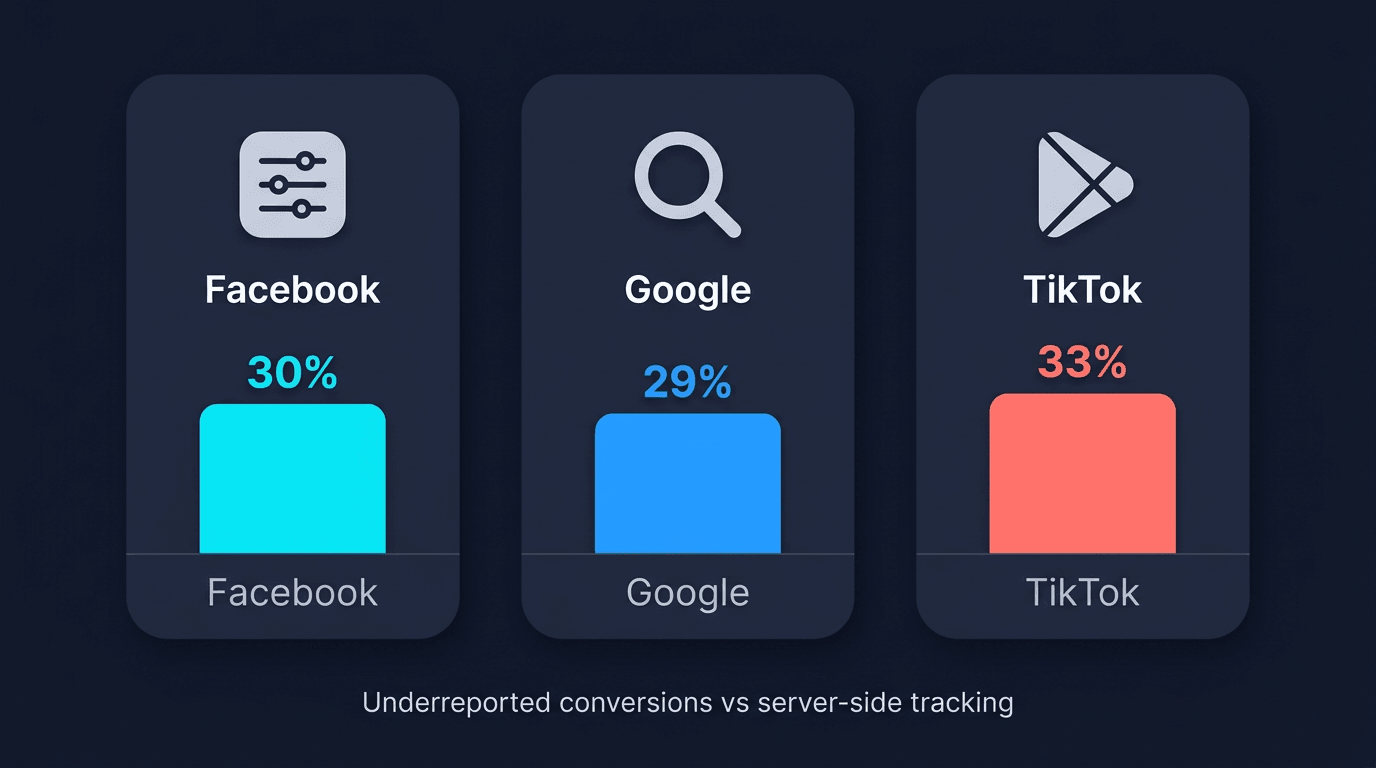
The gap is measurable. When we compare server-side tracking data against platform-reported numbers at Hyros, Facebook underreports conversions by approximately 30%, Google by 29%, and TikTok by 33%. Those aren’t edge cases. Those are the baseline discrepancies across thousands of accounts. A first-click or last-click model built on top of data that’s already 30% wrong is compounding errors, not solving them.
Customer journeys are longer and messier
The average B2B buying journey involves 6 to 10 touchpoints before a purchase. For high-ticket consumer products, the number is similar. Customers switch between phone, laptop, and tablet. They interact with ads, emails, organic content, social media, review sites, and word of mouth. A model that picks one of these touchpoints and ignores the rest is missing most of the picture.
First-click and last-click were tolerable when most purchases happened in one or two sessions on a single device. That world no longer exists for most advertisers.
Platform self-reporting is biased
Every ad platform reports its own numbers using its own attribution model and its own tracking data. Google Ads defaults to data-driven attribution, which credits Google’s touchpoints. Meta Ads defaults to a 7-day click, 1-day view attribution window, which credits Meta’s touchpoints. Neither platform has visibility into the other.
If you compare Google’s self-reported conversions to Meta’s self-reported conversions, the total will almost certainly exceed your actual sales. Both platforms are claiming credit for some of the same customers. A Databox analysis found that summing all platform-reported conversions typically produces 150-250% of actual closed customers. Running first-click or last-click on top of this already-inflated data just adds another layer of distortion.
Google Analytics deprecated first-click, linear, time-decay, and position-based attribution models in GA4 in 2023. Only last-click and data-driven attribution remain. The stated reason: fewer than 3% of conversions in Google Ads used those deprecated models. Google’s move signals where the industry is headed.
For a breakdown of how platform self-reporting creates discrepancies, see our comparison of ad tracking vs analytics.
Cross-channel blind spots compound over time
When you run first-click or last-click across multiple channels, the errors don’t average out. They compound. First-click will consistently overvalue whichever channel happens to show up first in the journey, even if that channel’s contribution to the final sale is minimal. Last-click will consistently overvalue branded search and retargeting, even when those channels are only converting customers who were already going to buy.
Over months and years, these biases lead to systematic misallocation of budget. Teams cut the campaigns that don’t show up in their single-touch model, not realizing those campaigns were feeding the ones that do show up.
I originally designed Hyros for my own businesses, not to sell software. I needed it because I couldn’t scale my ad spend without knowing where the sales were actually coming from. And without that clarity, I was doing exactly what I just described: scaling the wrong campaigns and turning off the right ones. I built Hyros because nothing else could show me what was real. Once I had that data, scaling became straightforward. That’s why I eventually made it available for everyone else.
I run a company that tracks attribution across thousands of ad accounts, and this pattern repeats constantly: 25-45% of winning campaigns are invisible to standard platform tracking. Those campaigns get killed in budget reviews because a single-touch model (whether first-click or last-click) can’t see their contribution. The sales don’t disappear overnight. They erode over weeks as the funnel starves.
What Attribution Models Should You Use Instead?
If first-click and last-click both have critical blind spots, the question becomes: what gives you a more complete picture?
Multi-touch attribution
Multi-touch attribution distributes credit across all touchpoints in a customer journey. There are several variants:
- Linear assigns equal credit to every touchpoint.
- Time-decay assigns more credit to touchpoints closer to the conversion.
- Position-based (U-shaped) gives 40% to the first touch, 40% to the last touch, and splits the remaining 20% across the middle.
- W-shaped adds a third anchor point at the lead creation stage.
Multi-touch is a step up from single-touch because it acknowledges that multiple channels contribute to a sale. The downside is that most multi-touch models still use fixed rules to distribute credit. A linear model assumes every touchpoint matters equally, which is rarely true. A position-based model assumes the first and last touches always matter most, which is often true but not always.
For a full breakdown of multi-touch models, see our guide on multi-touch attribution.
Data-driven attribution
Data-driven attribution uses machine learning to analyze all your conversion paths and assign credit based on actual measured contribution. Google Ads switched to data-driven as its default model in 2021. GA4 uses data-driven as its primary model. Data-driven attribution requires enough conversion data to build a statistical model, but Google removed the minimum data threshold in recent updates.
The advantage of data-driven is that it adapts to your actual customer behavior instead of following fixed rules. The disadvantage is that it’s a black box. You can’t see exactly how credit is being distributed or why. And when it runs inside a platform like Google Ads, it only sees Google’s touchpoints.
Server-side tracking with multi-platform visibility
The most accurate approach for businesses spending significant money on ads combines server-side tracking (which is more resistant to browser privacy restrictions) with a system that can see across multiple ad platforms. Server-side systems like Hyros report tracking 20-50% more sales than ad platforms alone, which means the data gap between what platforms show you and what actually happened is large enough to flip budget decisions. This is the approach Hyros takes: tracking individual customer journeys across channels and attributing revenue based on the actual path each buyer took.
Server-side tracking avoids the cookie and browser restrictions that break client-side attribution. Cross-platform visibility avoids the self-reporting bias that inflates each platform’s numbers. An analysis by CheckThat.ai that aggregated 601 Trustpilot reviews found that server-side attribution tools consistently track 29-33% more conversions than native platform pixels alone. The combination gives you data you can actually use for budget decisions.
For a comparison of how different tracking tools handle attribution, see our Hyros vs Triple Whale comparison.
FAQ
Is first-click or last-click better?
Neither is universally better. First-click is better for measuring which channels bring new customers to your brand. Last-click is better for measuring which channels close sales. For most businesses running ads across multiple channels, both models miss too much of the customer journey to be reliable on their own. Multi-touch or data-driven attribution gives a more complete picture. If you have to pick one single-touch model, last-click is more commonly used because it connects directly to the conversion event, but it will undervalue your prospecting campaigns.
Does Google Ads use first-click or last-click?
Google Ads uses data-driven attribution as its default model for all new conversion actions. Last-click is available as an alternative. First-click is no longer available in Google Ads. Google deprecated first-click, linear, time-decay, and position-based models in September 2023, citing adoption rates below 3%. Any conversion actions that were using those deprecated models were automatically switched to data-driven attribution.
What attribution model does Meta use?
Meta Ads uses a default attribution window of 7-day click-through and 1-day view-through. This means Meta will claim credit for a conversion if the user clicked an ad within the last 7 days or viewed an ad within the last 1 day before converting. In January 2026, Meta removed the 7-day view and 28-day view attribution window options. Meta’s model is a form of last-touch attribution within its own platform. It doesn’t see interactions on Google, email, or other channels, so it reports based only on its own touchpoints.
Why does Google Analytics use last-click?
Google Analytics (GA4) doesn’t use last-click as its primary model. GA4 defaults to data-driven attribution for its key event (formerly “conversion”) reports. Last-click is available as an alternative comparison model. The older version of Google Analytics (Universal Analytics, which was retired in 2023) used last-click as its default because it was the simplest model to implement and explain. When Google built GA4, it shifted the default to data-driven to reflect the reality that customer journeys involve multiple touchpoints.
How does Hyros handle first and last click?
Hyros tracks individual customer journeys across multiple platforms and channels using server-side tracking. Instead of defaulting to a single-touch model, Hyros records every touchpoint in the customer path and attributes revenue based on the actual sequence of interactions. You can view first-touch data, last-touch data, and full-path data in the same dashboard. This means you can see which channels introduce new customers (first-click view) and which channels close sales (last-click view) without being locked into either model. The system also accounts for long sales cycles, recurring revenue, and cross-device behavior that single-touch models miss.
Standalone Summary
First-click attribution assigns all conversion credit to the first marketing interaction a customer has with a brand. Last-click attribution assigns all credit to the final interaction before a purchase. First-click is useful for evaluating top-of-funnel and awareness campaigns. Last-click is useful for evaluating bottom-of-funnel and conversion campaigns. Both models ignore every touchpoint between the one they credit and the rest of the journey. For businesses with multi-channel campaigns, purchase cycles longer than one session, or ad spend above $100K/month, single-touch models create systematic budget misallocation. Multi-touch or data-driven attribution distributes credit across the full journey and gives a more accurate picture. Google deprecated first-click attribution in 2023. The industry standard has moved toward data-driven models, but platform-specific models still only see their own touchpoints. Server-side tracking across platforms provides the most complete attribution data.
Stop guessing between click models. See true revenue attribution with Hyros. Book a demo
Related in This Series
Silo: Ad Attribution Fundamentals
More from the Ad Attribution Fundamentals series:
- What Is Ad Attribution? A Complete 2026 Guide
- What Is Hyros? How the Ad Tracking Platform Actually Works
- Multi-Touch Attribution Explained (With Examples)
- How to Calculate ROAS: Formula, Examples, and Benchmarks
Also explore: