
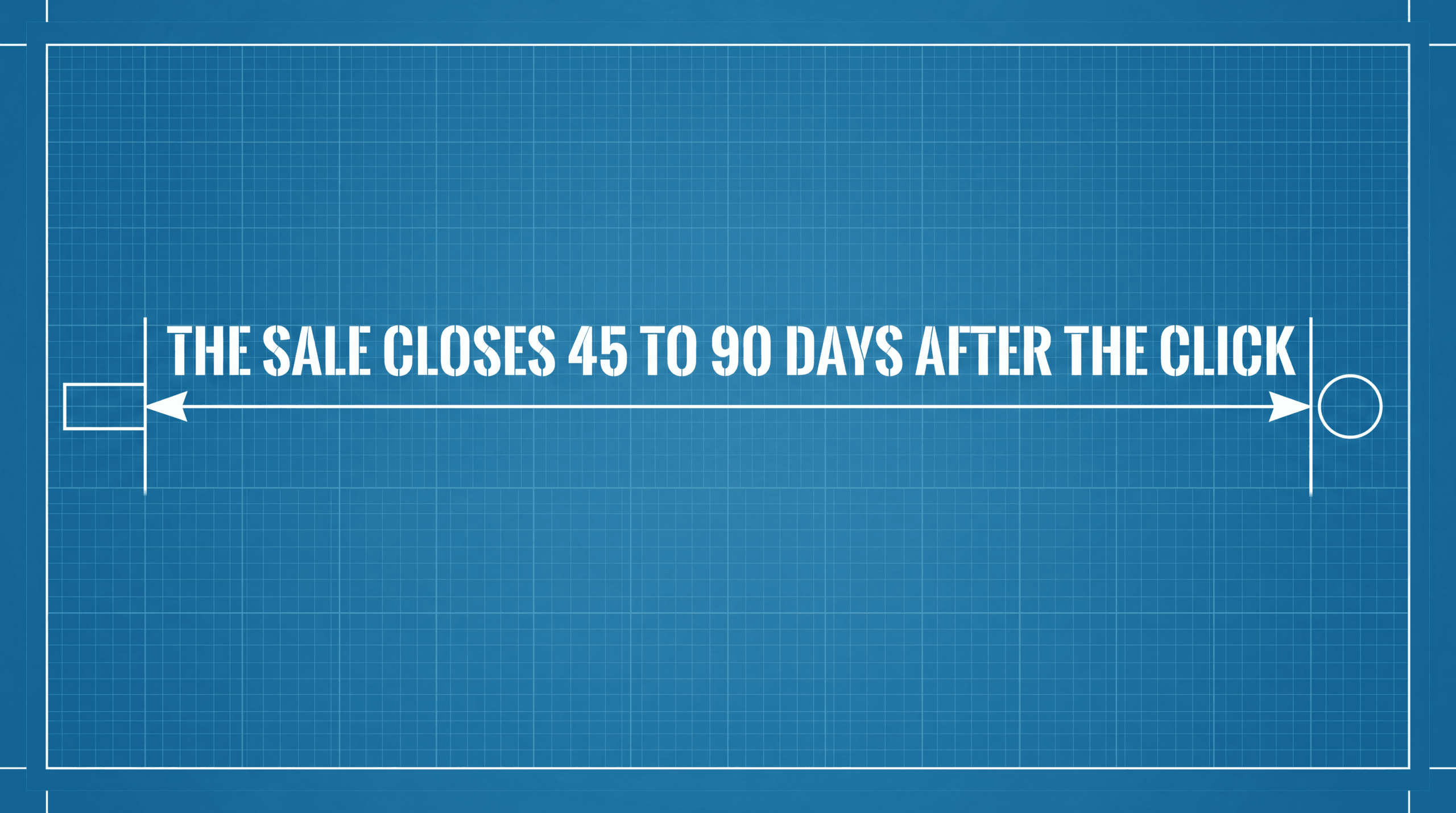

Attribution for High-Ticket Coaches: The Setup Guide for 45-90 Day Funnels
TL;DR
- Coaching cycles run 45 to 90 days, outlasting Meta’s 7-day and Google’s 30-day defaults
- The fix is five wires: UTM schema, server-side pixel, CRM stitch, call-tracking, refund events
- Coaches close on calls; if the call outcome cannot tie back to the ad, every decision is partial data
High-ticket coaching attribution needs a 60 to 180 day window because the buying journey (ad to opt-in to webinar to application to sales call to close) typically runs 45 to 90 days based on what we see across coaching customer accounts. Meta’s 7-day click and Google Ads’ 30-day default both expire before most coaching sales close. The fix is server-side, UID-based tracking that ties the close back to the original ad — five wires: UTM schema, server-side pixel, CRM stitch, call-tracking, refund events. Most coaches I audit run one or two. Coaches close on calls. If the call outcome cannot be tied back to the ad, every campaign decision is being made on partial data. Hyros was built for the info-product and high-ticket coaching segment. Dan Henry, Sam Ovens, and Tony Robbins’ team are documented customers.
Why Default Ad-Platform Attribution Breaks for Coaching Funnels
Most coaches I talk to think their attribution problem is a pixel they forgot to install. Almost nobody figures out the real issue. The ad platforms physically cannot see the close because it happens outside their window.
Here is the journey for a typical $5,000-$15,000 coaching offer. Someone clicks a Facebook ad. They opt in. They sit in a nurture sequence for 5 to 14 days. They register for a webinar. They watch part of it live or pull up the replay later. They fill out an application. A booking link goes to their calendar. A rep gets on a Zoom call 4 to 10 days after that. The rep closes on the call, or follows up for two more weeks until the close lands.
That sequence runs 45 to 90 days for most coaching offers in the $3K to $15K range based on what we see across coaching customer accounts. (Industry benchmarks for high-ticket coaching cycles vary widely and lack a single canonical source, so treat 45-to-90 as Hyros-observed.) Meta’s current default is 7-day click plus 1-day view. Google Ads runs a 30-day click default, configurable up to 90 days. LinkedIn runs 30-day click and 7-day view, configurable to 180.
The math is brutal. If the close lands on day 47, Meta saw nothing past day 7. The dashboard reports zero revenue from that ad set. You see negative ROAS, turn off the campaign, and kill the campaign that was generating $15K closes. The platform could not count past a week.
This is structural. Not creative. Not targeting. Not offer. The window is too short for the cycle. See How info-product businesses track ad revenue for the same pattern in info-product funnels.
The Real Coaching Funnel Map (Where Each Tool Loses the Trail)
Let’s imagine a coach selling a $7,000 mastermind. Here is the actual stack and which signal each tool can see.
- Ad platform (Meta, YouTube). Sees the click. Loses the trail at day 7.
- Landing page builder (ClickFunnels, Kajabi, Kartra). Captures the lead. Does not pass the click ID forward unless someone wired it that way.
- Email tool (ActiveCampaign, ConvertKit, Klaviyo). Attributes the next conversion to the email, not the original ad.
- Webinar tool (WebinarJam, Demio, Zoom). Tracks attendance. Does not pass attribution data back to the ad platform.
- CRM (Close, HighLevel, Pipedrive). Logs the application and call disposition. Does not natively know which ad started this chain.
- Call-tracking tool (CallRail, Aircall). Records the call. Does not natively tie the outcome back to the ad source.
- Checkout (Stripe, PayPal). Knows the dollar amount. Knows nothing about the ad.
That is typically four or more separate tools. (Treat “four or more” as observational.) Each captures one signal. None talk to each other about attribution. The cold-traffic ad source gets dropped at the first handoff (usually the email tool) unless a UID is being passed through the chain.
The result: email looks like the hero channel. Webinars look like a conversion engine. Sales reps look like they are closing warm leads. The cold-traffic ad spend that made the sequence possible looks unprofitable in the dashboard. Most coaches see this and cut ad spend. The ad spend was working. The tracking was not. For the webinar-funnel angle, see Webinar ad attribution: tracking long funnels.
The Attribution Window Math: Why 60 to 180 Days Is the Right Floor
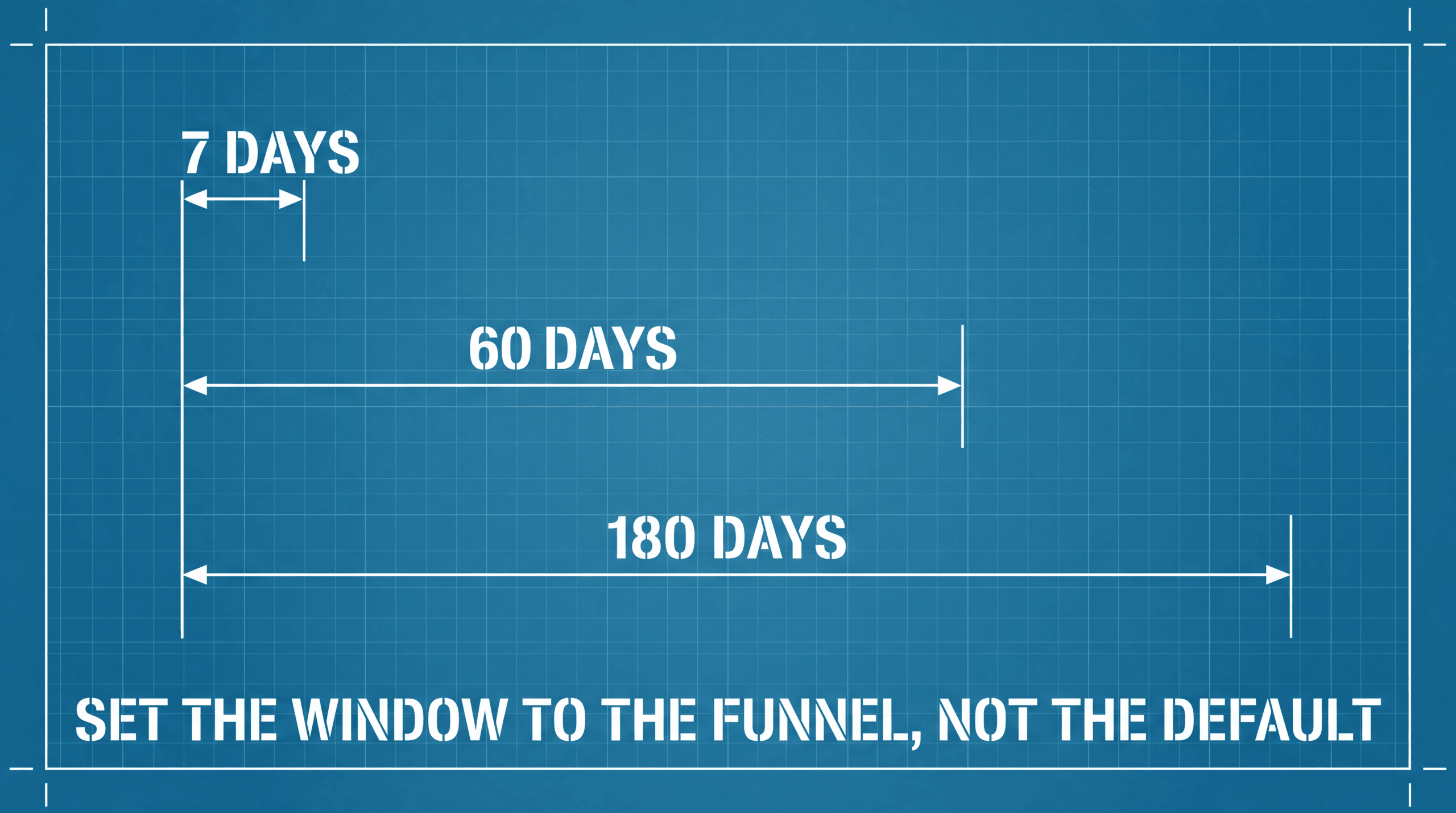
Default attribution windows versus actual coaching cycle length:
| Platform | Default click window | Maximum click window |
|---|---|---|
| Meta Ads | 7 days | 7 days (1-day view) |
| Google Ads | 30 days | 90 days |
| LinkedIn Ads | 30 days | 180 days |
| Hyros | configurable | reported up to 365 days (verify against current product docs at publish) |
The price-band-to-window mapping I use across coaching accounts is rough but useful. (Treat these as Hyros-observed, not a hard benchmark.)
- $2K to $5K offers: 60-day floor catches most of the cycle.
- $5K to $15K offers: 90-day floor is closer to right.
- $25K+ programs: 180-day floor is the realistic minimum.
If your attribution window is shorter than your actual cycle, the platform reports are systematically under-counting cold-traffic revenue. The bigger the offer, the bigger the gap. See B2B attribution: long sales cycle tracking for how this plays out across long cycles.
Tracking the Sales Call (The Step That Decides Every Coaching Deal)
Coaches close on calls. Not checkouts. That single fact rewrites the attribution problem.
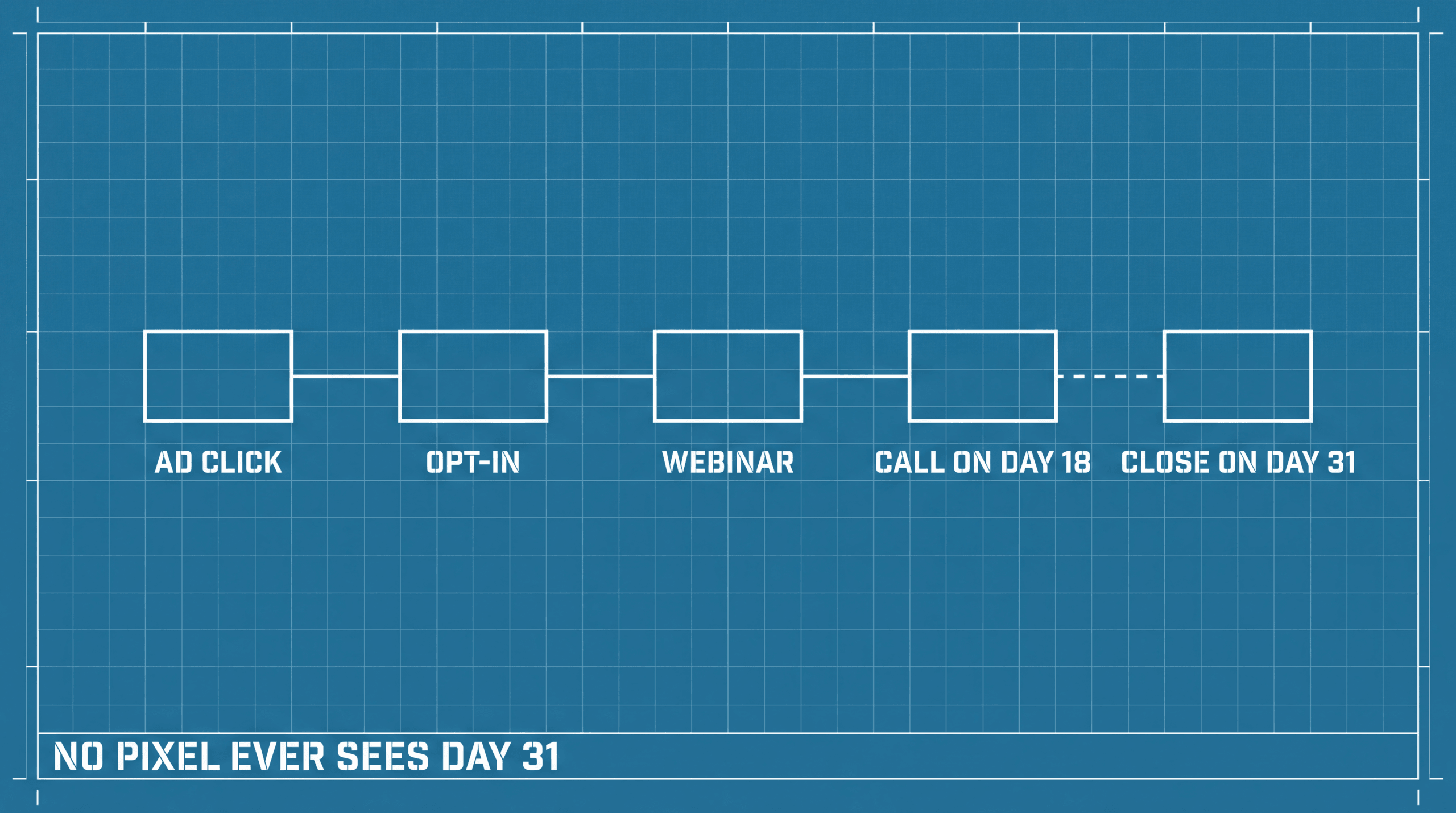
Picture this. A lead clicks your Meta ad Monday. Opts in Tuesday. Watches a webinar Friday. Books an application call. The call happens on day 18. They do not buy on the call. The rep follows up. They close on day 31 over email. Day 31 is the revenue event. Not a single native ad-platform pixel saw it.
The fix is UID-based tracking that survives the chain. A UID is generated server-side at opt-in and stored with the email, click ID, and UTM data. That UID passes into the CRM when the application fires. When the rep marks “Closed Won,” the close event fires back with the UID attached. The attribution platform reconciles the UID to the original Meta click. The revenue lands against the right ad set.
This is what most attribution tools cannot do. Cometly, Segmetrics, and most generic e-commerce-built platforms treat the sales call as a black box. They cannot tie a Closed Won event back to a cold-traffic ad source 47 days earlier. Every Hyros customer in the coaching segment I have worked with had a version of this problem before the wire went in.
The Setup, Step by Step (Five Wires, Mapped to Coaching Price Band)
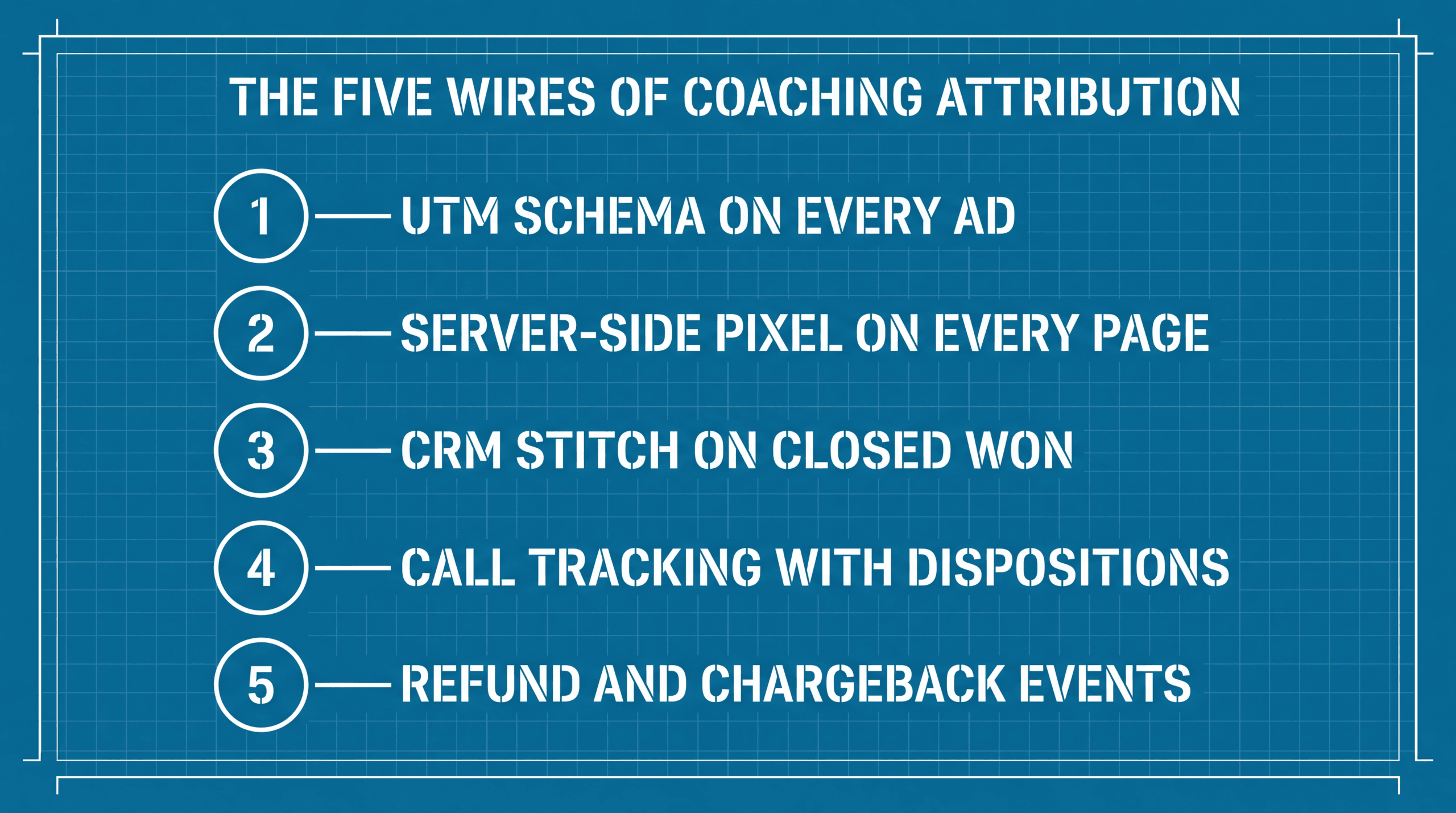
The whole high-ticket coaching attribution setup is five wires. Most coaches I audit have one or two in place and assume the rest fixes itself. (That one-to-two figure is observational across coaching customer accounts.) Here is the full set.
Wire 1: UTM schema standardized across every ad. Same source, medium, campaign, content, term structure on every platform, plus a coach-specific funnel_stage parameter at the ad-set level so you can later separate cold-traffic ads from retargeting in reporting.
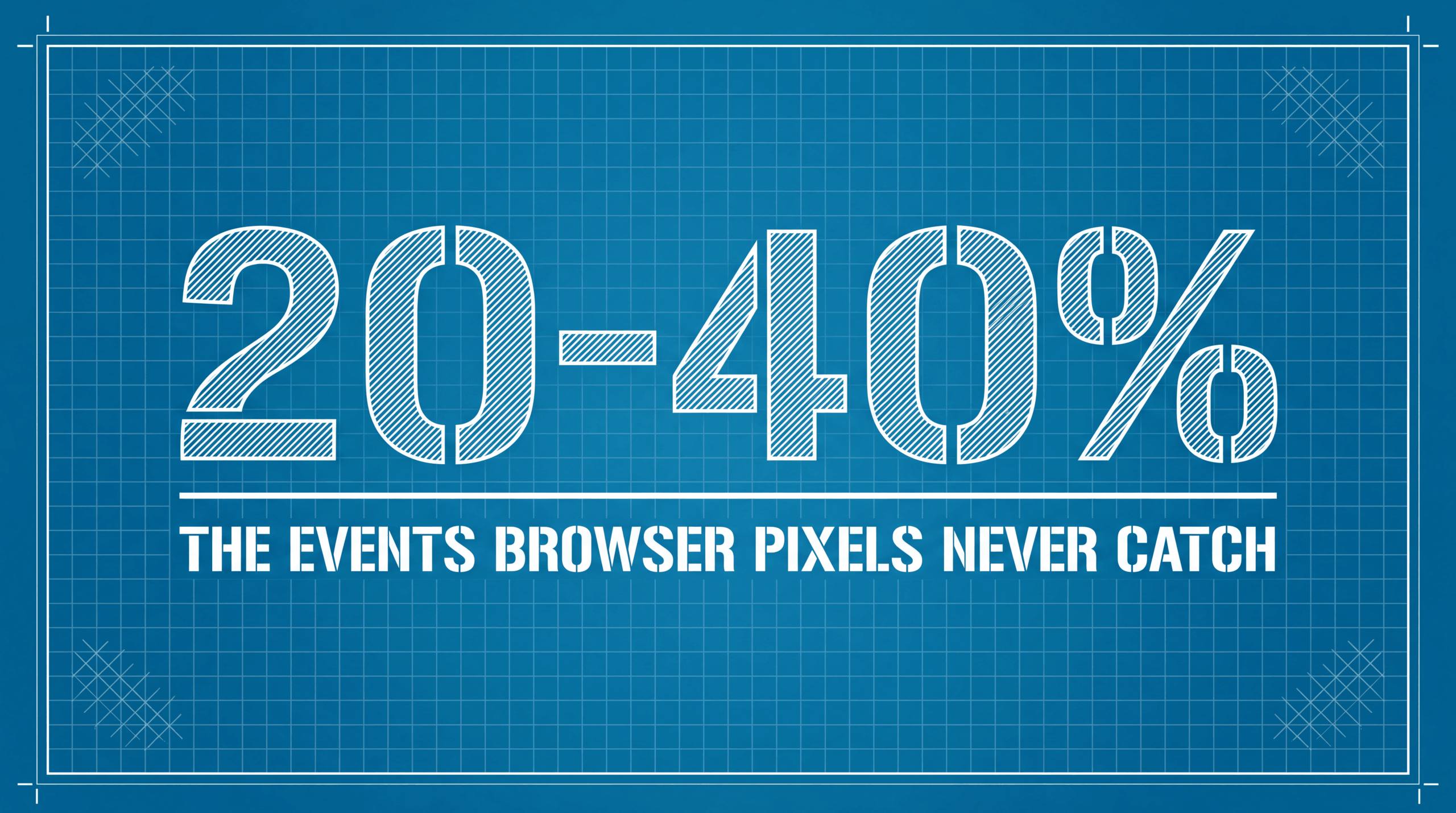
Wire 2: Server-side pixel on every funnel page. Browser pixels miss 20-40% of events because of cookie blockers, iOS privacy, and ad blockers. Server-side captures the event on your server and sends it directly. Install on opt-in, webinar registration, application form, booking page, and every checkout.
Wire 3: CRM stitch. The wire most coaches skip. The UID from opt-in has to be passed into the CRM (Close, HighLevel, Pipedrive, GoHighLevel). When a rep marks Closed Won, the CRM posts the close event back to your attribution platform with the original UID. Without this, the close event is invisible.
Wire 4: Call-tracking wire-up. If sales calls happen on Zoom or phone, the call disposition has to fire as a conversion event. CallRail, Aircall, and CallTrackingMetrics support this. The rep marks the outcome (Closed Won, Closed Lost, No Show, Follow Up) and that posts back with the UID attached.
Wire 5: Refund and chargeback events. High-ticket coaching carries meaningful refund exposure (treat refund-rate specifics as anecdotal across the segment, not benchmark-sourced). If your system counts the gross sale but ignores the refund 14 days later, ROAS is inflated. Wire refund and chargeback events from Stripe, PayPal, or your billing processor back so revenue is net.
Five wires. None complicated individually. Together they are the difference between knowing what your ad spend returned and guessing. For the LTV side of the math, see Customer lifetime value: definition and formulas.
Customer Lifetime Value and Why CAC Math Lies in High-Ticket Coaching
First-purchase CAC always overstates true CAC efficiency in coaching because the front-end offer is rarely the real revenue event. Let’s imagine a coach running a $3,000 front-end offer. CAC on first purchase: $1,200. On first-purchase math, the deal looks tight. Now bring LTV in. As a hypothetical, suppose roughly a quarter of $3K buyers upgrade into a $15K mastermind track over the year, with another slice taking monthly continuity at $497. (Treat these as a worked-example illustration, not a Hyros benchmark; the upgrade rate varies widely by offer.) Suddenly the campaign produces a multi-thousand-dollar LTV against the same $1,200 acquisition cost. The ROAS picture flips from negative to a strong multiple.
The mistake most coaches make is killing campaigns on first-purchase CAC alone. Fix is two-part: wire attribution so revenue traces back to the right ad, and build LTV reporting over 6 to 12 months.
Historical Case Studies From the Coaching Segment
A few documented coaching results from the Hyros customer base. Dan Henry (GetClients.com) became 300% more profitable within 72 hours of implementing Hyros, and scaled from $20K/month to $300K/month in ad spend. Sam Ovens (Skool) is another documented Hyros success credited with reshaping his ad measurement after years on platform-reported data. Tony Robbins’ team scaled ad spend 43% on Business Mastery and 100%+ on Unleash The Power Within over six months on the back of attribution that could see past the platform window. Source: hyros.com/our-results.
Hyros has 4,000+ customers tracking $3.5 billion+ in attributed revenue, built for the info-product and high-ticket coaching segment from day one. That is why the architecture handles 60 to 180 day windows, CRM-stitched call closes, and refund reconciliation as first-class features, not retrofits.
The Webinar Funnel Variant (Live + Evergreen)
Webinar funnels appear to compress the cycle. A live webinar can produce a buy decision in 7 to 21 days for live attendees, which fits inside most platform windows. The problem is live attendees are rarely the majority. Three cohorts matter:
Live attendees who buy. Cycle 1-7 days. Fits in any platform window.
Replay watchers who buy within 14 days. Cycle 7-21 days. Escapes Meta’s window. Google Ads still catches it.
Late buyers from the email sequence and retargeting. Cycle 21-90 days. Default pixels lose this cohort entirely.
The third cohort decides whether the campaign is profitable. Cold-traffic Meta ads skew heavier toward late buyers than retargeting does, so the cold-traffic campaigns are the ones most under-counted. The same ones most coaches want to scale. See Webinar ad attribution: tracking long funnels for the deeper walkthrough.
Common Mistakes Coaches Make (And How to Audit Yours)
The audit you can run on your stack this week. Five steps, one afternoon.
Pull 90 days of ad spend by campaign from every platform.
Pull 90 days of Closed Won deals from your CRM with date and dollar amount.
Match closes back to ad source using email as the bridge.
Calculate the percentage of closes with no traceable ad source. That is your attribution gap.
Compare your gap to platform-reported conversions for the same window.
Most coaches running this audit find a meaningful share of closes have no traceable ad source. We see 30% to 50% across coaching accounts before the wires go in. (Treat 30-50% as Hyros-observed, not a published benchmark. Full ranges are in the 2026 attribution benchmarks.) Independent validation from CheckThat.ai puts the Hyros tracking gap at 29-33% more conversions surfaced versus native platform reporting, which lines up.
That gap is the difference between scaling a campaign and killing it.
So, look. Here Is What Happens When the Wires Go In
When I was running ads for Hyros, Meta’s dashboard told us campaigns were marginal. We wired up the attribution properly, and the picture flipped. The marginal campaigns were funding everything. The “great” ones were retargeting, claiming credit for buyers cold traffic had already warmed up.
Every coaching account I audit follows the same script. Wires go in. CRM stitches. Call dispositions fire. Refund events net revenue. Scale-up decisions stop being a coin flip. That is the whole game. Not better creative. Not better targeting. Better data.
FAQ
What attribution window do I need for high-ticket coaching?
For $2K-$5K offers, a 60-day click window covers most of the cycle. For $5K-$15K offers, 90 days is closer to right. For $25K+ programs, 180 days is the realistic minimum. The actual right window matches the time-from-first-touch-to-close distribution in your CRM data. Use the 90th percentile of your last 90 days of Closed Won deals as your floor.
Why does Meta show negative ROAS on my coaching campaigns?
Meta’s default window is 7-day click plus 1-day view. Most high-ticket coaching closes 30 to 90 days after the original click. Meta cannot see past day 7, so the ROAS calculation is missing most of the dollars the campaign produced. The campaign is likely not unprofitable. Meta just cannot see the close.
Can I track sales-call closes back to ads?
Yes, with a persistent UID. Generate it at opt-in. Pass it into the CRM when the application fires. When the rep marks Closed Won, post the close event back to the attribution platform with the UID attached. Hyros integrates with Close, HighLevel, Pipedrive, and other coaching CRMs. CallRail, Aircall, and CallTrackingMetrics handle the call-side wire.
How do I attribute revenue when the cycle is longer than 90 days?
Use a platform with configurable windows past platform defaults. Meta caps at 7 days, Google Ads at 90, LinkedIn at 180. Hyros supports longer windows (verify the exact ceiling against current product copy at publish) and server-side capture that does not depend on browser cookies.
What is the five-wire setup for coaching attribution?
UTM schema, server-side pixel on every funnel page, CRM stitch for the close event, call-tracking integration for call disposition, and refund/chargeback event wiring so revenue is net. Most coaches have one or two wires in place and miss the rest.
Does Hyros work for coaches under $50K/month in ad spend?
Hyros is built for businesses spending $50K+/month on ads. Below that, the ROI may not justify the cost. In the $10K-$30K/month range, start with manual UTM schema, server-side tracking via a lighter tool, and Stripe metadata to connect payments to traffic sources. Past $30K-$50K/month, a dedicated attribution platform becomes the right call.
Hyros was built for high-ticket coaches. See every ad, every application, every sales-call close, across windows that match your cycle → Book a demo
Related in This Series
Silo: Audience-Specific Attribution Guides
More from the audience-specific attribution series:
- How info-product businesses track ad revenue
- Webinar ad attribution: tracking long funnels
- B2B attribution: long sales cycle tracking
- Customer lifetime value: definition and formulas
Also explore: