

Hyros vs Cometly: Ad Attribution Platform Comparison (2026)
TL;DR
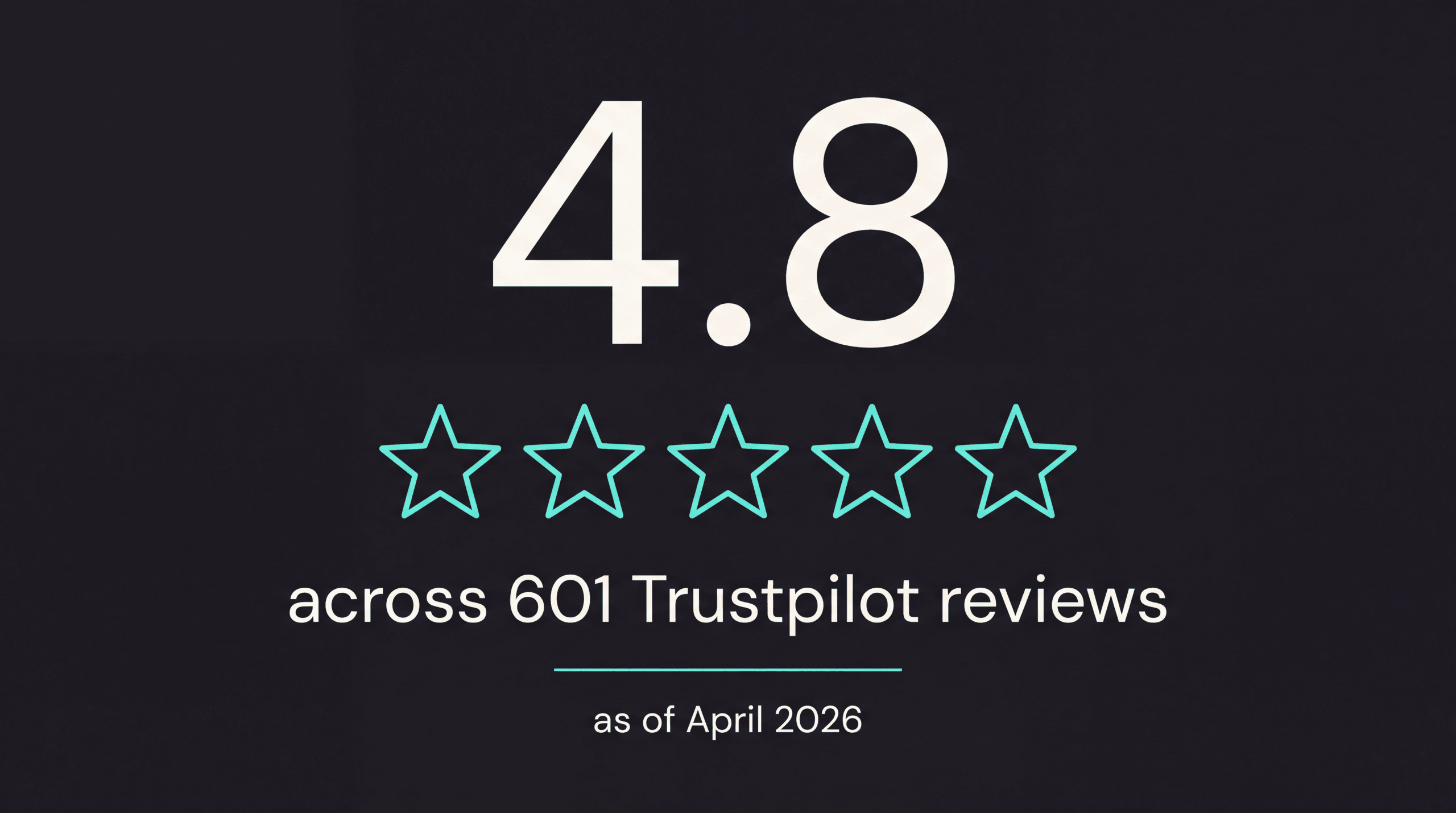
Hyros and Cometly are the closest architecturally of the major Hyros comparisons. Both are server-side ad attribution platforms that push enriched conversion data back to Meta, Google, TikTok, and other ad networks to improve optimization signal. Hyros is the incumbent with 601 Trustpilot reviews at 4.8, a mature integration footprint, VIP support on every plan, and a long track record across info-product, coaching, agency, and DTC accounts. Cometly is a newer AI-first platform built on a 100+ integration directory, ad-spend-scaled pricing, and AI recommendations for which campaigns to scale. Cometly’s Professional plan is positioned for under $500K/mo ad spend and Enterprise for $5M+/year. Hyros wins on depth, support, and track record. Cometly wins on breadth of integrations and entry-tier access.
What Are Hyros and Cometly?
Here’s the thing most people miss when they’re shopping for an attribution platform: the platforms aren’t fighting each other. They’re both fighting a system designed to take your money twice. Facebook’s going to take credit for the sale, Google’s going to take credit for the sale, and you can’t verify it because it’s a black box. I built Hyros because I watched that black box drain my own ad accounts before I understood what was happening. The question of Hyros vs. Cometly is legitimate, but it only matters if you first understand that you’re buying your way out of a rigged reporting system, not just upgrading a dashboard.
Hyros and Cometly are both server-side ad attribution platforms that feed enriched conversion data back to ad networks like Meta and Google. Both exist because native platform tracking is broken, and broken in a specific, costly way. According to Databox, summing all platform-reported conversions typically produces 150-250% of actual closed customers, and that double-counting alone makes native dashboards unreliable for spend decisions. LayerFive estimates that “nearly half” of marketing spend is wasted due to poor attribution. Hyros and Cometly are both bids to close that gap. I’d rather you use one of them than neither, regardless of which one you pick.
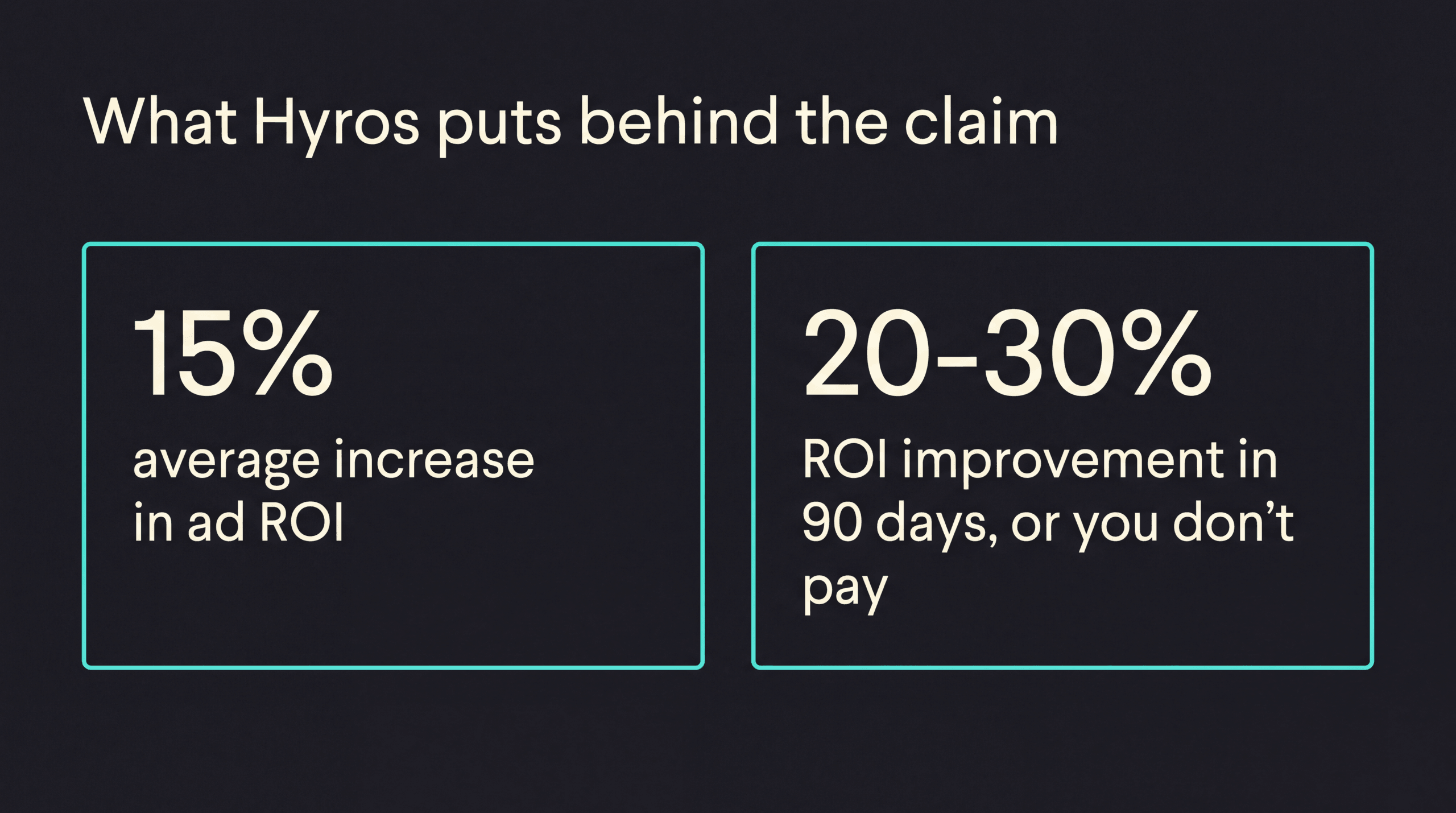
Hyros is the established platform with 601 Trustpilot reviews at 4.8 and a long track record across info-product, coaching, agency, and DTC accounts. According to Hyros, brands see at least a 15% increase in ad ROI on average, and they back that with a 90-day guarantee offering 20-30% ROI improvement or you don’t pay. Cometly is a newer AI-powered attribution platform built around server-side tracking, enriched conversion events, and a 100+ integration directory. Both scale pricing with ad spend. The core differences are maturity, support model, pricing transparency, and how deep the funnel tracking goes.
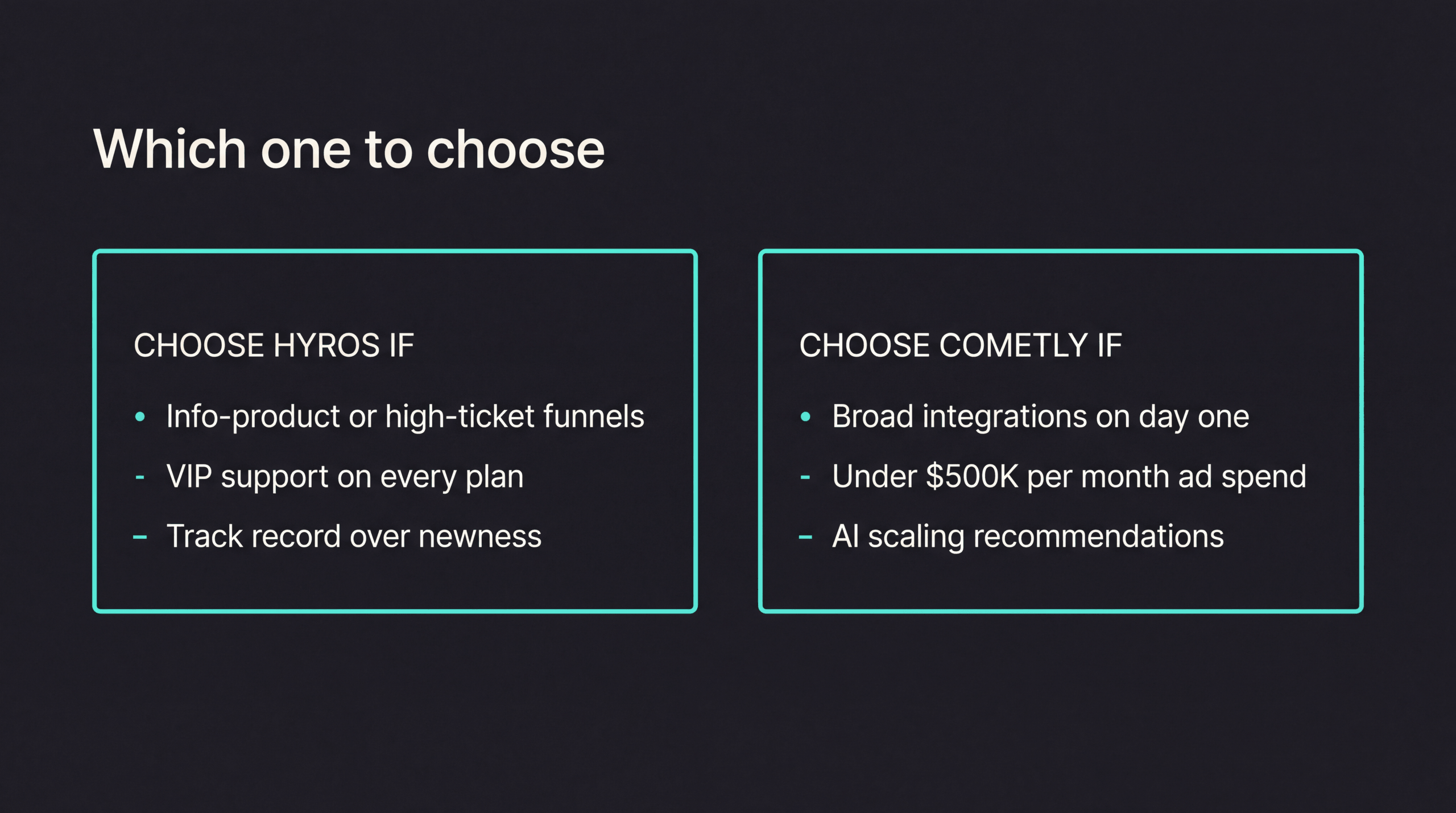
Verdict: Choose Hyros if you want the established high-touch server-side attribution platform with VIP support and a long track record; choose Cometly if you want a newer AI-first alternative with a broad integration directory and ad-spend-scaled pricing.
How Do Hyros and Cometly Compare on Features?
The feature surface area overlaps heavily. Both vendors lead with server-side tracking, CAPI enrichment, and multi-touch attribution. The differences show up in depth, support model, integration philosophy, and maturity of the review footprint.
| Feature | Hyros | Cometly |
|---|---|---|
| Primary use case | Precision funnel attribution for direct-response | Server-side attribution plus enriched ad signals |
| Server-side tracking | Yes | Yes (core product) |
| Enriched events back to ad platforms (CAPI / Enhanced Conversions) | Yes | Yes (core product) |
| Multi-touch attribution models | Yes | Yes (multiple models) |
| Long attribution windows | Yes | Yes (configurable) |
| AI recommendations for campaign scaling | Limited | Yes |
| Integration count | 30+ (deep) | 100+ (broad directory) |
| Shopify integration | Yes | Yes |
| Info-product and funnel support | Yes (core strength) | Yes |
| Agency and multi-client support | Yes (core strength) | Yes |
| CRM integration (Salesforce, HubSpot, GoHighLevel) | Yes | Yes |
| Post-purchase survey | No native | Limited |
| Free tier | No | Yes (limited events per reported listings) |
| Support model | VIP on all plans | Tiered by plan |
| Track record (public reviews) | 600+ Trustpilot at 4.8 | Newer, smaller review footprint |
| Pricing model | Quote-based, tracked revenue | Ad-spend-based tiers |
| Pricing transparency | Published ($230-$379/mo) | Mixed (public entry tiers, enterprise quote) |
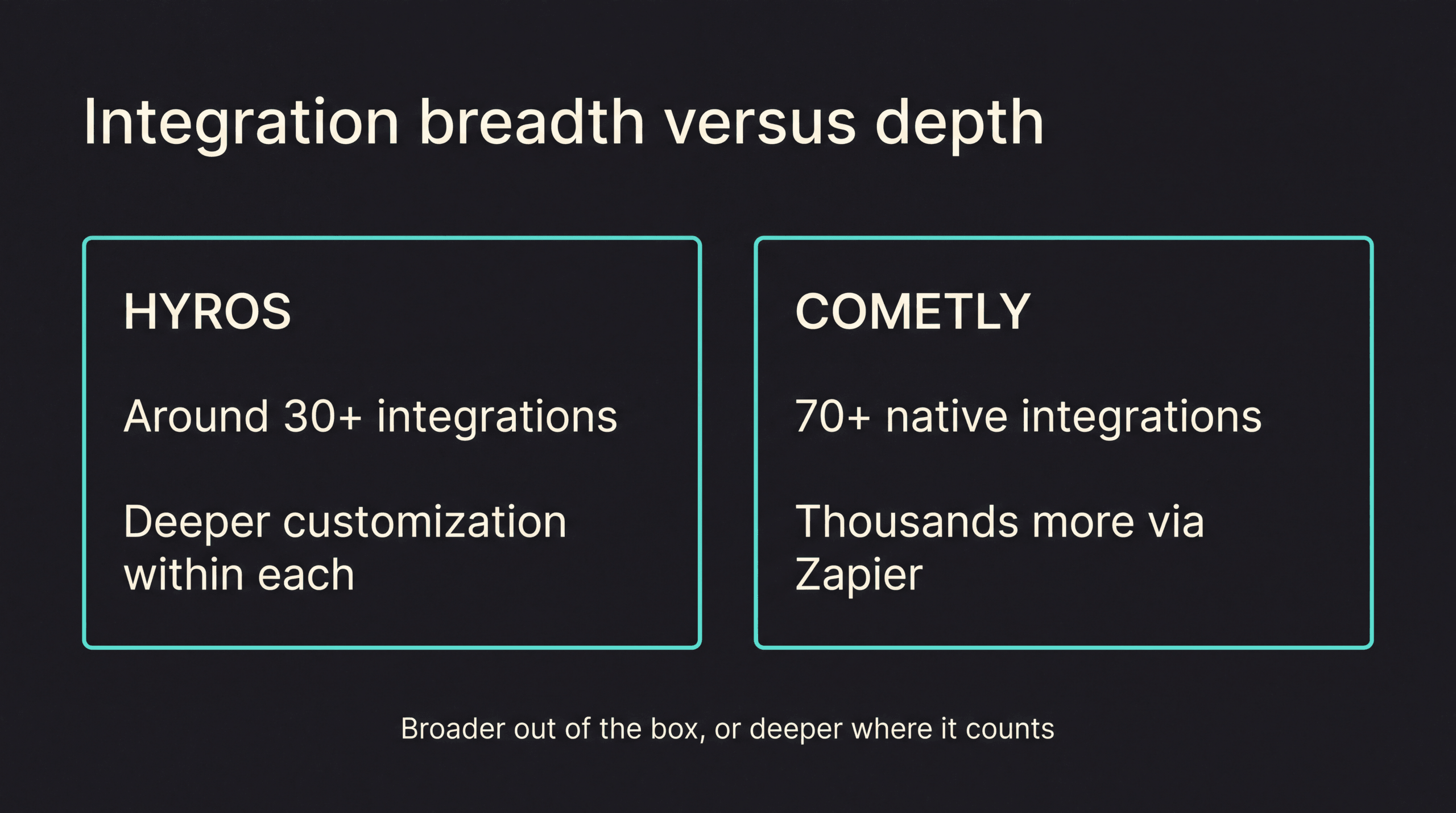
Two rows deserve special attention. First, the integration count isn’t a straight apples-to-apples metric. Cometly advertises 70+ native integrations (plus thousands via Zapier) in its public directory, which is broader out of the box. Hyros lists roughly 30+ integrations but delivers more customization within each one, particularly for info-product funnels, webinar sequences, high-ticket checkouts, and multi-step order bumps. The same integration label can mean very different depth. On the Hyros Shopify integration page, they report that Facebook underreports conversions by approximately 30%, Google by 29%, and TikTok by 33%. Those platform-specific gaps are what server-side tracking is designed to recover, and Hyros publishes them per-network instead of as a single blended number.
Second, the support model is a real operational difference. Hyros includes VIP support on every plan, which matters when a tracking script breaks mid-launch on a $40K/day campaign. Cometly tiers support by plan. For advertisers who treat attribution as mission-critical infrastructure, the always-on VIP model is a tangible reason Hyros retention stays high among accounts spending six figures a month.
I’m not going to sugarcoat the practical reality here: when you’re running $30K a day in ad spend and a pixel breaks on a Friday afternoon, tiered support is a revenue problem, not a software complaint. That’s why I built the VIP model into every Hyros plan from day one, not as a premium add-on.
Third, note the track-record column. Hyros has 601 Trustpilot reviews at a 4.8 average as of April 2026. An independent analysis by CheckThat.ai across 601 of those Trustpilot reviews found users consistently reporting 29-33% more conversions tracked versus native ad platforms. Cometly’s review footprint across Trustpilot, G2, and TrustRadius is materially smaller, which is expected for a newer vendor. Public reviews are an imperfect signal, but they shape buyer confidence and the depth of field-tested edge cases an attribution vendor has solved. For a team betting a large media budget on a single tracking layer, that track record is rarely irrelevant.
Fourth, the AI recommendations row is worth reading carefully. Cometly ships AI-driven recommendations for which campaigns to scale, pause, or reallocate spend toward, positioned as a core differentiator. Hyros offers some AI-assisted reporting features, but its product identity is precision tracking, not algorithmic budget optimization. If your team wants the tool to nudge pacing decisions, Cometly leans into that. If your team wants the tool to get the numbers right and let your media buyers decide the pacing, Hyros is the cleaner fit.
How Does Hyros Pricing Compare to Cometly?
Pricing current as of April 2026. Both vendors use quote-based pricing that changes. Verify before purchase.
Both vendors scale pricing with the business, but they use different inputs. Hyros scales with tracked revenue, which ties the bill to the size of the attribution job. Cometly scales with monthly ad spend, which ties the bill to the size of the media being tracked. Both approaches are defensible. The practical difference shows up at entry and at the high end.
| Plan | Hyros | Cometly |
|---|---|---|
| Free tier | No | Yes (limited events per reported listings) |
| Entry paid | ~$230-$379/mo Business pricing (quote) | Professional from ~$199/mo (positioned under $500K/mo ad spend) |
| Mid tier | Scales with tracked revenue | Scales with ad spend |
| Enterprise | Custom quote | Enterprise positioned at $5M/year+ ad spend (custom quote) |
| Agency plan | Yes (custom) | Yes |
| Organic-only plan | $49/mo | No |
| Support included at entry | VIP | Tiered |
A few observations. Hyros publishes entry pricing starting at $230/month (annual) or $379/month (monthly). Multiple third-party sources cite a $230-$379/mo entry range for Business pricing plans. Treat those as directional. Hyros pricing is always quote-based and will reflect tracked revenue, number of funnels, and integration complexity.
Cometly publishes a Professional tier that’s positioned for advertisers spending under $500K per month and an Enterprise tier positioned for businesses at roughly $5M per year in ad spend or higher. (Cometly’s pricing is now gated behind a ‘Get Started’ contact form on cometly.com; tier figures here are per third-party pricing aggregators and may not reflect current published rates.) Listings across third-party aggregators show tier prices ranging from $199 to $499. Mid-to-enterprise pricing is quote-based. A free tier is reported in at least one source with a limit near 20M events per month. Verify the free tier terms at cometly.com/pricing before relying on them in April 2026.
The organic-only Hyros plan at $49 per month has no direct Cometly equivalent. That plan exists for ecommerce and content sites that want Hyros tracking without a full paid-media attribution stack. Treat it as a wedge product, not a serious comparison data point against Cometly, which is purpose-built around paid-media enrichment.
A practical framing for buyers in the $50K to $200K per month spend band. At that level, both platforms will quote you something within the same order of magnitude. The deciding factors tend to be integration depth against your current stack, whether you need AI-driven budget recommendations, and how critical VIP support response time is when a pixel breaks. Cheaper-on-paper doesn’t automatically mean cheaper-in-practice when a tracking outage costs five figures a day in wasted spend on unoptimized auctions. As one media buyer on Reddit’s r/PPC put it: after switching from Triple Whale to Hyros on a $100K/month account, they reported ROAS climbing from 2.8x to 3.8x with “95%+ tracking accuracy” against backend Stripe data. The platform cost is noise at that spend level if the attribution accuracy is real.
For deeper background on how CAPI-based attribution actually works under the hood, see our guide to server-side tracking and the primer on what ad attribution is.
Who Should Choose Hyros?
I’ve looked at a lot of accounts where the team is convinced their ads aren’t scaling, and the conclusion I keep reaching is the same one every time. The big reason people don’t think their business is scaling, and their ads are not scaling their business, is because they think it’s something they’re not doing in the ad manager. They think it’s something with their front-end funnel. But they’ve spent hundreds of hours in the ad manager already. It’s almost never the funnel. It’s almost always the data going into the algorithm. That’s the real decision underneath the Hyros vs. Cometly question: not which platform has more features, but whether your margins and your business model can support running on clean attribution versus running blind.
Hyros is built for high-spend direct-response operators who treat attribution as mission-critical infrastructure, not a quarterly reporting exercise. The customer profile is specific, and it has stayed consistent for years.
- Info-product businesses, high-ticket coaching programs, and course creators running complex webinar and application funnels.
- Agencies managing many paid-media clients across info-product, coaching, and DTC verticals, where a single broken pixel across ten accounts becomes a real revenue event.
- DTC brands with non-standard checkouts, multi-step order bumps, subscription upgrades, or funnels that live outside a simple Shopify “add to cart” flow.
- Advertisers spending $30K to $500K+ per month who need funnel-level precision and can justify the cost of a dedicated attribution platform.
- Teams that have tried lighter-weight trackers, hit limitations on long-window attribution or multi-funnel routing, and need a heavier tracking layer before scaling further. Tony Robbins’ ad team scaled spend by 43% on Business Mastery and 100%+ on Unleash The Power Within over six months after switching to Hyros. Dan Henry (closedeals.com) went from $20K to $300K per month in ad spend while reporting 300% more profitable campaigns. Those are the scale trajectories Hyros is built around.
- Operators who value VIP support with fast response times without having to sign an enterprise contract or wait on a ticket queue.
Hyros is a weaker fit for micro-budget advertisers, pure Shopify-only stores that already have a fine-tuned native pixel setup, or teams that want a dashboard-first operating system with AI chat on top. In those cases, the sophistication Hyros brings is overkill, and the quote-based pricing is hard to justify. In those cases, the sophistication Hyros brings is overkill, and the quote-based pricing is hard to justify.
One recurring theme in Hyros accounts is that churn is low once a team is live. Switching attribution platforms mid-scale is operationally risky. Historical data doesn’t cleanly transfer, reporting baselines reset, and every paid media decision runs through the new numbers for weeks while teams rebuild trust. High-spend accounts tend to stay, and that stickiness is visible in the 601 Trustpilot reviews at 4.8 as of April 2026. An independent review by Softailed found that Hyros’s AI pixel training alone produced a 22% boost in ad ROI, and that server-side tracking in general recovers 18-40% more conversions compared to browser-only methods. That recovery gap is the reason high-spend accounts rarely go back to native pixels once they have seen the delta.
Who Should Choose Cometly?
Cometly is built for performance advertisers who want a newer AI-first platform with broad out-of-the-box integrations and pricing that scales linearly with media spend. The profile is less entrenched than Hyros’s, which is expected for a newer vendor, but it’s coherent.
- Performance advertisers who want AI-driven recommendations on which campaigns to scale, pause, or reallocate spend toward.
- Teams that need many integrations out of the box. Cometly advertises 70+ native integrations (plus thousands via Zapier) in its directory, which reduces the friction of connecting niche ad networks, landing page builders, and CRMs.
- Brands comfortable running on a newer platform in exchange for lower entry pricing and faster feature velocity.
- Advertisers under $500K per month in ad spend who want server-side CAPI enrichment without committing to a quote-based incumbent at first.
- Startups and early-stage DTC brands that can use Cometly’s free or entry tier to validate attribution workflows before paying for the full stack.
- Teams that value transparent pricing tiers over a sales-led quote process at the entry level.
Cometly is a weaker fit for accounts that treat attribution downtime as a revenue emergency, mature info-product brands with highly customized funnels and years of historical data in another platform, or agencies that need white-glove migration support. The newer review footprint also means there’s less independent field data on edge cases than there’s for Hyros. Worth noting: media buyers on Reddit’s r/ecommerce who tried Hyros on $200K/month Shopify accounts reported a 28% ROAS uplift and 92% attribution match rates against backend data. That kind of field data from real operators doesn’t exist yet for Cometly at comparable scale, which isn’t a knock. It is a function of time in market.
One thing Cometly does well is public positioning. The pricing page, the integration directory, and the AI-recommendation pitch are all legible without a sales call. For an operator doing initial discovery, that matters. You can form a rough mental model of whether the platform fits before anyone picks up the phone.
My honest take on Cometly: it’s a real platform solving a real problem, and if you’re earlier in the scale curve, it deserves a serious look. I’d just make sure you run both trackers in parallel for at least four weeks before committing. The attribution delta between any two platforms on a $50K/month account will tell you more than any comparison article, including this one.
For broader context on where both platforms sit in the 2026 attribution landscape, compare them against our Hyros vs Triple Whale breakdown and the Hyros vs Wicked Reports comparison.
FAQ
Is Cometly a Hyros alternative?
Yes. Architecturally they solve very similar problems. Both are server-side attribution platforms that feed enriched events back to ad networks like Meta and Google. Cometly positions itself as a newer, more AI-first alternative. Hyros is the established incumbent with a larger review footprint at 601 Trustpilot reviews at 4.8 as of April 2026. For most performance advertisers evaluating one, the other belongs on the shortlist.
Which is cheaper, Hyros or Cometly?
Entry-level pricing is close. Cometly begins near $199 per month and Hyros begins near $230 per month for paid plans. Cometly offers a limited free tier that Hyros doesn’t, which makes Cometly cheaper at the floor. At mid-market and enterprise levels, both become quote-based and the comparison depends on ad spend, tracked revenue, integration requirements, and support SLAs. For accounts spending $100K+ per month, the headline tier price is rarely the deciding factor.
Does Cometly actually send enriched conversion data back to Meta and Google?
Yes. Cometly’s core positioning is server-side tracking plus enriched conversion-ready events pushed back to Meta, Google, and other ad platforms to improve targeting and optimization. Hyros offers equivalent functionality through its CAPI and enhanced conversions integrations. The practical question isn’t whether either platform does this, but how clean the enrichment is for your specific funnel shape.
Which has more integrations?
Cometly advertises 70+ native integrations (plus thousands via Zapier) in its directory, which is broader out of the box. Hyros has fewer integrations on paper, roughly 30+, but tends to offer deeper customization within each one. Info-product and coaching funnels with webinar platforms, course hosts, payment processors, and CRMs usually need that depth. DTC brands with many niche ad networks may benefit more from Cometly’s breadth.
Is Hyros still worth it if Cometly is cheaper?
For high-spend direct-response advertisers, usually yes. Hyros’s value comes from precision at the funnel level, VIP support on every plan, and a long track record across info-product, coaching, and agency accounts. Cometly is a credible newer option. Established direct-response teams often stay with Hyros because switching attribution tools mid-scale is operationally risky, not because Cometly can’t technically do the job.
Can I run Hyros and Cometly in parallel during evaluation?
Yes, and many serious buyers do. Running both trackers in parallel for two to four weeks is the cleanest way to compare attribution outputs on the same media spend. Expect minor differences in reported conversions because no two attribution platforms model touches identically. The goal isn’t to reconcile the numbers perfectly but to check which platform is closer to the ground truth reported by your payment processor and CRM.
Conclusion
Here’s how I think about this decision personally. If I’m running $50K+ a month in ads and my margins are real (meaning I actually know my CPL, my close rate, and my backend revenue per customer), I want the attribution layer that’s been stress-tested by people at my scale and above it. That’s Hyros. Not because Cometly doesn’t work, but because I don’t want to find out it has edge cases on a $300K launch week. I’ve seen what wrong attribution data does to a scaling operation: it kills the campaigns that are actually working and scales the ones bleeding money. Both outcomes are expensive.
Hyros versus Cometly is a maturity-and-depth decision more than a features checklist. Both platforms do server-side tracking, both push enriched events back to Meta and Google, both support multi-touch attribution, and both scale with the size of the account. What separates them is track record, support model, integration depth, and who the platform was originally built to serve. Hyros has 601 Trustpilot reviews at 4.8 and years of info-product, coaching, agency, and DTC accounts behind it. Cometly is a newer AI-first alternative with a broad integration directory and transparent entry pricing. Both are legitimate choices.
My decision framework is simple. If your monthly spend is past the point where a tracking outage costs real money (and that threshold is lower than most people think, around $30K/month), if your funnels are more complex than a native Shopify checkout, or if you’re an agency managing multiple accounts where support response time is a hard requirement, Hyros is the safer pick. If you’re earlier in the scale curve, want to validate attribution workflows before committing to a quote-based platform, or need a specific niche integration already in the Cometly directory, Cometly earns a serious look. Just run both in parallel for four weeks before you commit either way. The numbers will tell you what no comparison article can.
For related comparisons, see our Hyros vs Northbeam breakdown and the complete Hyros comparison hub.
Book a Hyros demo to see how server-side attribution looks on your actual funnels before you commit. A 30-minute walkthrough on your live ad accounts is usually enough to decide whether the precision is worth the quote.
Standalone Summary
Hyros and Cometly are the most architecturally similar pairing in this comparison set. Both are server-side attribution platforms that push enriched conversion events back to Meta, Google, TikTok, and other ad networks to improve optimization signal. Hyros is the established incumbent: 601 Trustpilot reviews at 4.8 as of April 2026, VIP support on every plan, 30+ deep integrations built around info-product funnels, webinar sequences, and multi-step checkouts, with Business pricing plans starting near $230/month (annual). Cometly is the newer AI-first challenger, broader out-of-the-box with 70+ native integrations plus thousands via Zapier, AI-driven campaign scaling recommendations, a limited free tier, and a Professional plan starting near $199/month for advertisers spending under $500K per month. The key differentiation: Hyros wins on track record, integration depth for complex direct-response funnels, and always-on VIP support; Cometly wins on breadth of integrations, entry pricing, and AI-native campaign pacing recommendations. Hyros is the stronger fit for established high-spend direct-response operators where attribution downtime is a revenue emergency. Cometly is the stronger fit for performance advertisers earlier in the scale curve who want broad out-of-the-box connectivity and transparent entry pricing before committing to a quote-based incumbent.
Related in This Series
Silo: Hyros Comparison Series
Other Hyros platform comparisons:
- Hyros vs Triple Whale: Ad Attribution Comparison (2026)
- Hyros vs Northbeam: Ad Attribution Comparison (2026)
- Hyros vs Wicked Reports: Ad Attribution Comparison (2026)
- Hyros vs Rockerbox: Ad Attribution Comparison (2026)
Also explore: