

UTM Parameters: The Complete 2026 Guide
Most marketers obsess over UTM hygiene while a meaningful share of their actual revenue arrives with no UTM at all. Organic shares. Copy-paste links to Slack. Podcast mentions. AI referrers that strip query strings before the click. I built Hyros because I kept watching advertisers fight a losing battle inside dashboards quietly missing a third of their conversion paths. UTMs are useful. They are the floor of attribution, not the ceiling. This guide is everything the other UTM guides cover, plus the part they skip.
TL;DR
- UTMs tag the click but cannot stitch cross-device, dark social, view-through, or AI-referral paths
- Three 2026 forces broke UTM-only attribution: ITP 7-day cookies, AI link stripping, and ATT opt-outs
- Fix is UTMs plus a UID layer; UTM-only setups commonly miss 30-50% of revenue paths
UTMs are the floor of attribution, not the ceiling. Five parameters populate GA4 traffic-source dimensions when the query string survives the click, which makes them accurate for click-source but blind to cross-device, dark social, view-through, and AI-referral paths. In 2026, three forces broke UTM-only attribution: iOS Safari ITP caps first-party cookies at 7 days, AI tools (ChatGPT, Perplexity, Claude) often render outbound links without preserving query strings, and ATT made post-click pixel matching unreliable for opted-out iOS users. Hyros customer audits show UTM-only setups commonly miss 30-50% of revenue paths — see the 2026 attribution benchmarks for the vertical breakdown. The fix is UTMs plus a UID layer: per the Hyros Shopify integration page, Facebook underreports by approximately 30%, Google by 29%, and TikTok by 33% versus server-side tracked data, and most of that gap is path-stitching, not click-source.
What Is a UTM Parameter?
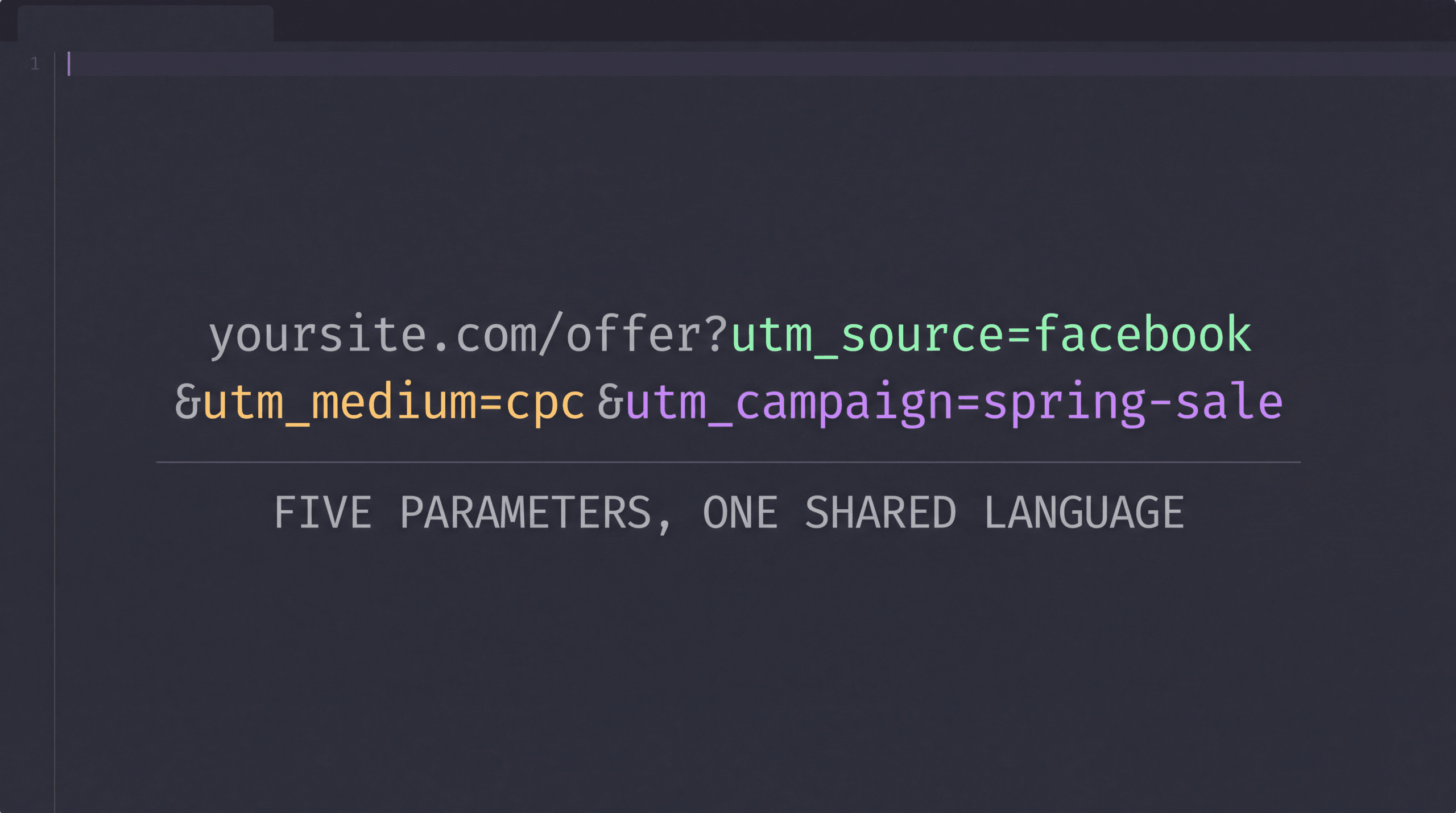
A UTM parameter is text appended to a URL that tells your analytics platform where a visitor came from. You add ?utm_source=facebook&utm_medium=cpc&utm_campaign=spring-sale to your destination URL, and Google Analytics records those values when someone clicks.
| Parameter | Required? | What it captures | Example values |
|---|---|---|---|
| utm_source | Required | The platform that sent the traffic | facebook, google, newsletter |
| utm_medium | Required | The channel type | cpc, email, social, organic, referral |
| utm_campaign | Required | The specific campaign name | spring-sale-2026, q2-launch |
| utm_term | Optional | The paid keyword (Google Ads users skip this) | running-shoes |
| utm_content | Optional | The specific ad creative or link variant | hero-image-a, footer-link |
UTM stands for Urchin Tracking Module, after Urchin Software, the company Google acquired in 2005 and rebuilt into Google Analytics. Every major ad platform treats these five parameters as the universal language of campaign attribution. The part other guides skip: UTMs only work when the query string survives the click. They do not survive every click in 2026.
How to Build a UTM-Tagged URL
Append a ? then key=value pairs separated by &:
`
`
GA4 credits the session to Facebook, paid social, Spring Launch 2026, hero video variant A.
Two practical builders: Google’s free Campaign URL Builder for one-off links, and a shared spreadsheet template for teams with a formula cell that concatenates source, medium, campaign, content into a final URL. That is what scales when five marketers are building links across ten campaigns.
Common mistakes: spaces (use hyphens), capitalization drift (Facebook and facebook are different sources in GA4), URL-encoding errors on special characters, and stacking ? (one per URL, additional parameters use &).
Naming Conventions That Do Not Break in 6 Months
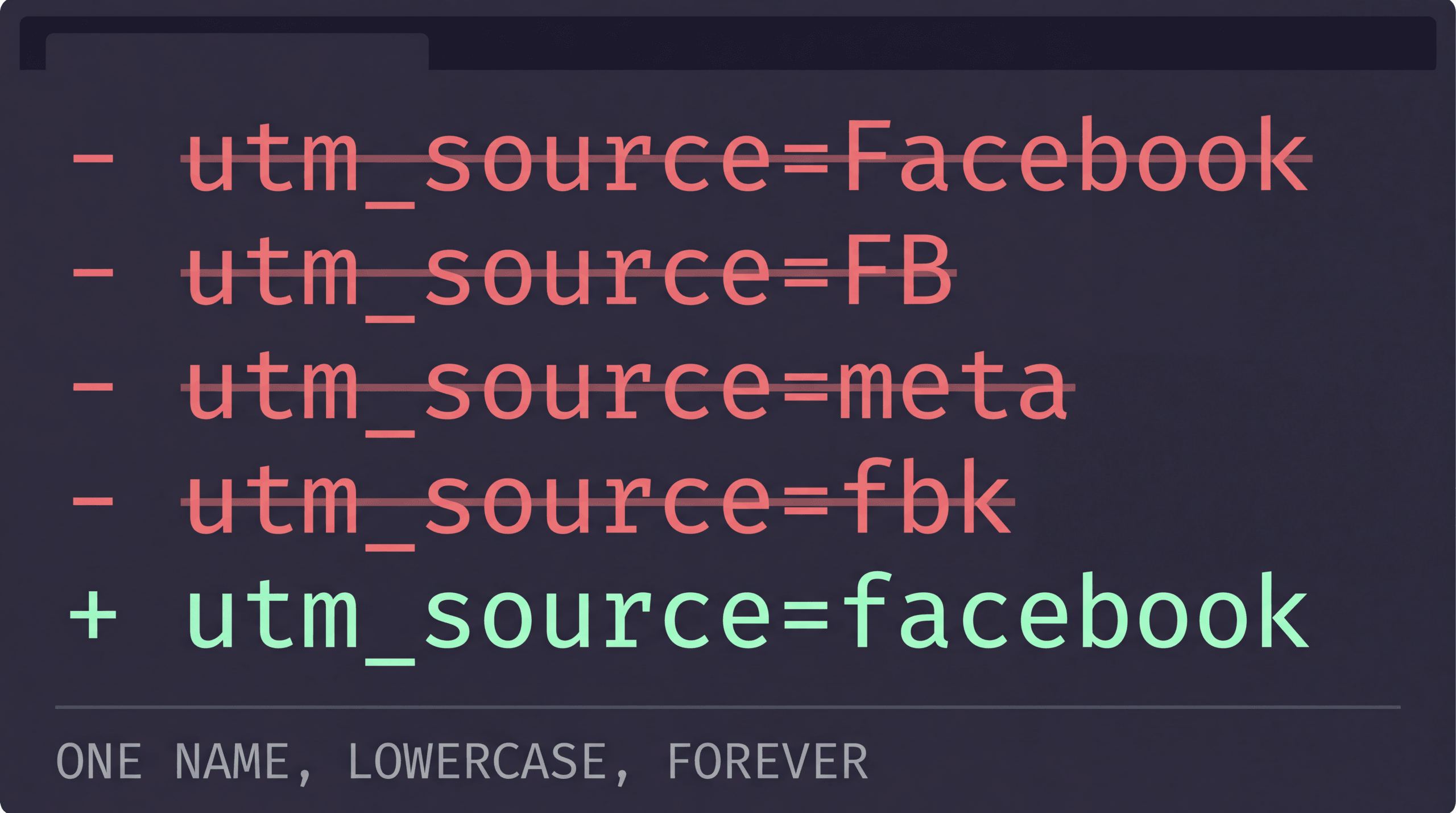
UTM data is only as good as the naming discipline of the team building the links. I have watched accounts where one Meta campaign was tagged as facebook, Facebook, FB, meta, and fbk by five different people. Five different sources in GA4. Data is a mess.
Six rules that hold up.
1. Lowercase everything. GA4 is case-sensitive. Enforce it.
2. Hyphens, not underscores. Both work. Pick one.
3. Source is the platform. Medium is the channel TYPE. Campaign is the campaign NAME. utm_source=facebook plus utm_medium=cpc means “paid traffic from Facebook.” utm_source=facebook plus utm_medium=social means “organic post from Facebook.” Different channel grouping in GA4.
4. Build a shared values document. One Google Doc or Notion page. Approved values per parameter. One owner. Quarterly review.
5. Never UTM-tag internal links. Most common UTM mistake and the most damaging. Tag a homepage-to-pricing link with utm_source=internal&utm_medium=nav and GA4 starts a NEW session, credits it to “internal,” and overwrites the original session source (Google organic, paid Meta, whatever). You lose the real attribution. Period.
6. Quarterly review. Pull all UTM values from the last 90 days. Delete deprecated ones. Flag new values that bypassed the approved list.
When I was running ads for Hyros, disciplined accounts pulled a clean channel report in 30 seconds. Undisciplined accounts spent an hour reconciling fb versus facebook versus Facebook Ads.
GA4 and Google Ads UTM Behavior
GA4 collects the five standard UTM parameters automatically. They flow into Reports > Acquisition > Traffic Acquisition, mapped to Session Source, Session Medium, and Session Campaign dimensions.
GA4’s default channel grouping reads utm_medium to bucket traffic. utm_medium=cpc goes in Paid Social. utm_medium=social goes in Organic Social. The medium value drives the bucket. Check Google’s GA4 default channel group definitions for current rules.
Google Ads is the one platform you do NOT manually UTM-tag. It uses auto-tagging via the GCLID parameter. Every click gets a unique ?gclid=xxx appended automatically, and GA4 reads that GCLID to pull keyword, ad group, and campaign data. Manually adding utm_term OVERWRITES the GCLID. You lose the keyword data. You break the integration.
The rule: Google Ads gets auto-tagging only. Everything else gets manual UTMs.
What UTMs CANNOT See: The Floor Problem

This is the section every other UTM guide skips. UTMs are accurate for one thing: they tell you the source of a click when the query string survives the click. That is a narrow piece of the attribution problem. Five blind spots.
1. Cross-device journeys
User clicks your UTM-tagged Meta ad on phone Monday. Tuesday night on desktop, they search your brand on Google and buy. GA4 sees session 1 as paid social, session 2 as organic search. Two different users. Meta gets no credit. UTM captured. Journey not.
2. Dark social and paste-distortion
Someone copy-pastes your UTM-tagged URL into Slack, iMessage, WhatsApp. UTMs survive the paste. Now every click from every paste in every private channel shows up in GA4 with the SAME utm_source=facebook&utm_campaign=spring-launch. Your campaign suddenly looks like it is driving traffic from places no Facebook ad ever ran. Technically correct, substantively wrong.
3. AI referrers stripping UTMs
ChatGPT, Perplexity, and Claude often render outbound links without preserving query strings. When an AI tool cites your page and a user clicks through, the UTMs are gone. Traffic arrives as direct or referral from chat.openai.com or perplexity.ai. No top-six SERP guide on UTM parameters mentions this. AI-cited traffic is a measurable channel and growing fast. UTMs cannot see it.
4. View-through conversions
User scrolls past your Meta ad. They do not click. Three days later they Google your brand and buy. UTMs see nothing. The session is organic search. The ad drove the conversion. Report credits Google. Picture this happening 1,000 times across a campaign and you see how view-through paths quietly distort the entire spend allocation.
5. iOS 14.5+ ATT undercount
utm_source=facebook is still accurate on the click side. The problem is post-click pixel attribution back to the Meta ad. For ATT-opted-out users, Meta’s pixel cannot fire post-click match data. The conversion logs in GA4 as facebook/cpc, but inside Meta Ads Manager it never ties back to the specific ad set. After iOS 14.5, roughly 96% of US iPhone users initially opted out (Flurry Analytics, 2021); opt-in rates have since climbed to approximately 35-37% as of 2026.
Verification note: Hyros customer audits show UTM-only setups commonly miss 30-50% of revenue paths across these five blind spots combined.
For a broader look, see our guide on what is ad attribution.
The UID-Supplemented Upgrade Model
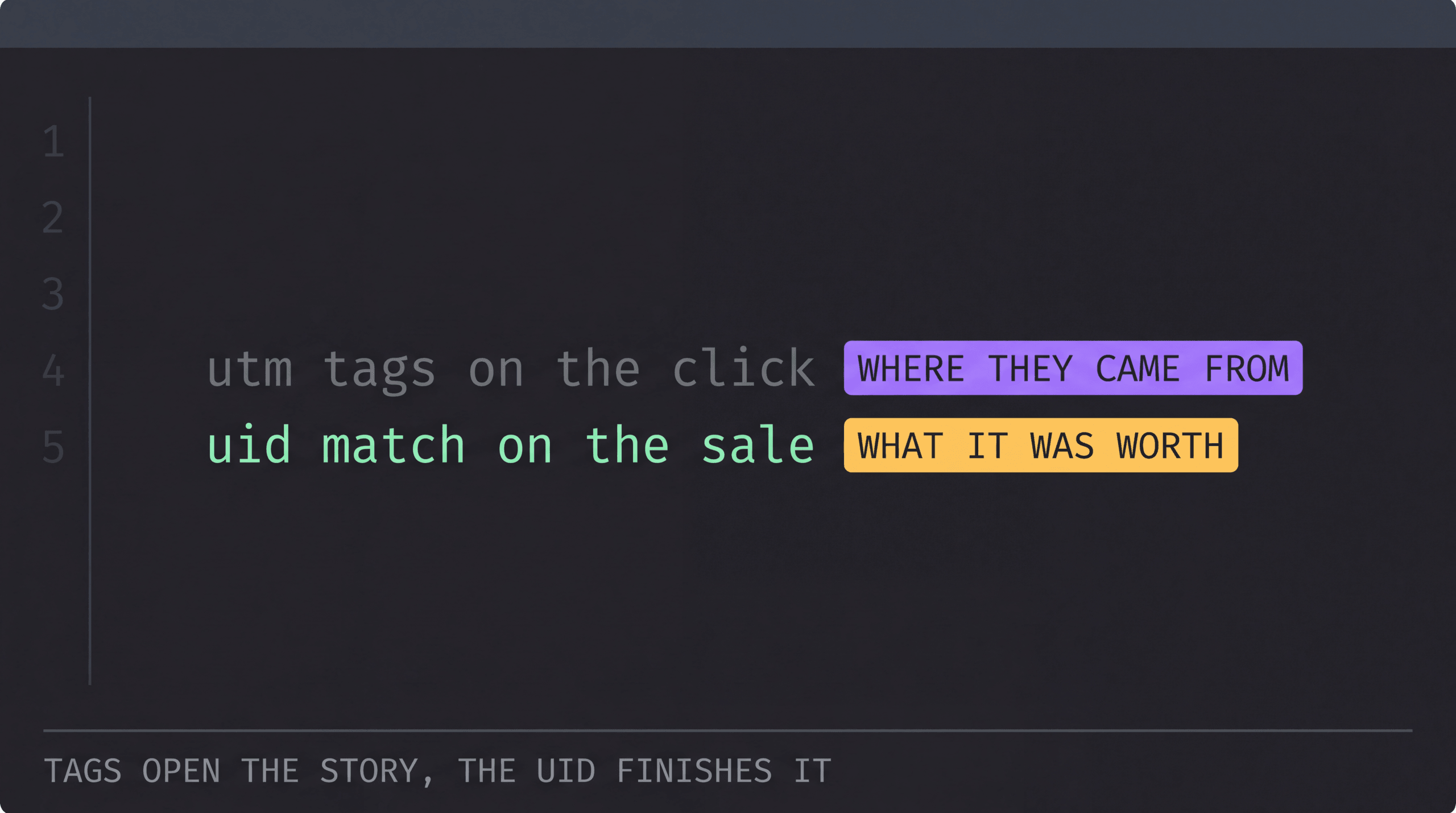
The fix is not to abandon UTMs. The fix is to add the layer UTMs cannot provide.
A persistent user ID (UID) attaches to a visitor on first touch and survives across sessions, devices, channels, and ad blockers. When the same UID returns through a different channel weeks later, the platform stitches the journey into one user record instead of a new anonymous session. Email-based matching, hashed phone, and authenticated logins all feed the UID layer.
Picture this walk-through.
- Day 1: User clicks a Meta ad on iPhone. utm_source=facebook&utm_campaign=spring-launch captures the click source. They browse, do not buy.
- Day 4: Same user on desktop hits your site (no UTMs, direct traffic) and signs up with the email they typed on mobile. UID layer matches desktop to mobile.
- Day 7: User Googles your brand, clicks organic, buys $300. UID layer stitches the full journey at checkout: Meta click day 1, direct visit day 4, branded search purchase day 7. UTM-only credits Google organic. Meta gets zero credit.
Same $300 sale, two completely different stories about where to put the next ad dollar.
I designed Hyros for my own ad accounts because I was watching this exact pattern destroy budget allocation. Platforms were saying one thing, actual data was saying another, and there was no way to break open the black box without an independent UID layer.
UID stitching runs on a server-side tracking foundation, with the handoff into Meta and Google happening through Conversions API endpoints. See server-side tracking, Meta Conversions API, and ad tracking vs analytics for why GA4 and Hyros report different numbers.
UTMs stay essential. They are the click-source signal. UIDs add the path-stitching layer on top.
2026-Specific UTM Realities
Cookieless GA4 and Consent Mode v2. When a user declines cookies, GA4 falls back to behavioral modeling. UTMs still flow on the click, but downstream session attribution gets modeled. Direct inflates. Modeled conversions are estimates, not real users.
AI-referral category needs its own tracking. For any link you place on a platform that gets ingested by an LLM (your llms.txt, podcast show notes, partner blog posts), tag it utm_source=ai-citation. When the rare preserved UTM comes through, you can isolate it.
ATT impact on paid social UTMs. utm_source=facebook is still accurate as the click source. What changed is post-click attribution back to the specific Meta ad set. UTM tells you the campaign. It does not tell you which creative worked.
First-party data is the new stack. UTMs plus UIDs plus server-side events. The advertisers I see scaling cleanly in 2026 run all three layers together.
UTM Audit Checklist: Steal This
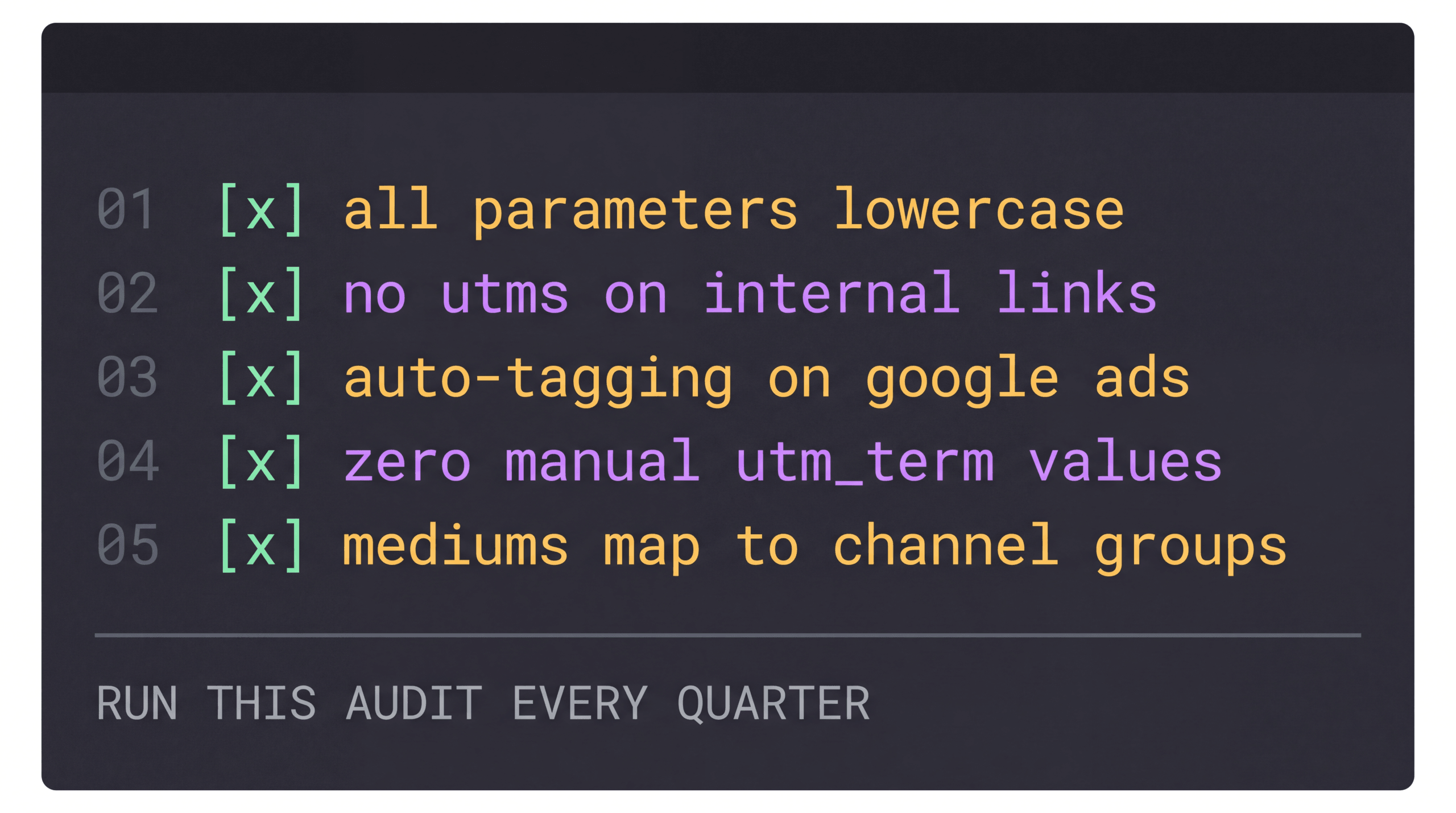
Run through these every quarter on a live account.
All five UTM parameters use lowercase across every link in the last 90 days.
No internal links carry UTMs.
Google Ads URLs use auto-tagging only. Zero manual utm_term values.
utm_medium values map cleanly to GA4 default channel groups.
One naming-convention document exists, has one named owner, was reviewed within 90 days.
AI-citation traffic has its own utm_source value on links you control (llms.txt, podcast show notes, partner placements).
Cross-device users are stitched via a UID layer (email or phone hash).
Dark-social paste-distortion is monitored (same UTM value, sudden direct-traffic spike not matching active spend).
View-through conversions are reported separately from click-through.
Quarterly review removes deprecated campaign values from the shared URL builder.
Fail more than three and your UTM data is contaminating your spend decisions.
When UTMs Are Enough vs When You Have Outgrown Them
UTMs are enough for single-channel campaigns with same-session conversions, low-AOV ecommerce with one-session purchase patterns (under $50), and content tracking where attribution does not drive spend decisions.
You have outgrown UTMs when:
- You spend more than $10,000 per month on paid acquisition
- Your sales cycle exceeds 7 days from first touch to purchase
- You sell across multiple devices (mobile-to-desktop is the most common stitching failure)
- Your reported ROAS does not match bank deposits within plus-or-minus 20%
- You are running B2B campaigns where the buying group has 6-10 stakeholders (Gartner) and median sales cycles run 30-180 days depending on ACV band
If two or more apply, UTMs are giving you the click-source layer and nothing else. The path-stitching layer has to come from a UID system on top. See the best attribution tools for a comparison.
Hyros ships a UID-supplemented attribution layer on top of your UTM tagging, with no GTM container to maintain. Book a demo.
FAQ
Are UTM parameters case-sensitive?
Yes. In GA4, utm_source=Facebook and utm_source=facebook are two different sources. Same for all five parameters. Enforce lowercase via a shared values document, a named owner, and quarterly audits. I have watched accounts where one campaign showed up as five sources because of capitalization drift.
Will UTM parameters hurt my SEO?
No. Google ignores UTM parameters for ranking. The only related risk is your UTM-tagged URL getting indexed instead of the clean URL. Set a canonical tag pointing to the URL without UTMs.
Should I UTM-tag my email links?
Yes. Every marketing email link should carry utm_medium=email plus a campaign-specific utm_campaign value. One caveat: do not UTM-tag transactional emails (password resets, order confirmations).
Do UTM parameters work with Google Ads?
Use auto-tagging, not manual UTMs. Google Ads adds a unique gclid parameter automatically when auto-tagging is on. GA4 reads the GCLID to pull keyword, ad group, and campaign data. Manually adding utm_term overwrites the GCLID and breaks the integration.
Why did my direct traffic go up after I added UTMs?
Three likely causes. Paste-distortion from people copying UTM-tagged URLs into private channels (Slack, iMessage, WhatsApp). AI tools stripping query strings before rendering outbound links. Referrer-policy stripping by sites that remove referrer headers on outbound clicks.
How long do UTM parameters last?
UTMs tag the entry to a session, not the user. Comes back tomorrow without UTMs, that is a new session credited to whatever source they arrived from. UTMs are not persistent user attribution. That gap is what a UID layer fills.
Standalone Summary
UTM parameters are five query-string values (source, medium, campaign, term, content) appended to URLs that tell analytics platforms where a click came from. They are the floor of attribution, not the ceiling. Accurate for click-source when the query string survives the click, blind to cross-device journeys, dark-social paste-distortion, AI-referral traffic that strips UTMs, view-through conversions, and post-click pixel undercount from iOS ATT. In 2026, the working stack is UTMs plus a UID layer plus server-side events. Lowercase everything, never UTM-tag internal links, never manually tag Google Ads (use GCLID auto-tagging), and run a quarterly audit on the ten-item checklist.
See how Hyros stitches every UTM-tagged click to actual revenue across every channel. Book a demo
Related in This Series
Silo: Technical Setup
- Server-Side Tracking: The Complete Guide
- Meta Conversions API: Implementation and Benefits
- Ad Tracking vs Analytics: What’s the Difference?
- What Is Ad Attribution? Definitive Guide
Also explore: