

Hyros vs Triple Whale: Ad Attribution Comparison (2026)
TL;DR
Hyros vs Triple Whale comes down to fit, not a winner-takes-all verdict. Triple Whale is the default pick for Shopify DTC brands under $15M GMV that want attribution bundled inside a broader ecommerce analytics dashboard, Moby AI agents, post-purchase surveys, and profit tracking. Hyros is the pick for high-spend advertisers who need precision long-window, multi-funnel, server-side attribution, especially info-product businesses, high-ticket coaches, agencies managing many paid media accounts, and DTC brands running complex upsell or subscription funnels. Triple Whale is broader, Hyros is deeper. Triple Whale starts near $179 per month and scales past $2,500. Hyros starts at $230 per month (annual) or $379 monthly for paid traffic plans. Both offer server-side tracking. Hyros has 601 Trustpilot reviews at 4.8 as of April 2026.
What Are Hyros and Triple Whale?
Most people comparing these two tools think they’re asking a product question. They’re not. The real question is whether you trust your ad platforms to tell you the truth. I don’t. Facebook’s going to take credit for the sale, Google’s going to take credit for the sale, and you’re not even going to see credit going where it needs to go, because what happens is both platforms say they got the conversion and you can’t verify it. It’s a black box. Hyros vs Triple Whale only matters after you accept that platform-native attribution is broken by design.
Here’s the second thing most people miss. No matter what you do in the ad manager, no matter what you tweak in your funnels, you’re only going to get a 10 to 15% lift from those optimizations, and that’s not enough to fix the problems with most ad campaigns. The bigger lever is the data layer itself. That’s why choosing the right attribution tool isn’t a software preference. It’s a revenue decision. Hyros is an AI-powered ad tracking platform built for high-spend direct-response advertisers, info-product businesses, coaches, agencies, and DTC brands that need long-window, server-side attribution across multiple funnels. Triple Whale is an ecommerce intelligence platform built specifically for Shopify-first DTC brands that want a unified dashboard combining attribution, profitability, post-purchase survey data, and Moby AI agents for operational decisions. The short version is simple. Hyros is a precision attribution engine. Triple Whale is a Shopify operating system that includes attribution as one feature among many.
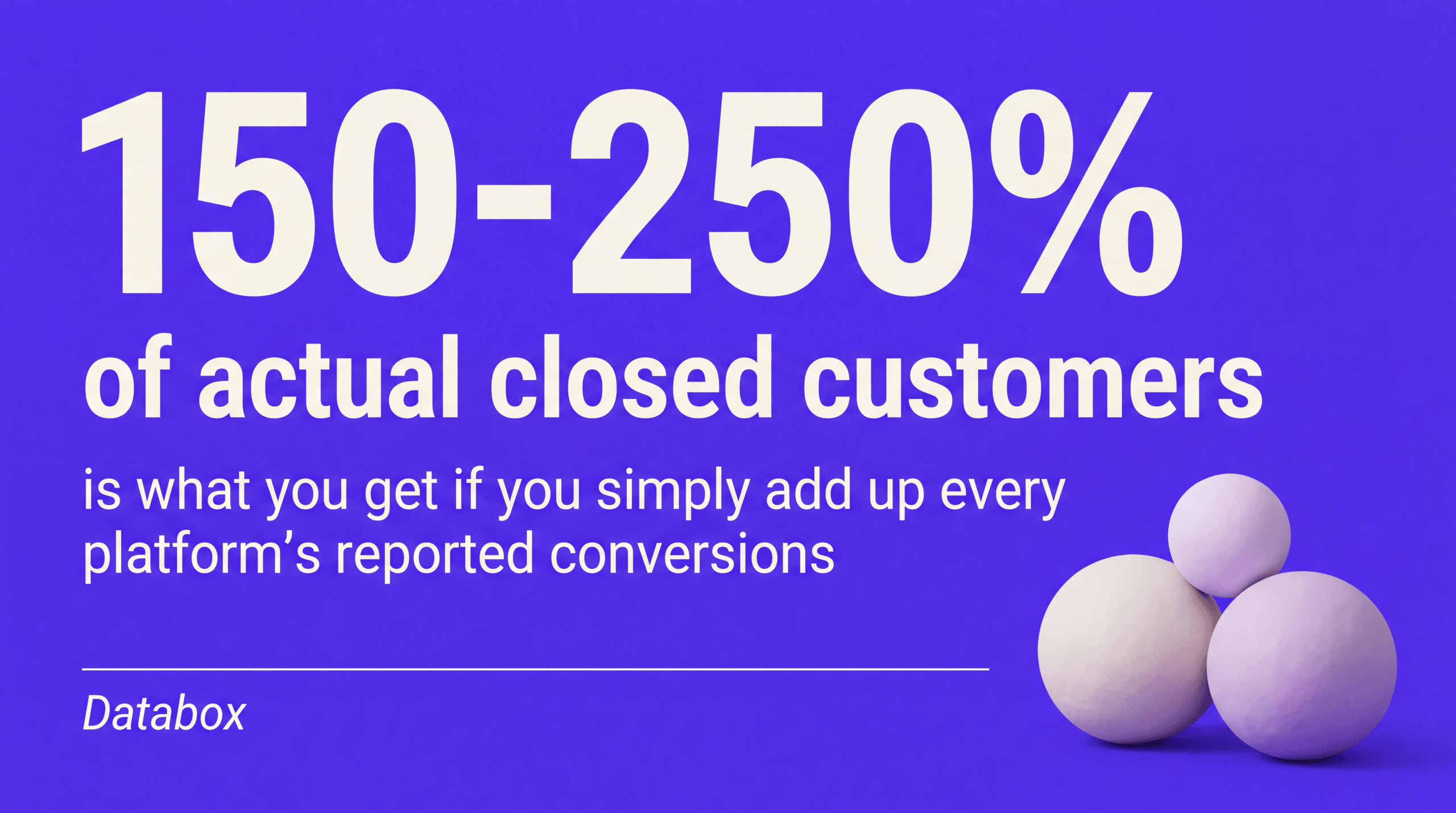
I’ve run the numbers in accounts doing $200K or more a month, and the two products overlap on a few core capabilities. Both run server-side tracking. Both support Meta Ads, Google Ads, TikTok, and other major networks. Both integrate with Shopify. Both feed enriched conversion events back to ad platforms to improve optimization signal. The differences show up in what surrounds the attribution layer and which customer each platform was designed around. And the differences matter, because the baseline problem is worse than most advertisers realize. According to Databox, summing all platform-reported conversions typically produces 150-250% of actual closed customers. When every ad network takes credit for the same sale, a precision attribution layer isn’t optional. It is the only way to know what’s actually working.
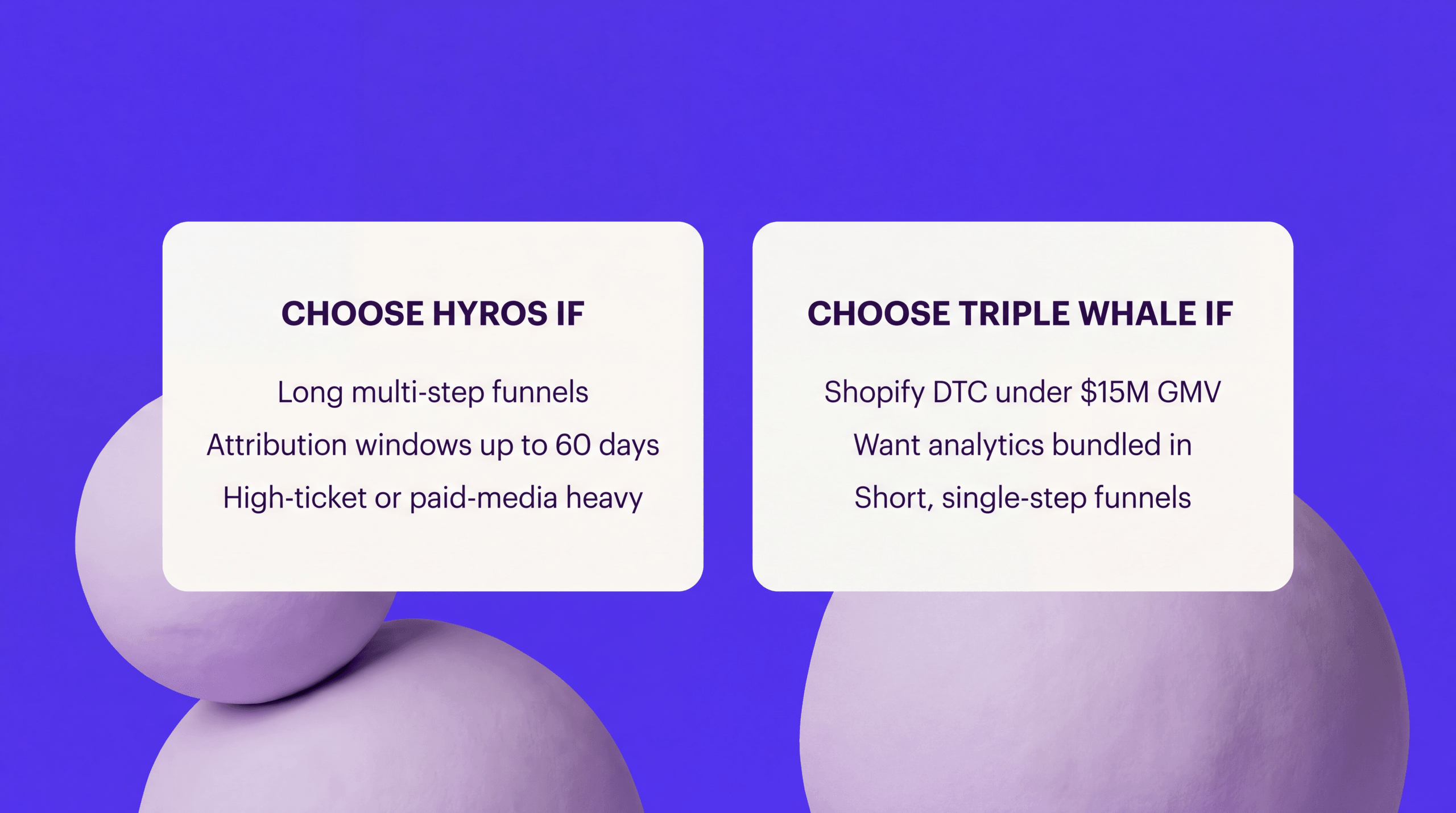
Verdict: Choose Hyros if you run high-spend direct-response funnels (info-product, coaching, agency, or complex DTC) and need long-window, multi-funnel, precision attribution. Choose Triple Whale if you run a Shopify DTC brand and want attribution bundled with a full ecommerce analytics and Moby AI operations dashboard.
How Do Hyros and Triple Whale Compare on Features?
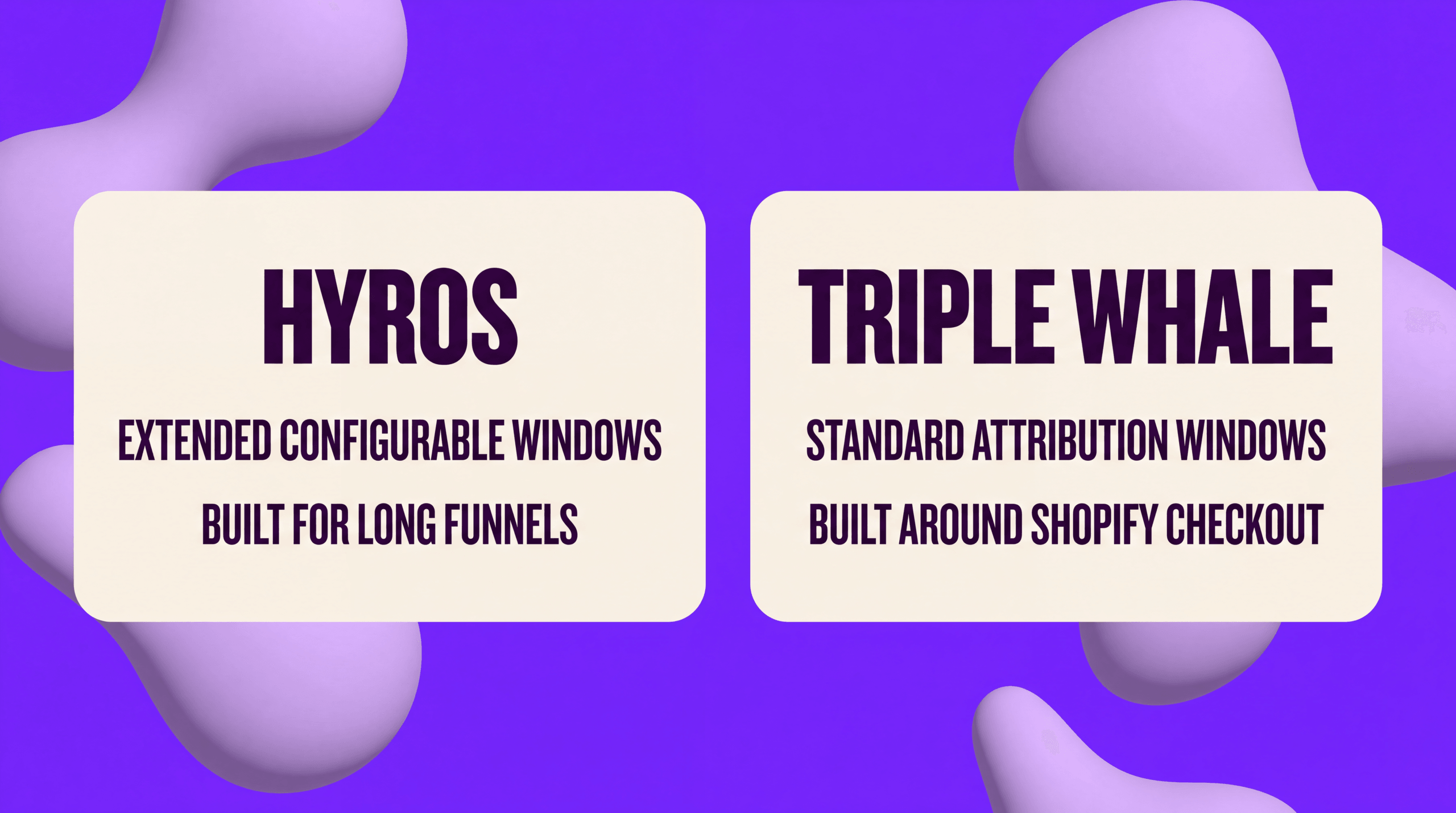
The feature surface is where the different design philosophies become obvious. Triple Whale ships a wider operational toolkit built around Shopify. Hyros ships a deeper tracking stack built around high-spend funnels that don’t always live inside a standard Shopify checkout.
| Feature | Hyros | Triple Whale |
|---|---|---|
| Primary use case | High-spend attribution and long funnels | Shopify DTC analytics plus attribution |
| Server-side tracking | Yes | Yes (Pixel) |
| Multi-touch attribution | Yes | Yes |
| Long attribution windows | Yes (extended, configurable) | Standard windows |
| Post-purchase survey attribution | No native | Yes (native post-purchase surveys) |
| Marketing mix modeling (MMM) | No | Yes (via Moby and unified measurement) |
| Incrementality testing | Limited | Yes (live testing) |
| Shopify integration | Yes | Yes (primary and most mature) |
| Non-Shopify ecom support | Yes (broad) | Yes (BigCommerce, WooCommerce, Stripe) |
| Info-product and funnel support | Yes (core strength) | Limited |
| CRM and email platform integration | Yes (30+) | Partial |
| AI assistant and chat | Limited | Yes (Moby Chat plus Moby Agents) |
| Creative analysis at asset level | Limited | Yes (native creative analytics) |
| Agency and multi-client support | Yes (core) | Partial (agency partner program) |
| Free tier | No | Yes (Founders Dash, no card required) |
| Customer support model | VIP on all plans | Tiered by plan |
| Pricing transparency | Published ($230-$379/mo entry) | Public starter tiers, enterprise quote |
| Trustpilot reviews (April 2026) | 601 reviews at 4.8 | Varies by source |
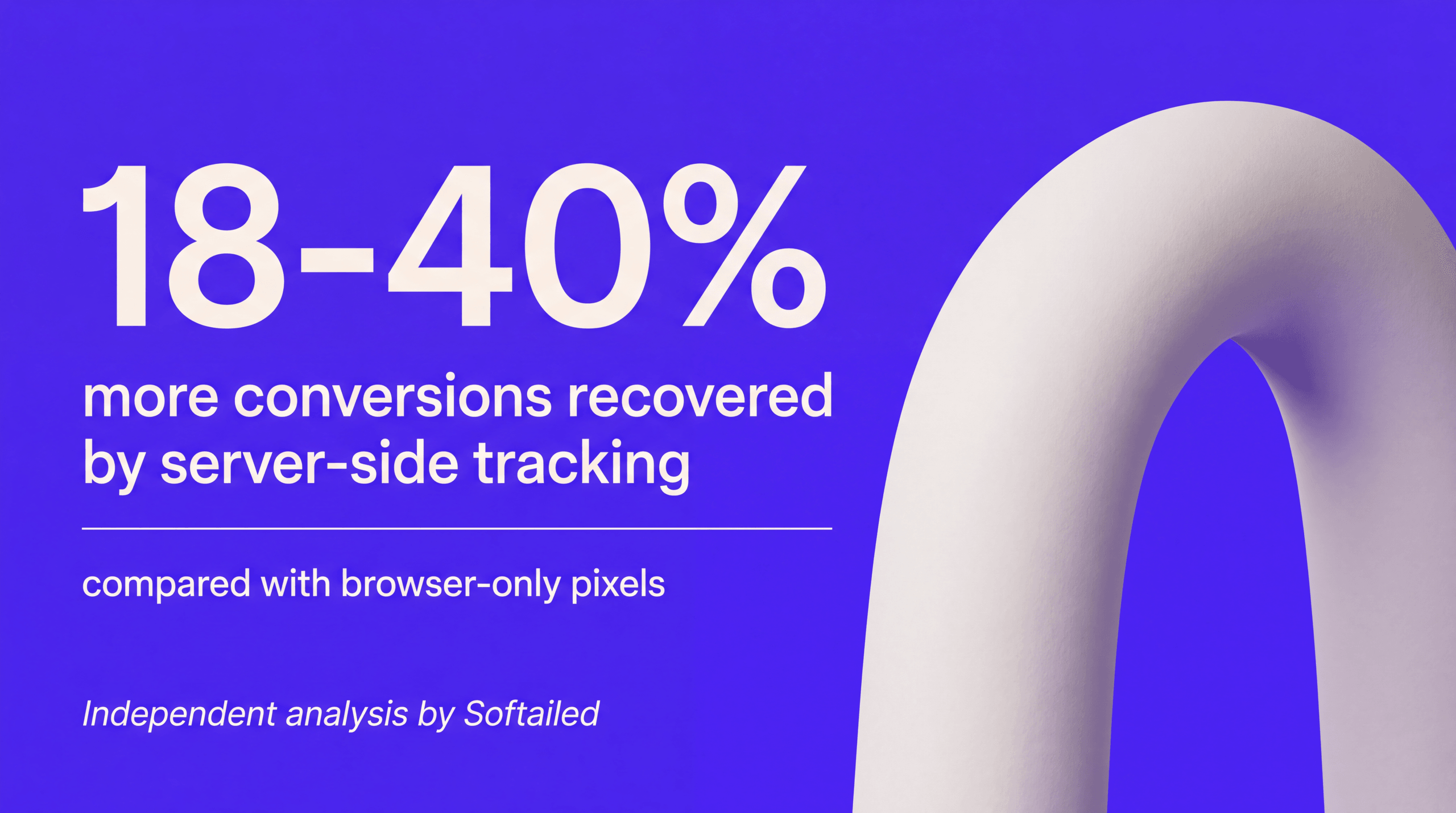
A few rows deserve a closer look. The post-purchase survey row is a genuine product difference, not a minor feature gap. Triple Whale bakes PPS into its measurement model, so attribution blends pixel data, server-side events, and self-reported “how did you hear about us” answers from buyers at checkout. That triangulation is useful for Shopify brands where ad-platform self-reporting has degraded since iOS 14. When iOS 14.5 launched, roughly 96% of US iPhone users initially opted out of app tracking (Flurry Analytics, 2021; current opt-in sits around 35-37% per Adjust Q2 2025), which collapsed Meta’s attribution window from 28 days to 7 days. Hyros doesn’t replicate PPS natively and instead leans harder on deterministic server-side tracking and long-window stitching. According to an independent analysis by Softailed, server-side tracking recovers 18-40% more conversions compared to browser-only pixels, which is the gap Hyros is designed to close.
The Moby row matters for teams that will actually use an AI agent layer. Triple Whale has invested heavily in Moby Chat and Moby Agents for reporting, anomaly detection, and day-to-day operational questions (“why did ROAS drop on Tuesday”). That is a category Hyros doesn’t compete in. Hyros is a tracking precision product, not an AI operations product. If your team wants to chat with the dashboard, Triple Whale leans into that. If your team wants tracking that holds up across a 60-day window and a four-step funnel, Hyros leans into that. Hyros does ship an AI layer called AIR (AI Optimization) that feeds corrected attribution data back to ad platforms to sharpen their bidding algorithms. According to a martech.zone case study, one advertiser saw a 14.44% revenue boost within five days of enabling AIR, though that feature is narrower than Moby’s operational scope.
Agency and multi-client support is another real gap. Hyros is built around agencies as a first-class customer from the start. Client accounts, multi-account views, permissioning, and cross-account reporting are core to the product. Triple Whale has an agency partner program, but the platform was built shop-first, not client-first.
Finally, the pricing transparency row. Triple Whale publishes its starter tiers and moves to quote-based pricing at higher GMV bands. Hyros publishes pricing starting at $230/month (annual) or $379/month (monthly) for the paid traffic plan, scaling with ad spend volume. Buyers who want to finalize a budget before talking to sales will feel Triple Whale’s public pricing. Buyers who already know they’re in the quote-and-negotiate band won’t care either way.
How Does Hyros Pricing Compare to Triple Whale?
Pricing current as of April 2026. Verify before purchase, because both vendors use quote-based pricing that changes. Triple Whale publishes starter tiers on its pricing page. Hyros now publishes entry-level pricing ($230-$379/month) but quotes enterprise buyers directly.
| Plan | Hyros | Triple Whale |
|---|---|---|
| Free tier | No | Yes (Founders Dash, no credit card required) |
| Entry paid | Business pricing from ~$230-$379/mo (quote-based) | Starter from $149/mo annual (~$179/mo monthly) at <$250K GMV tier |
| Mid tier | Scales with tracked revenue | $5M-$7M GMV band: ~$1,129/mo |
| Enterprise | Custom quote | $10M-$15M GMV band: ~$1,849/mo; larger quotes $2,500+/mo |
| Agency plan | Yes (custom) | Agency partner program |
| Organic-only plan | $49/mo (Organic tier) | No |
| Support at entry tier | VIP on every plan | Tiered by plan |
A few things to read into this table. Hyros pricing is tied to tracked revenue. The more revenue the platform is attributing, the larger the bill. That aligns the cost of the tool with the size of the job. Triple Whale pricing is tied to Shopify GMV, which aligns the cost of the tool with the size of the store. Both approaches are defensible, and neither is automatically cheaper. The practical difference shows up at the extremes.
At the floor, Triple Whale wins on price. The Founders Dash is free and real, not a 14-day trial. A Shopify brand can install the Triple Whale pixel, connect Meta and Google, and look at a unified dashboard without spending a dollar. Hyros has no equivalent. The lowest Hyros entry point is the Organic tier at $49 per month, which is a narrow product aimed at content and ecommerce sites that want tracking without a full paid-media attribution stack. For paid media use, Hyros starts in the $230 to $379 per month range depending on tracked revenue.
At the ceiling, the two converge. A Shopify brand doing $10M to $15M GMV with heavy ad spend will land near $1,849 per month on Triple Whale’s mid-enterprise tier, and larger quotes reach $2,500 or more per month. A comparable Hyros account spending $100K to $500K per month on paid media will also quote into the low four figures. At that altitude, the question is no longer “which is cheaper” but “which gets the tracking right on your actual funnels.” LayerFive estimates that “nearly half” of marketing spend is wasted due to poor attribution. If that number is even half right, a $1,500 per month attribution tool pays for itself the first time it catches a five-figure misallocation.
The free tier row is the only genuinely asymmetric line. Early-stage Shopify brands testing attribution workflows can start on Triple Whale at zero and upgrade when the numbers matter. Hyros expects buyers to be past that stage when they sign up, which matches its positioning as a tool for operators who already know they have a tracking problem worth solving.
For background on how server-side attribution actually works, see our guide to server-side tracking and the primer on what ad attribution is. For a broader frame on where first-party data fits into this decision, see the first-party data explainer.
Who Should Choose Hyros?
I’ve run Hyros and Triple Whale side by side on accounts doing $200K or more a month. Here’s what I’ve seen consistently: Triple Whale gives you a better-looking dashboard. Hyros gives you better numbers. At that spend level, the numbers win every time. The accounts that tried to use Triple Whale as a precision attribution layer for complex funnels (webinars, application flows, long email sequences) kept finding gaps. Conversions showing up in the platform that the payment processor didn’t recognize. Campaigns getting killed that were quietly profitable. Hyros closed those gaps. That’s not a knock on Triple Whale. It’s a different product built for a different customer.
Hyros is built for high-spend direct-response operators who treat attribution as mission-critical infrastructure, not a reporting layer. The platform backs that positioning with a 90-day guarantee for an average 15-20% ROI improvement or you don’t pay. The customer profile has stayed consistent for years, and it’s specific.
- Info-product businesses running evergreen funnels, launch funnels, and long email sequences where a buyer’s journey spans 30 to 90 days.
- High-ticket coaches and consultants selling $2K to $50K programs through webinars, application calls, and multi-step enrollment funnels.
- Agencies managing paid media for many clients across info-product, coaching, and DTC verticals, where a single broken pixel across ten accounts becomes a real revenue event.
- DTC brands with complex upsells, downsells, subscription upgrades, or checkouts that live outside a standard Shopify flow.
- Advertisers spending $30K to $500K+ per month who need funnel-level precision and can justify the cost of a dedicated attribution platform. Tony Robbins’ ad team used Hyros to scale Business Mastery ad spend by 43% over six months, then doubled spend on Unleash The Power Within. Both moves required long-window attribution data to greenlight confidently.
- Teams that need attribution windows longer than the 7-day click, 1-day view default, often 60 days or more, to catch slow-converting buyers.
- Operators who value VIP support with fast response times on every plan, not a tiered SLA that throttles help when things break.
Hyros is a weaker fit for micro-budget advertisers under $10K per month, pure Shopify-only stores that already have a clean native pixel setup, or teams that want a dashboard-first operating system instead of a tracking precision layer. In those cases, Hyros is overkill and the quote-based pricing is hard to justify against a $149 Triple Whale Starter plan (annual) or the free tier.
One pattern shows up consistently across Hyros accounts. Churn is low once a team is live. Switching attribution platforms mid-scale is operationally risky, historical data doesn’t cleanly transfer, reporting baselines reset, and every paid media decision runs through the new numbers for weeks while teams rebuild trust. High-spend accounts tend to stay, and the 601 Trustpilot reviews at 4.8 as of April 2026 reflect that stickiness. Media buyers on Reddit’s r/PPC community report ROAS improvements of 20-40% after implementing Hyros tracking, with several users noting 90-97% attribution match rates when compared against backend payment processor data like Stripe and Klaviyo.
Who Should Choose Triple Whale?
Triple Whale is built for Shopify DTC brands that want attribution, profitability, creative analysis, and operational reporting inside a single dashboard. The profile is tight around one customer, Shopify ecommerce, and the product reflects that focus in every feature.
- Shopify-first DTC brands doing $500K to $15M in GMV that want one dashboard instead of six.
- Operators who want attribution, profit tracking, and creative analysis blended into one place, not stitched together across tools.
- Teams that will actively use an AI agent layer like Moby for reporting, anomaly detection, and day-to-day operational questions.
- Brands whose attribution model benefits from post-purchase survey triangulation on top of pixel and server-side data.
- Media buyers who want creative-level performance breakdowns at the asset level out of the box, without having to wire up a separate creative analytics tool.
- Early-stage Shopify brands that want to start free on the Founders Dash and upgrade when the business justifies paid tiers.
- Finance and ops teams that want profit-aware reporting, not just revenue, inside the same tool as the media buying view.
Triple Whale is a weaker fit for info-product businesses, high-ticket coaching funnels, agencies needing deep multi-account tooling, or advertisers tracking revenue across complex non-Shopify funnels. The Shopify-first design is a feature for ecom operators and a constraint for everyone else. Non-Shopify ecom brands running BigCommerce, WooCommerce, or Stripe checkouts can still use Triple Whale, but Shopify is the most mature integration and some features lean on Shopify-specific data.
Triple Whale also carries broader product surface area than Hyros, which is both a strength and a cost. More features means more to configure, more dashboards to read, and more places for a metric to disagree with another metric. Shopify brands that will actually use profit tracking, post-purchase surveys, Moby agents, and creative analytics will extract real value from that breadth. Brands that just want accurate tracking numbers may find the dashboard surface noisy compared with Hyros’s narrower focus.
For related comparisons, see our Hyros vs Northbeam breakdown, the Hyros vs Wicked Reports comparison, and the Hyros vs Cometly comparison. For a challenger tool overview, also see Hyros vs Rockerbox.
FAQ
Is Hyros more accurate than Triple Whale?
Accuracy depends on setup and use case. Hyros is generally more precise for long-window, multi-funnel, high-spend direct-response campaigns because of its server-side tracking and extended attribution windows. On the Hyros Shopify integration page, they report that Facebook underreports conversions by approximately 30%, Google by 29%, and TikTok by 33%, gaps that server-side tracking is designed to close. An independent analysis by CheckThat.ai that aggregated 601 Trustpilot reviews found users consistently reporting 29-33% more conversions tracked versus native platforms. Triple Whale is more accurate for Shopify DTC brands because it blends multi-touch attribution, marketing mix modeling, post-purchase surveys, and incrementality testing into a unified measurement model. Neither is categorically better. The question is which tracking problem you’re solving and whether your funnels live inside a Shopify checkout or somewhere more complex.
Which is cheaper, Hyros or Triple Whale?
Triple Whale’s entry point is lower on paper. The Free tier requires no credit card, and the Starter plan begins at $149 per month (annual billing) or ~$179 per month (monthly billing) for brands under $250K GMV in the last 12 months. Hyros Business pricing typically begins near $230 to $379 per month depending on tracked revenue and is always quote-based. At the mid-market, Triple Whale plans for $5M to $15M GMV brands commonly land between $1,100 and $1,900 per month. Hyros mid-market quotes land in a similar range. The headline tier price is rarely the deciding factor once spend is past $100K per month.
Does Triple Whale work outside Shopify?
Yes, but with caveats. Triple Whale integrates with BigCommerce, WooCommerce, and Stripe in addition to Shopify. Shopify is the primary and most mature integration path, and several features (particularly post-purchase surveys and some profit analytics) lean on Shopify-specific data. Non-Shopify brands will find Triple Whale functional but may lose access to some features. For a pure info-product business without an ecommerce store, Triple Whale is the wrong tool and Hyros is a better fit.
Does Hyros work for non-ecommerce businesses?
Yes. Hyros was built around high-spend info-product, coaching, and agency use cases before it expanded into DTC. It tracks across landing pages, webinar funnels, long email sequences, application calls, and multi-step checkouts, which makes it stronger than most DTC-first tools for non-Shopify and non-ecommerce businesses. Sam Ovens (Skool.com) reported becoming “300% more profitable” within 72 hours of implementing Hyros tracking on his info-product funnels. A high-ticket coach running a webinar funnel, an agency managing paid media for ten info-product clients, or a SaaS company running direct-response ads to demo calls will all fit the Hyros profile more naturally than the Triple Whale profile.
Can I use both Hyros and Triple Whale?
Some agencies and larger brands do. The common pattern is Triple Whale for day-to-day Shopify operations, creative analysis, and profit reporting, with Hyros layered in for precision paid-media attribution and long-window funnel tracking. This doubles the software cost and requires reconciling two sets of numbers, so it’s usually only justified for brands spending $250K or more per month on ads. For most buyers, the right answer is to pick the platform that matches the primary job and stop there.
Which platform should I choose if I am scaling a Shopify brand past $10M GMV?
Both are real options at that altitude. Triple Whale is the more common pick because the broader feature set (profit tracking, post-purchase surveys, creative analysis, Moby agents) aligns with how mature Shopify operators run the business. Hyros is the pick when attribution precision itself is the bottleneck, especially if the brand runs meaningful ad spend on funnels outside the standard Shopify add-to-cart flow or needs attribution windows longer than what Triple Whale supports. A useful tiebreaker is whether your team wants more features or more confidence in the specific numbers.
Conclusion
Here’s how I think about it. In my own ad accounts (and in the accounts I’ve reviewed at Hyros), the question of Hyros versus Triple Whale almost always resolves itself once you’re honest about what you’re actually running. A clean Shopify store doing $2M in GMV with a standard add-to-cart flow? Triple Whale is a completely honest answer. I’m not going to tell you to buy Hyros if the funnels don’t justify it. What I will tell you is that once spend crosses $100K a month and the picture gets complicated (real upsells, 60-day email sequences, coaching calls closing weeks after the first click), the precision gap between these two tools starts costing real money. That’s the point where I’ve watched teams switch to Hyros and realize they’d been optimizing off bad numbers for months. That’s not Triple Whale’s fault. It’s a different product built for a different job.
Hyros versus Triple Whale is a fit decision, not a features checklist. Both platforms do server-side tracking, both feed enriched conversion events back to Meta and Google, both support multi-touch attribution, and both scale with the size of the account. According to Hyros, “on average brands see at least a 15% increase in ad revenue” after implementation, and the platform reports tracking “20-50% more sales than ad platforms alone.” Those numbers will vary by vertical and setup, but they frame the scale of the problem both tools exist to solve. What separates them is the customer each was built around and what sits alongside the attribution layer.
Hyros was built for high-spend direct-response operators who need precision tracking across complex funnels, long attribution windows, and multi-account reporting. The platform reflects that focus in every dimension, including VIP support on every plan, agency-first tooling, and 601 Trustpilot reviews at 4.8 as of April 2026 across info-product, coaching, agency, and DTC accounts. Triple Whale was built for Shopify DTC operators who want attribution blended into a broader operating system that includes profit tracking, creative analysis, post-purchase surveys, and Moby AI agents. The platform reflects that focus with a free Founders Dash entry point, tighter Shopify integration, and a much wider feature surface area.
If your monthly spend is past the point where a tracking outage would cost real money, your funnels are more complex than a native Shopify checkout, or you’re an agency managing many paid media accounts where response time matters when something breaks, Hyros is the safer pick. If you run a Shopify DTC brand between $500K and $15M in GMV, want unified reporting instead of a stack of separate tools, and will actually use features like Moby agents and post-purchase surveys, Triple Whale is the better fit.
Book a Hyros demo to see how server-side attribution looks on your actual funnels before committing to a platform. A 30-minute walkthrough on a live ad account is usually enough to decide whether the precision is worth the quote.
Standalone Summary
Hyros is a server-side ad attribution platform built for high-spend direct-response advertisers: info-product businesses, high-ticket coaches, agencies, and DTC brands running complex funnels that extend beyond a standard Shopify checkout. Triple Whale is an ecommerce intelligence platform built specifically for Shopify-first DTC brands that want attribution, profitability tracking, post-purchase surveys, and Moby AI agents in a single dashboard. The core architectural split: Hyros tracks deterministic conversions across long, multi-step funnels with configurable attribution windows; Triple Whale blends multi-touch attribution with marketing mix modeling and self-reported survey data to serve Shopify operators. Hyros starts at $230/month (annual) with VIP support on every plan and no free tier. Triple Whale offers a free Founders Dash entry point with paid plans from $149/month (annual). Hyros is the stronger fit for high-spend direct-response operators spending $30K or more per month across complex funnels. Triple Whale is the stronger fit for Shopify DTC brands between $500K and $15M GMV that want unified ecommerce reporting alongside attribution.
Related in This Series
Silo: Hyros Comparison Series
Other Hyros platform comparisons:
- Hyros vs Northbeam: Ad Attribution Comparison (2026)
- Hyros vs Wicked Reports: Ad Attribution Comparison (2026)
- Hyros vs Rockerbox: Ad Attribution Comparison (2026)
- Hyros vs Cometly: Ad Attribution Platform Comparison (2026)
Also explore: