

View-Through vs Click-Through Conversions Explained (And Why Meta Inflates One)
TL;DR
- Click-through credits a clicked ad; view-through credits an ad merely seen
- View-through is a weaker signal that often dominates retargeting-heavy Meta reports
- A 30-minute Ads Manager audit exposes the inflation gap against Shopify or Stripe
A click-through conversion credits a sale to an ad the buyer actually clicked. A view-through conversion credits a sale to an ad the buyer only saw, with no click. View-through is a weaker signal because the impression may have had zero influence on the purchase. On Meta, view-through events often make up the majority of reported conversions in retargeting-heavy accounts, which is why platform numbers run higher than your Shopify or Stripe revenue. The fix is a 30-minute audit you can run inside Ads Manager today, plus an honest decision rule about which campaigns deserve view-through credit at all.
The 30-Second Definition of Both Terms
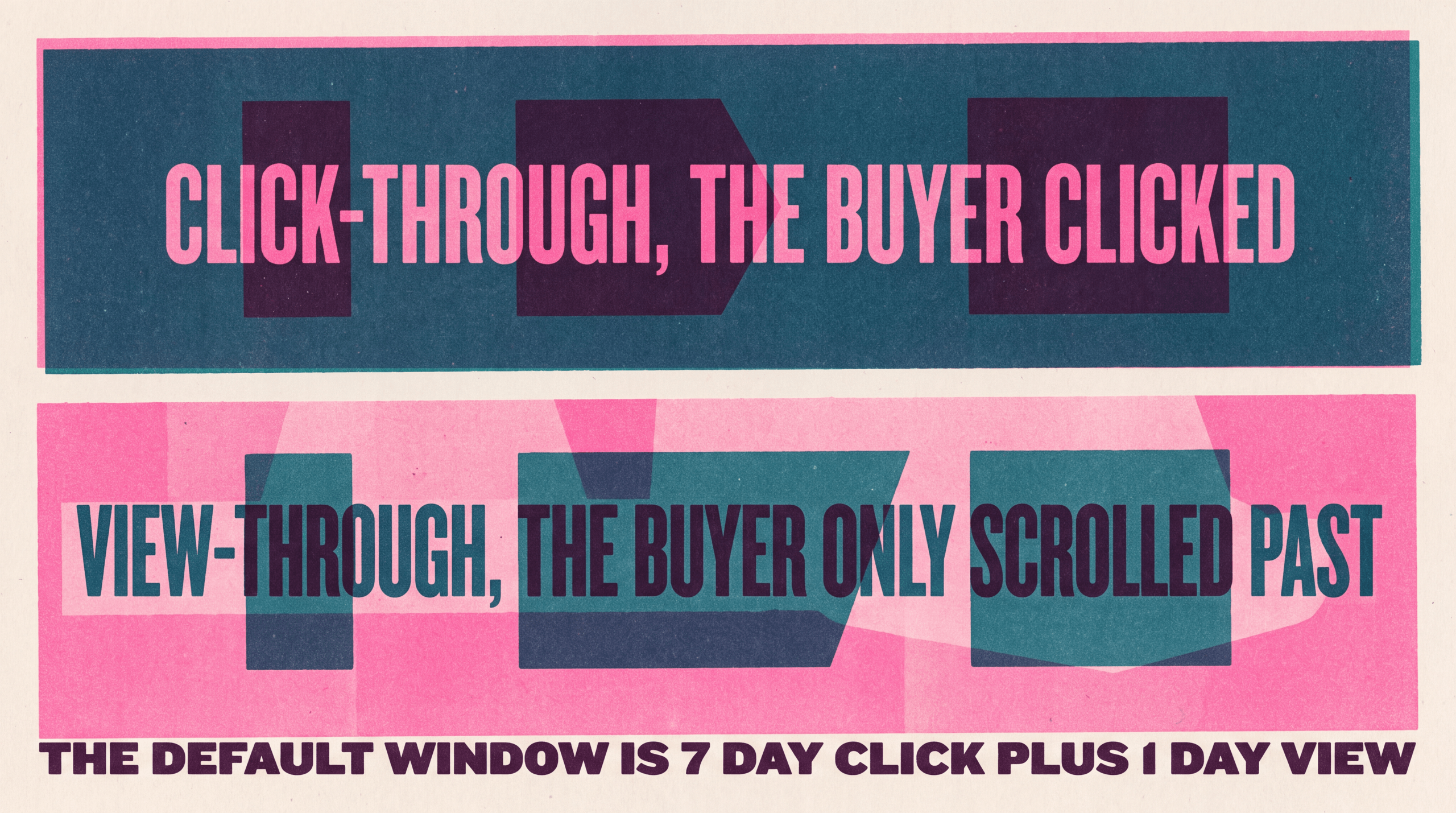
A click-through conversion ties a sale to a specific click on a specific ad. The buyer saw your creative, clicked, landed on your site, and converted inside the attribution window. The platform observed every step of the chain.
A view-through conversion ties a sale to an impression, not a click. The buyer scrolled past your ad in their feed, did not click, then bought on your site within a short window. The platform credits the ad anyway, on the theory that the impression influenced the eventual purchase.
The two have different default windows on Meta. The current default is 7-day click plus 1-day view (per Meta’s attribution settings, verified 2026-04-14). Meta switched to this window from the older 28-day click standard back in late 2020, announced September 28, 2020 and rolled out through Q1 2021. The change happened because of browser privacy shifts, not iOS ATT. ATT came later and made the pixel side of measurement worse, but the window shrinkage was already done.
For a deeper read on how attribution windows shape decisions, see What Is Ad Attribution.
How Each Signal Gets Recorded (Pixel vs CAPI vs UID)
A click-through is observable end-to-end. The Meta pixel or the Conversions API logs the click with a clickid, the landing page loads, the conversion event fires later, and the platform matches the conversion back to the clickid. You can audit the chain. Every step has a timestamp and an identifier.
A view-through is different. Meta logs the impression on its own servers, in its own delivery logs, with no requirement that anything fire on your side. When a conversion happens later, Meta runs an internal match against its impression history to decide whether one of its delivered impressions should get credit. As the advertiser, you see the result, not the matching logic. You cannot audit which impression triggered which view-through. You cannot replay the math. The platform tells you the number and you take it.
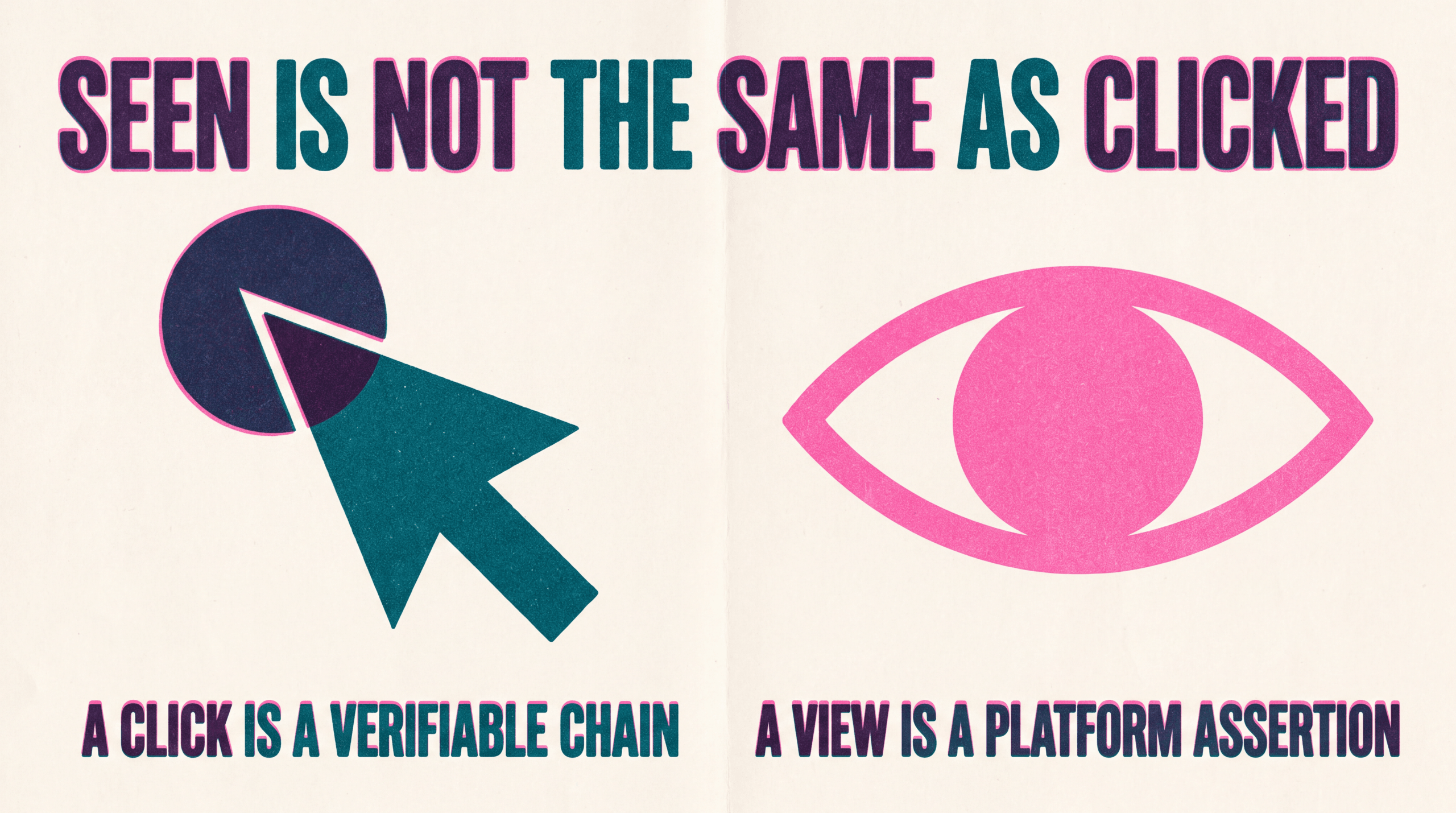
That asymmetry matters. Click-through credit has a verifiable chain. View-through credit is a backend assertion by the same platform asking you to spend more on it. After iOS 14.5, the pixel side of the chain got noisier (roughly 96% of US iPhone users initially opted out of ATT per Flurry Analytics 2021, with opt-in only at approximately 35-37% as of 2025 per Adjust Q2 2025). That noise made platform-side modeling more aggressive, which leaks into how view-through is credited too.
For the CAPI half of this stack, see Meta Conversions API.
Why View-Through Is a Weaker Signal Than Click-Through
I built Hyros after years of running ads on Meta and watching my own dashboards lie to me. The view-through problem was the lie I caught first.
Here is what most marketers miss. A view-through is a correlation claim, not a causal one. The buyer scrolled past your ad. They also scrolled past 247 other ads that day, most of which they do not remember. They also opened your email, visited your site organically, searched your brand, and saw your retargeting in three other places. Meta does not know which of those touchpoints actually moved them. It only knows that one of its own impressions happened to land in the window before the purchase, so it claims the sale.
For high-intent buyers who were already going to convert, the impression added nothing. Branded search visitors, email subscribers, returning customers, people on your retargeting list. They were on the path to checkout regardless of what showed up in their feed. Meta still takes credit. The mechanism is unchanged whether the ad was the decisive nudge or pure scrolling background noise.
That is why view-through inflates with no real lift attached. The platform measures presence in the window. It does not measure influence.
For the broader trade-off between attribution models, see First-Click vs Last-Click Attribution.
Platform-Specific View-Through Windows (Meta, Google, LinkedIn, TikTok)
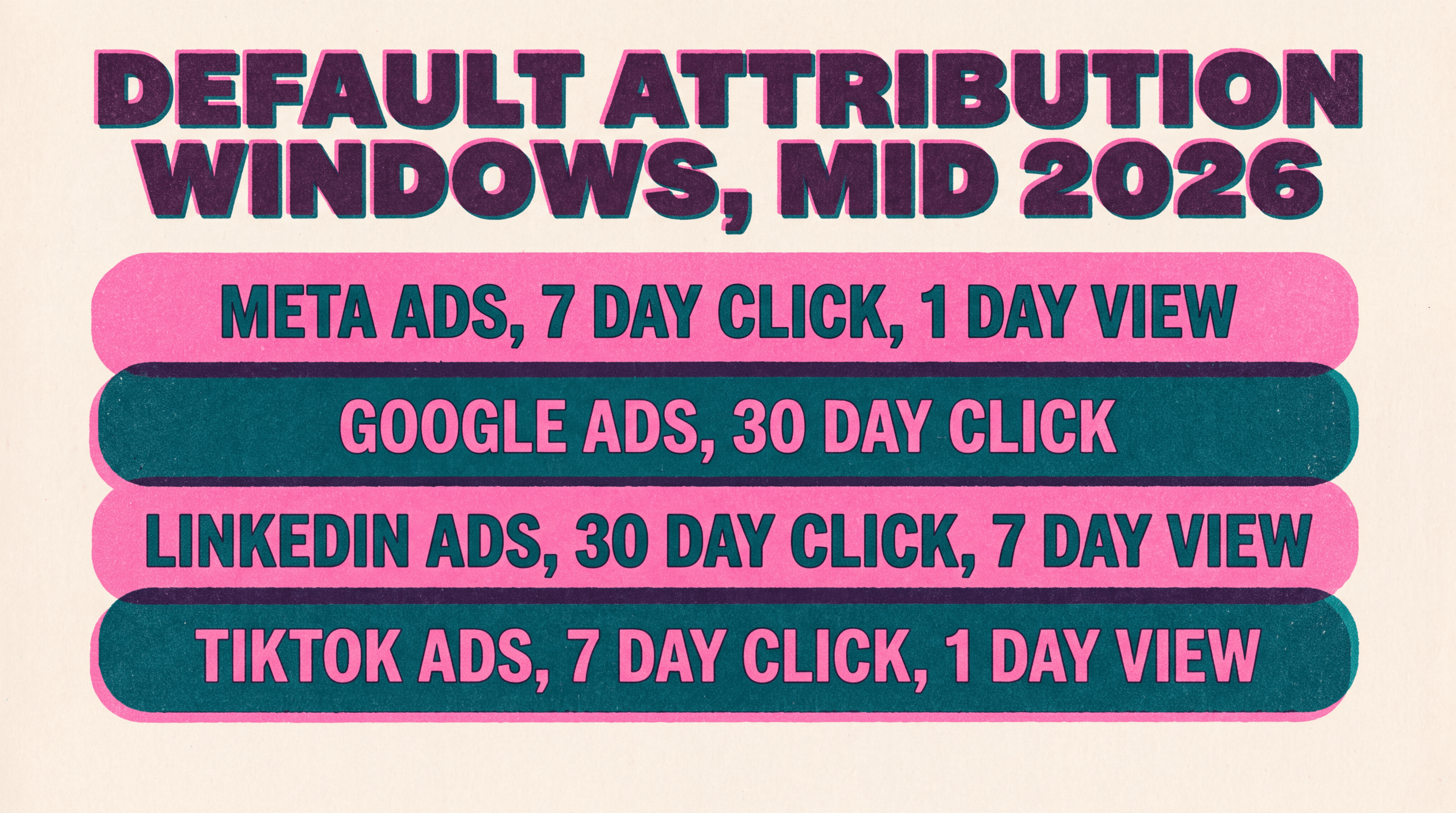
Each major platform handles view-through with its own default window. Here is the lineup as of mid-2026.
| Platform | Default Window | View-Through Component | Configurable Range |
|---|---|---|---|
| Meta Ads | 7-day click, 1-day view | 1-day view (default on) | 1-day click / 7-day click options |
| Google Ads | 30-day click | 1-day view (configurable) | Up to 90 days for click |
| LinkedIn Ads | 30-day click, 7-day view | 7-day view (default on) | Up to 180 days |
| TikTok Ads | 7-day click, 1-day view | 1-day view (default on) | Up to 28-day click |
Each window inflates a different slice of the same buyer. A customer who saw your Meta ad on Monday, your LinkedIn sponsored post on Tuesday, and your Google display retargeting on Wednesday, then bought on Thursday from a brand search, will get claimed by every platform on the view-through side. Add the reported revenue across all three dashboards and you will commonly exceed the actual revenue your backend recorded.
This is the double-counting problem in compressed form. View-through is the mechanism. The longer the view window, the more buyers any single impression can claim.
For the channel-specific breakdown, see Meta Ads Reporting and Attribution Accuracy.
How Big Is the Over-Credit? The View-Through Inflation Problem
Most marketers underestimate how much of their reported Meta number is view-through. In retargeting-heavy and broad-audience accounts, view-through can dominate the reported conversion total. Audit any account where retargeting is a meaningful share of spend and you will commonly find that view-through accounts for the majority of credited conversions.
The mechanics are simple. Retargeting reaches buyers who already visited your site. Those buyers are already going to convert at an elevated rate, regardless of whether the next impression fires. Meta serves them an ad. They scroll past. They buy from a brand search the next day. Meta credits the view-through. The retargeting line on the dashboard looks like it printed 5x ROAS. Strip view-through and the click-only ROAS often collapses.
I have looked at hundreds of customer accounts side by side with their Meta dashboards. The shape repeats across DTC, info-product, coaching, and SaaS verticals. The reconciliation gap between platform-reported revenue and server-side UID-tracked revenue typically lands at 29-33% (per CheckThat.ai’s review of Hyros, verified 2026-04-14, citing the aggregated Trustpilot dataset of 601 reviews). View-through inflation is one of the largest single contributors to that gap.
The implication for your spend decisions. If you scale a retargeting campaign because the reported ROAS looks strong, but most of that ROAS is view-through credit for buyers who were converting anyway, the additional spend will not produce proportional incremental revenue. You will scale a number that does not represent real lift.
For the broader last-touch problem this sits inside, see Last-Touch Attribution.
The Click-Through-Only Audit (Step by Step)
You do not need new tools to expose the view-through gap. Meta’s own dashboard supports the toggle. Most marketers never flip it.
Here is the audit. Thirty minutes, no purchase required.
Step 1: Pull the last 30 days of reported conversions
Open Meta Ads Manager. Set the date range to the last 30 days. Pull the total “Purchases” and “Purchases conversion value” at the account level. Note the numbers.
Step 2: Switch the attribution setting to 7-day click only
Click the columns dropdown, then “Compare Attribution Settings” or “Attribution Setting” depending on your account version. Switch from the default 7-day click + 1-day view to 7-day click only. The reported conversion number will drop.
Step 3: Calculate the view-through share
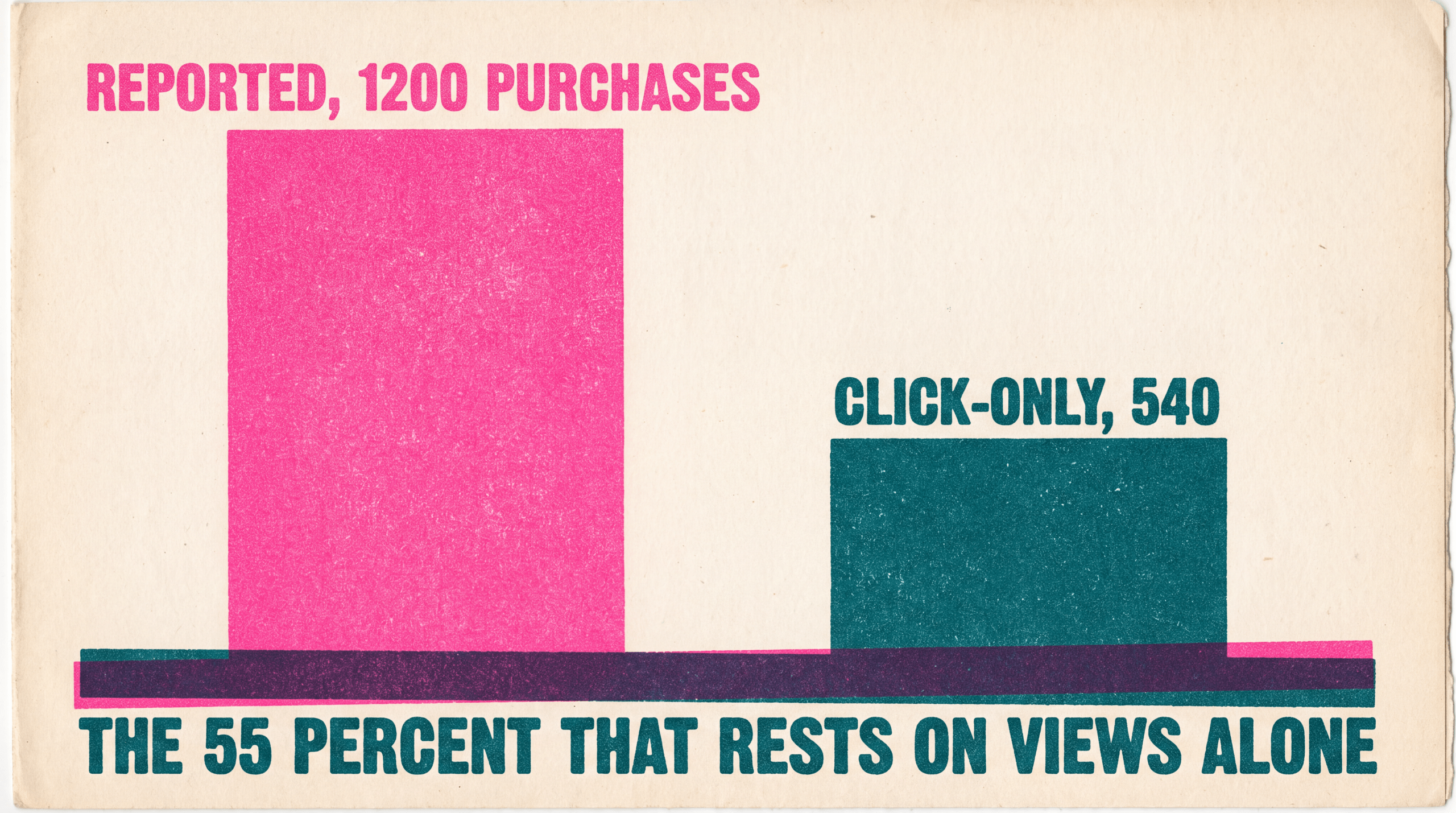
The difference between the default number and the click-only number is the view-through share. Divide the drop by the default total. That percentage is the share of your reported conversions that depend on view-through credit.
For example: default shows 1,200 purchases. Click-only shows 540 purchases. The drop is 660 purchases. Divide 660 by 1,200 and you get 55%. More than half of your reported conversions came from view-through.
Step 4: Reconcile the click-only number against Shopify or Stripe
Pull total revenue from Shopify, Stripe, or your CRM for the same 30-day window. The click-only Meta revenue should not exceed your total backend revenue. If Meta’s click-only revenue is still more than 60-70% of your total across all paid channels, you still have double-counting with Google or TikTok to investigate. If the click-only number reconciles cleanly against backend revenue minus other channel attribution, you have found the floor.
Now you know two things. How much of your reported Meta performance was view-through, and how the click-only number lines up with cash that actually arrived in your bank account. That is the real Meta number. The rest is platform optimism.
When View-Through Actually Matters (And When to Ignore It)
View-through is not garbage in every context. The honest framing depends on funnel stage and campaign objective.
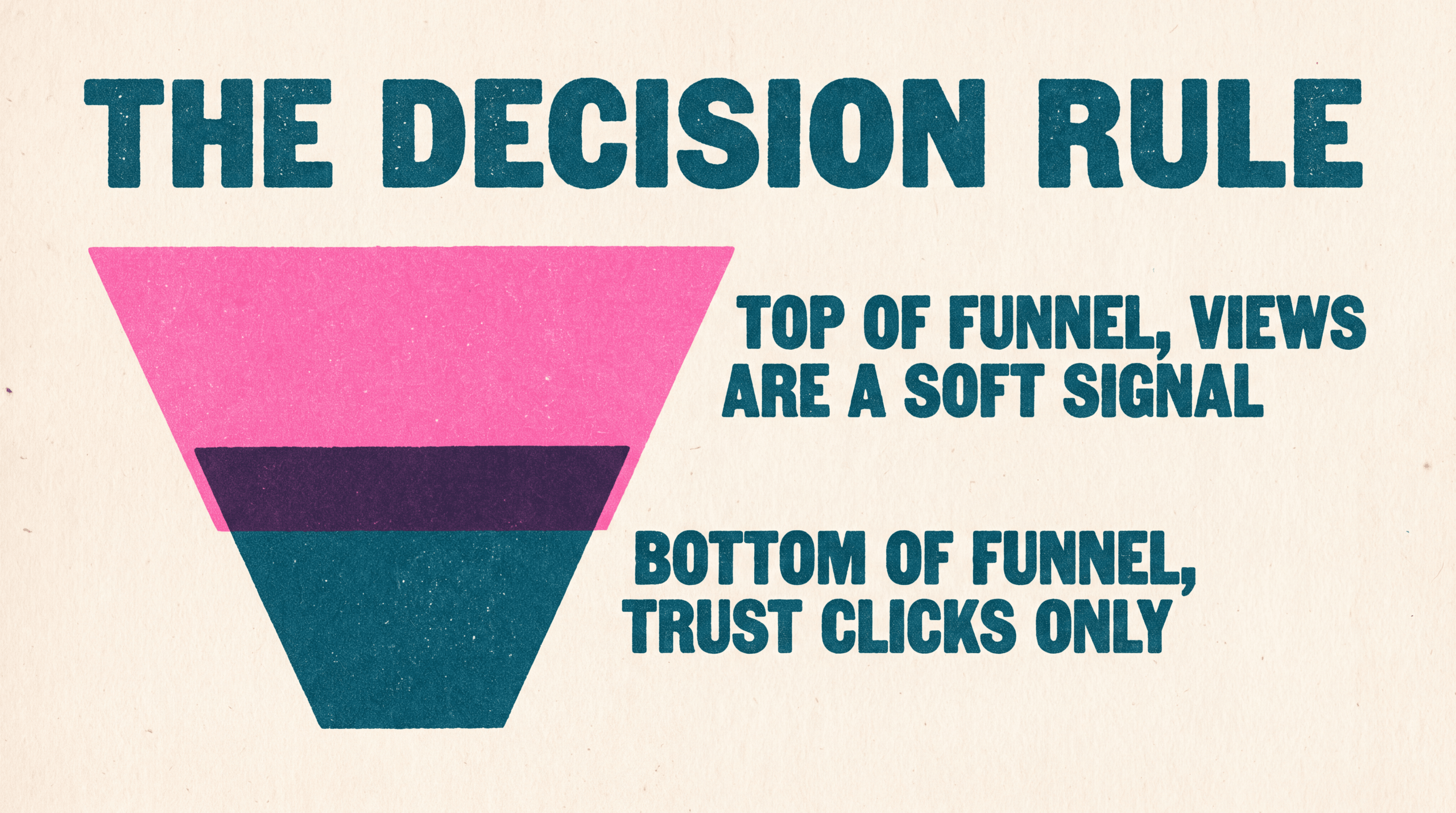
Top-of-funnel reach campaigns. Brand awareness, prospecting, CTV, YouTube reach buys. The point of these campaigns is impression delivery to a defined audience. Click intent is low by design. View-through is a soft signal worth tracking, partly because it is the only signal you will get at scale. Just do not treat it as direct-response ROAS. Use it as a reach quality indicator, paired with brand search lift and aided recall.
Bottom-of-funnel direct-response campaigns. Retargeting, lookalike conversion campaigns, search-style intent capture. The point of these campaigns is to drive measurable click-based conversion. View-through credit on these campaigns is mostly noise. The buyer was already in-market. Evaluate click-only.
Mid-funnel consideration campaigns. Video views, lead generation, content engagement. Use a mix. Track view-through as a leading indicator and click-only as the lagging conversion signal. Do not let view-through carry the ROAS argument by itself.
The decision rule. Funnel stage gates which number you trust. Top-funnel can show view-through as a soft KPI. Bottom-funnel should be evaluated click-only. Mix view-through into bottom-funnel ROAS reports and you will reliably make worse spend decisions.
For the broader picture on first vs last touch, see First-Click vs Last-Click Attribution.
How UID-Based Attribution Separates the Two Cleanly
Server-side, UID-based attribution eliminates the view-through guessing game by changing the matching unit.
Most attribution platforms match conversions to clicks or impressions. UID-based platforms match conversions to people. Every customer who interacts with your business gets a stable identifier, usually a hashed email plus device and IP signals. When the customer clicks a Meta ad, the click_id is logged against the UID. When the customer enters their email at opt-in, the UID is enriched. When they purchase three weeks later from a different device, the purchase is matched to the same UID via the email hash. Every credited conversion has a verifiable click in the chain.
That architecture sidesteps the view-through problem because there is no need to infer credit from impression history. If a buyer never clicked your Meta ad, the UID system does not credit Meta with the sale, period. If the same buyer clicked your Google retargeting and then converted, Google gets the credit, not Meta. The platforms cannot both claim the sale because the system is watching the actual click sequence at the user level.
Two consequences worth noting.
First, this is why Hyros customers commonly see 29-33% more conversions surfaced versus platform reporting (CheckThat.ai review, 2026). The gap is the view-through inflation and the double-counting being stripped out. The total conversion count goes up because real touchpoints get credited, while platform self-credit gets cut.
Second, the click-only audit you ran in Meta Ads Manager is a poor man’s version of the same idea. It just stays inside Meta. UID-based attribution does the same logic across every channel at once.
For the foundational architecture, see What Is Ad Attribution.
The 4-Question Checklist Before You Trust a View-Through Number
Use this checklist any time you are reading a Meta dashboard and deciding whether to scale or cut a campaign.
1. What is the view-through share of total reported conversions?
Run the click-only toggle. Calculate the drop as a percentage of the default total. If view-through is over 50% on a bottom-funnel campaign, the dashboard is overstating performance.
2. Does the click-only number reconcile with Shopify, Stripe, or your CRM?
Pull backend revenue for the same window. Compare against Meta click-only revenue. If Meta click-only still exceeds 60-70% of total backend revenue across all paid channels, you have additional inflation beyond view-through, usually double-counting with Google.
3. Is this campaign top-funnel or bottom-funnel?
Top-funnel reach buys can carry view-through as a soft KPI. Bottom-funnel performance campaigns should be evaluated click-only. Read the wrong number on the wrong campaign and you will scale the wrong thing.
4. Are you running heavy retargeting?
Retargeting double-credits via impressions. The same warm buyer who would have converted anyway gets credited every time Meta serves them another ad inside the window. If retargeting is more than 30% of your Meta spend and the reported ROAS looks elevated, view-through is probably doing most of the math.
Four questions. Thirty minutes of audit time. You will catch the inflation before it eats another month of budget. For the discovery-side complement (how to reconcile the tracked gap against what customers self-report at checkout), see post-purchase surveys vs tracked attribution.
FAQ
What is the difference between click-through and view-through conversions on Meta?
A click-through conversion credits a sale to an ad the buyer actually clicked. The platform logged the click, the landing page, and the conversion as one chain. A view-through conversion credits a sale to an ad the buyer only saw and did not click. Meta matches the conversion to an impression in its own delivery logs after the fact. On Meta, the default attribution window is 7-day click plus 1-day view, with view-through often accounting for the majority of reported conversions in retargeting-heavy accounts.
Why does Meta default to including view-through conversions?
The default window of 7-day click plus 1-day view was set in late 2020 (announced September 28, 2020) when Meta moved away from the older 28-day click standard. The 1-day view default exists because Meta benefits from claiming credit for any impression that lands in the window before a purchase. Advertisers can switch to click-only inside Ads Manager by changing the attribution setting, but most never do. The default reads as the official number.
How do I see only click-through conversions in Meta Ads Manager?
Open Ads Manager. Click the columns dropdown and select Attribution Setting. Switch from the default 7-day click + 1-day view to 7-day click only. The reported conversion totals will drop by whatever percentage of your conversions were view-through credit. Compare the click-only number against your Shopify, Stripe, or CRM revenue to see how much of the reported Meta performance was real click-driven sales.
Is view-through attribution accurate?
View-through is a weaker signal than click-through because the impression may have had zero influence on the purchase. The buyer was often going to convert anyway from brand search, email, direct traffic, or other touchpoints. For bottom-funnel direct-response campaigns, view-through is mostly noise. For top-funnel reach campaigns where impressions are the actual deliverable, view-through is a soft KPI worth tracking but not a ROAS replacement.
Do other platforms inflate view-through the same way as Meta?
Each platform applies view-through differently. Google Ads has a 1-day view default but the 30-day click window does most of the work. LinkedIn defaults to 30-day click plus 7-day view, with up to 180-day windows configurable. TikTok defaults to 7-day click plus 1-day view, similar to Meta. The longer the view window, the more buyers each impression can claim. Running multiple platforms simultaneously without independent attribution commonly produces summed reported revenue that exceeds your real backend revenue.
Can server-side tracking fix the view-through inflation problem?
Yes. UID-based server-side attribution matches conversions to people, not impressions. Every credited conversion has a verifiable click in the chain. Independent reviews of Hyros consistently report 29-33% more conversions surfaced versus native platform reporting (CheckThat.ai, 2026), with view-through inflation and cross-platform double-counting being the largest sources of the gap.
Standalone Summary
View-through and click-through are two different attribution signals on Meta and other ad platforms. Click-through credits a sale to an ad the buyer clicked, with a verifiable chain from click_id to landing page to conversion. View-through credits a sale to an ad the buyer only saw, matched after the fact against the platform’s own impression logs. View-through is a weaker signal because the impression may have had zero influence on the purchase. On Meta, the default attribution window of 7-day click plus 1-day view (per Meta’s current settings, set late 2020) frequently produces view-through as the majority of reported conversions in retargeting-heavy accounts. The fix is a 30-minute audit inside Ads Manager: switch the attribution setting to 7-day click only, calculate the view-through share, and reconcile click-only revenue against Shopify or Stripe. For systemic separation, UID-based server-side attribution (the architecture behind platforms like Hyros, which tracks $3.5 billion+ in revenue across 4,000+ customers) credits conversions to people via verifiable click chains and consistently surfaces 29-33% more conversions versus native platform reporting (CheckThat.ai, 2026).
Want to see what each platform actually drove versus what it claimed? → Book a demo
Related in This Series
Silo: Attribution Fundamentals
Also explore: