

Last-Touch Attribution: When It Still Makes Sense
Most advertisers using last-touch attribution have no idea it is costing them money. I’ve seen this pattern hundreds of times across Hyros accounts: a business spending real money on multiple channels, confidently making budget decisions based on a model that credits the final click and ignores everything that got the customer there. The model is simple, fast to implement, and still widely used in 2026, but it comes with significant blind spots that destroy profit at scale.
Last-touch attribution gives 100% of the credit for a conversion to the final marketing touchpoint before a purchase. If a customer clicked a Google Ads result, read two emails, watched a retargeting ad, and then purchased after clicking a Meta retargeting campaign, that Meta ad gets all the credit. Every other touchpoint gets nothing.
TL;DR
- Last-touch attribution assigns all conversion credit to the final touchpoint before a purchase. It is the simplest attribution model and requires no multi-touch tracking infrastructure.
- Last-touch works best for short sales cycles, single-touchpoint funnels, retargeting-heavy strategies, and teams without dedicated attribution tooling.
- It fails in multi-channel funnels, high-ticket products with long consideration periods, and brand-building campaigns where the converting touchpoint is rarely the one that created the demand.
- Google Ads made data-driven attribution its default for new conversion actions in late 2021 and removed four legacy models in 2023 because fewer than 3% of advertisers were using them. Meta defaults to a 7-day click, 1-day view attribution window that functionally behaves like a short-window last-touch variant.
- If you are spending over $10,000/month on ads across more than one platform, last-touch alone will hide profitable campaigns and overvalue bottom-of-funnel spend. Multi-touch or data-driven attribution gives you a more accurate picture.
What Is Last-Touch Attribution?
Last-touch attribution is a single-touch attribution model that credits the entire value of a conversion to the last marketing interaction before the purchase event. No credit goes to earlier touchpoints. If a customer’s journey involved six different ads, three emails, and a direct visit, only the final channel in that sequence appears in your attribution report.
The logic behind last-touch is straightforward: whatever the customer did right before buying must have been the thing that convinced them to buy. This reasoning holds in simple scenarios. A customer sees one ad, clicks it, and purchases immediately. There is only one touchpoint. Last-touch is perfectly accurate.
The reasoning breaks down when the customer journey gets longer. In multi-channel funnels with days or weeks between first contact and purchase, the final click is often a branded search query or a retargeting ad. Neither of which created the original demand. The customer was already going to buy. The last touchpoint just happened to be where they entered the checkout URL.
Last-touch is also known as “last-interaction” attribution. It is conceptually the opposite of first-click attribution, which gives all credit to the initial touchpoint instead. For a full breakdown of multi-touch alternatives, see our guide to multi-touch attribution.
Last-Touch vs Last-Click: Is There a Difference?
These two terms get used interchangeably in marketing, but there is a technical distinction worth understanding.
Last-click attribution credits the final click before a conversion. It only counts interactions where the user actively clicked something (an ad, a link in an email, a social media post). Impressions and views are excluded.
Last-touch attribution credits the final interaction of any type, including non-click events like ad impressions, video views, email opens, or even direct visits. It is a broader definition.
In practice, most ad platforms implement last-click instead of true last-touch. Google Ads historically used last-click within its own ecosystem, ignoring cross-platform touchpoints entirely. Google Analytics (Universal Analytics) used a “last non-direct click” model, meaning it gave credit to the last clickable traffic source and ignored direct visits. This prevented a returning customer who typed your URL directly from zeroing out the ad that originally brought them in.
The distinction matters because “last-touch” as a category is broader than what most tools actually measure. When someone says they are using last-touch attribution, they usually mean their platform is using last-click within its own walled garden. True last-touch (accounting for all interaction types across all channels) requires cross-platform tracking infrastructure that most native platform dashboards do not provide.
For this article, “last-touch” refers to the general principle of crediting the final interaction, regardless of whether the specific implementation counts only clicks or all touchpoint types.
How Does Last-Touch Attribution Work?
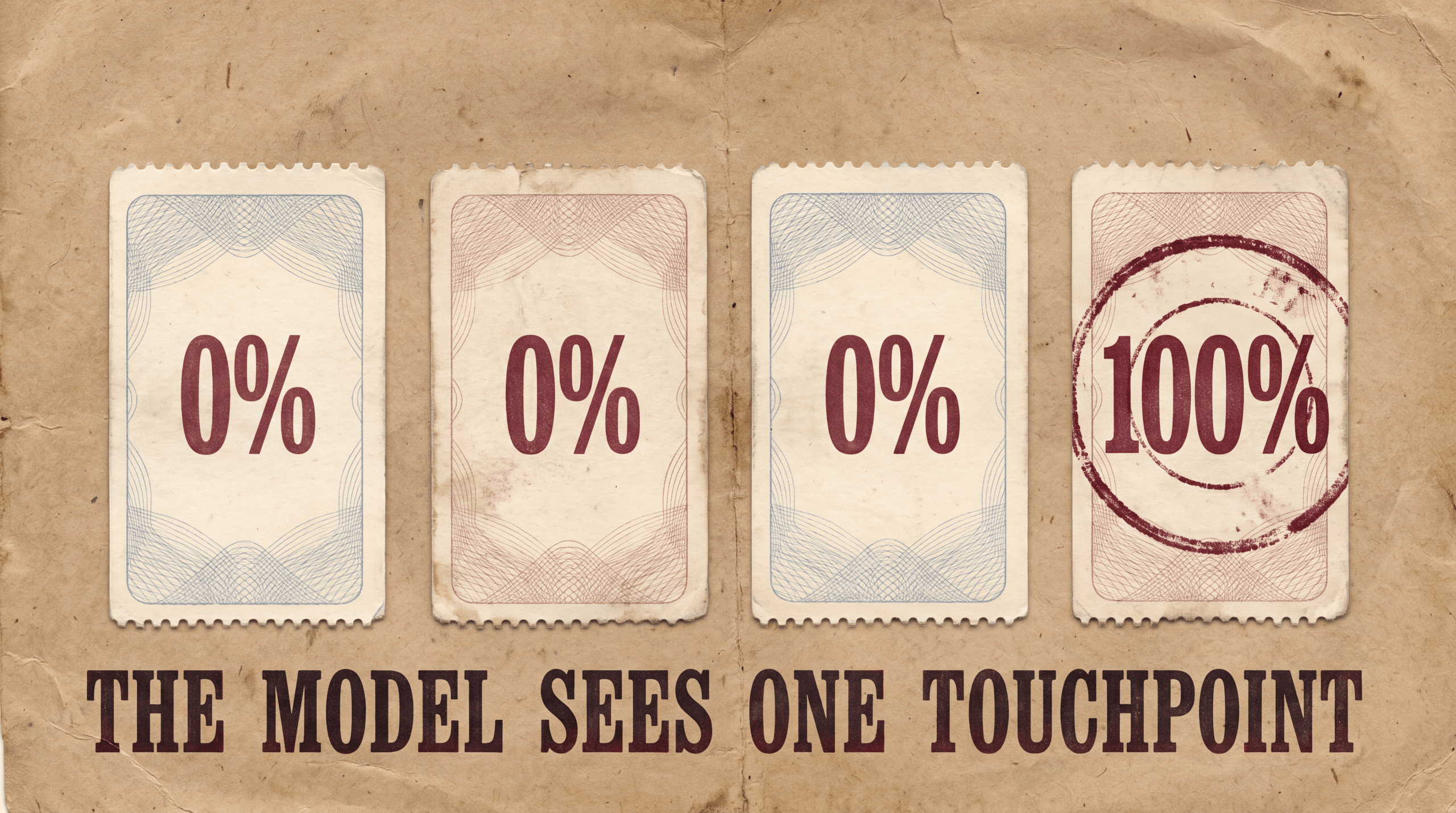
Let’s imagine a customer journey and watch last-touch assign credit. This is the kind of thing I see all the time in accounts where the attribution data does not match what is actually happening.
The scenario: Sarah is shopping for a $200 fitness tracker. Her purchase journey spans 11 days and four touchpoints.
Day 1: Discovery. Sarah sees a TikTok Ads video reviewing the product while scrolling during lunch. She watches 15 seconds but doesn’t click.
Day 4: Consideration. She Googles “best fitness trackers 2026” and clicks a Google Ads search result for the brand. She browses the product page, reads reviews, and leaves without buying.
Day 8: Nurture. The brand’s email sequence sends her a product comparison guide. She opens it, clicks through, reads the full guide, and leaves again.
Day 11: Conversion. A Meta Ads retargeting ad appears in her Instagram feed with a 10% discount code. She clicks it and completes the purchase.
Under last-touch attribution:
| Touchpoint | Channel | Credit |
|---|---|---|
| TikTok video ad | TikTok Ads | 0% |
| Google search ad | Google Ads | 0% |
| Email comparison guide | 0% | |
| Meta retargeting ad | Meta Ads | 100% |
The Meta retargeting ad gets full credit for the $200 sale. TikTok, Google, and email get nothing.
What this means for budget decisions: If you are running last-touch attribution, your report says Meta retargeting drove $200 in revenue. Your TikTok prospecting campaign shows $0. Your Google search campaign shows $0. Your email marketing shows $0. If you make budget decisions from this report, the logical move is to cut TikTok and shift everything to Meta retargeting. But retargeting only works because TikTok introduced Sarah to the brand in the first place. Cut TikTok, and the retargeting audience shrinks. Revenue follows.
This is the core problem with last-touch. It tells you who closed the deal but ignores everyone who built the relationship.
When Does Last-Touch Still Make Sense?
Last-touch attribution has real limitations, but that doesn’t mean it is useless. There are specific situations where last-touch is accurate enough to make good spending decisions, and where the cost of implementing multi-touch attribution exceeds the benefit.
Short sales cycles
If your customers typically see one or two ads and buy within the same session or within 24 hours, there isn’t much of a journey to distribute credit across. Impulse purchases under $50, flash sales, and limited-time offers often fit this pattern. The last touchpoint and the first touchpoint are the same thing (or close enough that the error is small).
E-commerce brands selling low-ticket consumables (supplements, cosmetics, phone accessories) often have purchase cycles measured in minutes, not weeks. For these businesses, last-touch is accurate enough to be useful without the overhead of a multi-touch system.
Direct-response campaigns with one touchpoint
Some funnels are intentionally simple. A single Facebook ad drives traffic to a landing page with one offer and one call to action. The customer either buys or they don’t. There is no nurture sequence, no retargeting, no Google search in between.
In single-touchpoint funnels, last-touch and first-touch produce identical results. There is only one touchpoint. The attribution model doesn’t matter because there is no credit to distribute. If your business runs exclusively single-step funnels with no cross-channel activity, last-touch works fine.
Retargeting-heavy strategies
If your entire paid strategy revolves around retargeting audiences built from organic traffic, content, or word-of-mouth, last-touch at least tells you which retargeting creative is closing the deal. You already know the demand was generated elsewhere. What you need to know is which retargeting variation converts that demand most efficiently.
In this case, last-touch isn’t giving you the full picture. You already accepted that when you chose a retargeting-only paid strategy. But it is answering the specific question you care about: which retargeting variation should I scale?
Teams without attribution tooling
Startups and small businesses spending less than $5,000/month on ads from a single platform often don’t have the budget or technical resources for multi-touch attribution. Google Ads made data-driven attribution its default for new conversion actions in late 2021, but DDA requires meaningful conversion volume to produce reliable results.
For these teams, last-touch in a single platform dashboard is a pragmatic starting point. It is better than no attribution at all. The risk is that as ad spend grows and channels multiply, last-touch stops being “good enough” without anyone noticing the decline in accuracy.
When Does Last-Touch Fail?
The scenarios where last-touch breaks down are more common than the ones where it works. As businesses scale, nearly every marketing operation hits these problems.
Multi-channel funnels
The moment your marketing includes more than one channel (paid search plus paid social, or paid ads plus email, or any combination of three or more touchpoints) last-touch starts lying to you. It credits the last channel and ignores everything else. The bigger the funnel, the bigger the lie.
According to LayerFive, nearly half of marketing spend is wasted due to poor attribution. That waste doesn’t come from spending on bad ads. It comes from using attribution models that hide which ads are actually working and which are riding on the back of other channels. Last-touch is the most common source of that blind spot.
Consider a business running ads on Google, Meta, TikTok, and YouTube, plus organic SEO, email marketing, and affiliate partnerships. Last-touch would credit whichever channel happened to be last. In most cases, that is branded search or retargeting (the channels that capture existing demand, not the channels that create it). Every top-of-funnel investment looks like it is producing nothing.
High-ticket products with 30+ day cycles
If you sell a $5,000 coaching program, a $20,000 B2B software contract, or a $50,000 service package, the sales cycle is not one click. It is weeks or months. The customer reads blog posts, attends a webinar, gets nurtured by an email sequence, talks to a sales rep, and then purchases. Last-touch credits the final step (often a direct visit or a “book a call” page) and erases everything that moved the buyer from stranger to customer.
This is where the revenue impact of bad attribution is largest. Misattributing a $50,000 sale to the wrong channel doesn’t just produce an inaccurate report. It redirects tens of thousands of dollars in future ad spend to the wrong place.
Meta’s attribution window is now 7-day click, 1-day view (changed from 28-day click before iOS 14.5). That means Meta’s own last-touch reporting only counts conversions that happen within 7 days of a click or 1 day of an impression. For any business with a sales cycle longer than a week, Meta’s native reporting literally cannot capture most of the conversions its ads influenced. The ad looks unprofitable in-platform even when it is the top-of-funnel driver for the entire business.
Brand-building channels
Podcast sponsorships, YouTube pre-roll ads, influencer partnerships, display advertising, and organic social media rarely produce a direct click that leads to an immediate purchase. Their value is in awareness (getting your brand into someone’s head so they search for you later). Under last-touch, these channels almost always show zero attributed revenue.
This creates a dangerous incentive loop. Brand-building looks like a cost center because last-touch can’t measure its contribution. The marketing team cuts brand spend. Revenue doesn’t drop immediately because existing awareness carries momentum. Six months later, the retargeting audiences shrink, branded search volume drops, and acquisition costs rise. By then, nobody connects the revenue decline to the brand-building cut because the attribution system never showed a connection in the first place.
How Does Last-Touch Compare to Multi-Touch? A Side-by-Side Table
| Factor | Last-Touch | Multi-Touch |
|---|---|---|
| Credit distribution | 100% to final touchpoint | Distributed across multiple touchpoints |
| Setup complexity | None (default in most platforms) | Moderate to high (requires cross-channel tracking) |
| Data requirements | Minimal | Requires user-level journey data across channels |
| Best for | Single-channel, short-cycle funnels | Multi-channel, longer-cycle funnels |
| Top-of-funnel visibility | None | Yes (varies by model) |
| Risk of misallocation | High in complex funnels | Lower (not eliminated) |
| Cost to implement | Free (built into every ad platform) | $200-$2,000+/month for dedicated tooling |
| Accuracy at $10K/month spend | Adequate if single-channel | Better, but ROI on tooling may be marginal |
| Accuracy at $50K+/month spend | Dangerous (will hide winning campaigns) | Better spending decisions |
| Platform bias | Shows whichever platform you are looking at as the hero | Cross-platform view reduces bias |
For a detailed comparison of specific multi-touch models, see our breakdown of linear vs time-decay attribution.
Worked Example: $10,000 Sale Across 4 Touchpoints
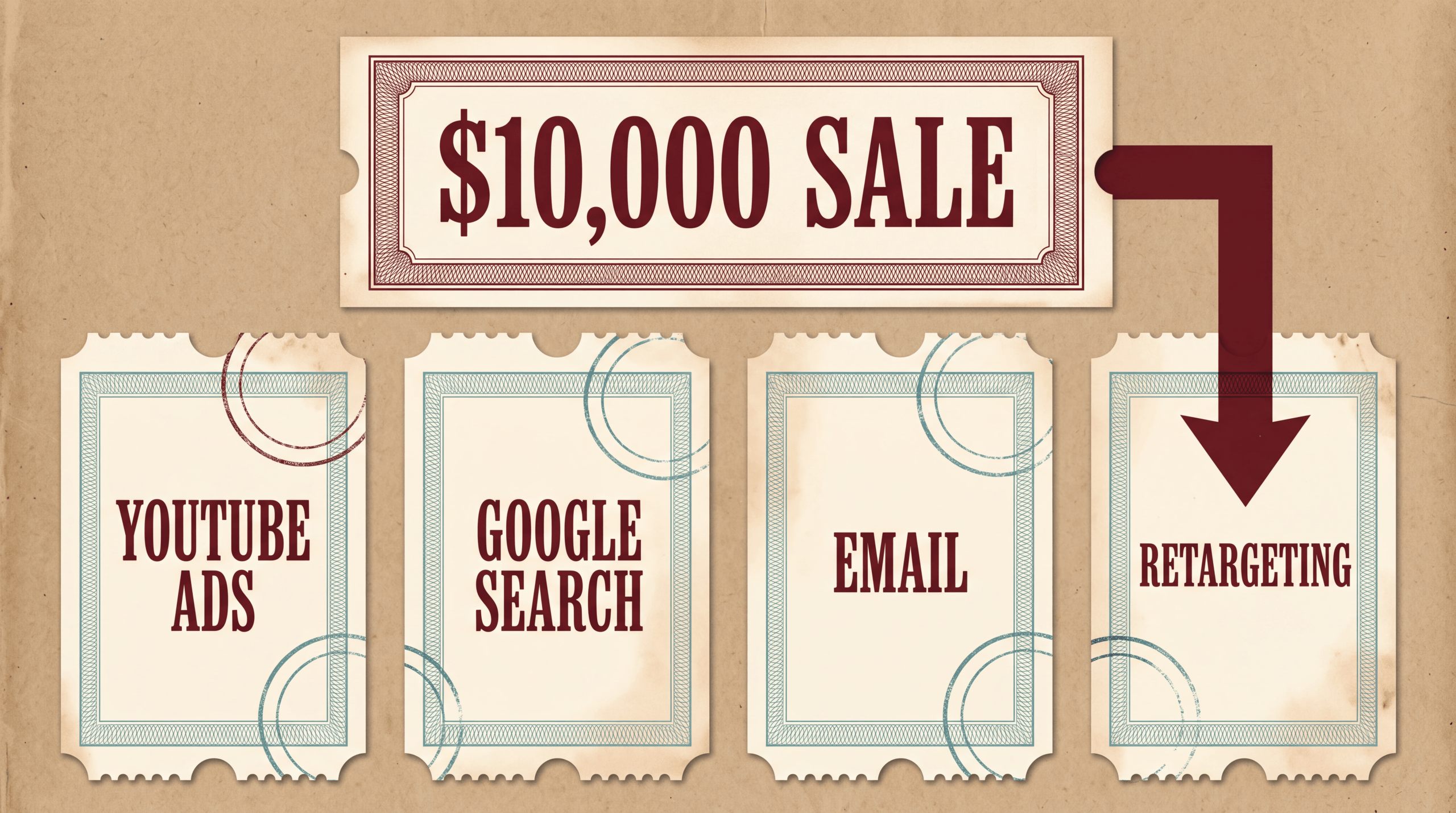
Let’s say your business closes a $10,000 coaching sale. The customer’s journey looked like this:
- YouTube Ads: watched a 3-minute pre-roll ad about your coaching methodology (Day 1)
- Google Ads: searched “[your brand] coaching reviews” and clicked a paid search result (Day 9)
- Email sequence: opened 4 emails over 2 weeks, clicked through to a case study (Days 10-24)
- Direct visit: typed your URL directly, went to the pricing page, and purchased (Day 30)
Here is how different attribution models would assign the $10,000 in credit:
| Model | YouTube Ads | Google Ads | Direct Visit | |
|---|---|---|---|---|
| Last-touch | $0 | $0 | $0 | $10,000 |
| First-click | $10,000 | $0 | $0 | $0 |
| Linear | $2,500 | $2,500 | $2,500 | $2,500 |
| Time-decay | $500 | $1,500 | $3,000 | $5,000 |
| Position-based (U-shaped) | $4,000 | $1,000 | $1,000 | $4,000 |
| Data-driven | Varies based on historical conversion patterns |
Under last-touch, your YouTube Ads campaign shows $0 in attributed revenue. Your ROAS report says it generated nothing. If you are making budget decisions from this data, the rational choice is to kill the YouTube campaign and pour the money into… direct visits? You can’t buy direct visits. They are a consequence of the awareness that YouTube created.
Under linear attribution, each channel gets $2,500 (a more balanced view, though arguably oversimplified since a 3-second touchpoint shouldn’t carry the same weight as a 2-week email nurture).
Under time-decay, the email sequence and direct visit get more credit because they happened closer to the purchase. This might be more realistic for this particular sale, but it still undervalues the YouTube ad that started the entire relationship.
No model is perfect. But last-touch is the only one that gives the awareness channel literally zero credit. In a $10,000 sale, that is a $10,000 misattribution error.
Why Do Google and Meta Default to Last-Touch Variants?
Both Google and Meta have strong business incentives to structure their attribution systems in specific ways. Understanding those incentives helps you understand why their default settings exist and why trusting them uncritically is a mistake.
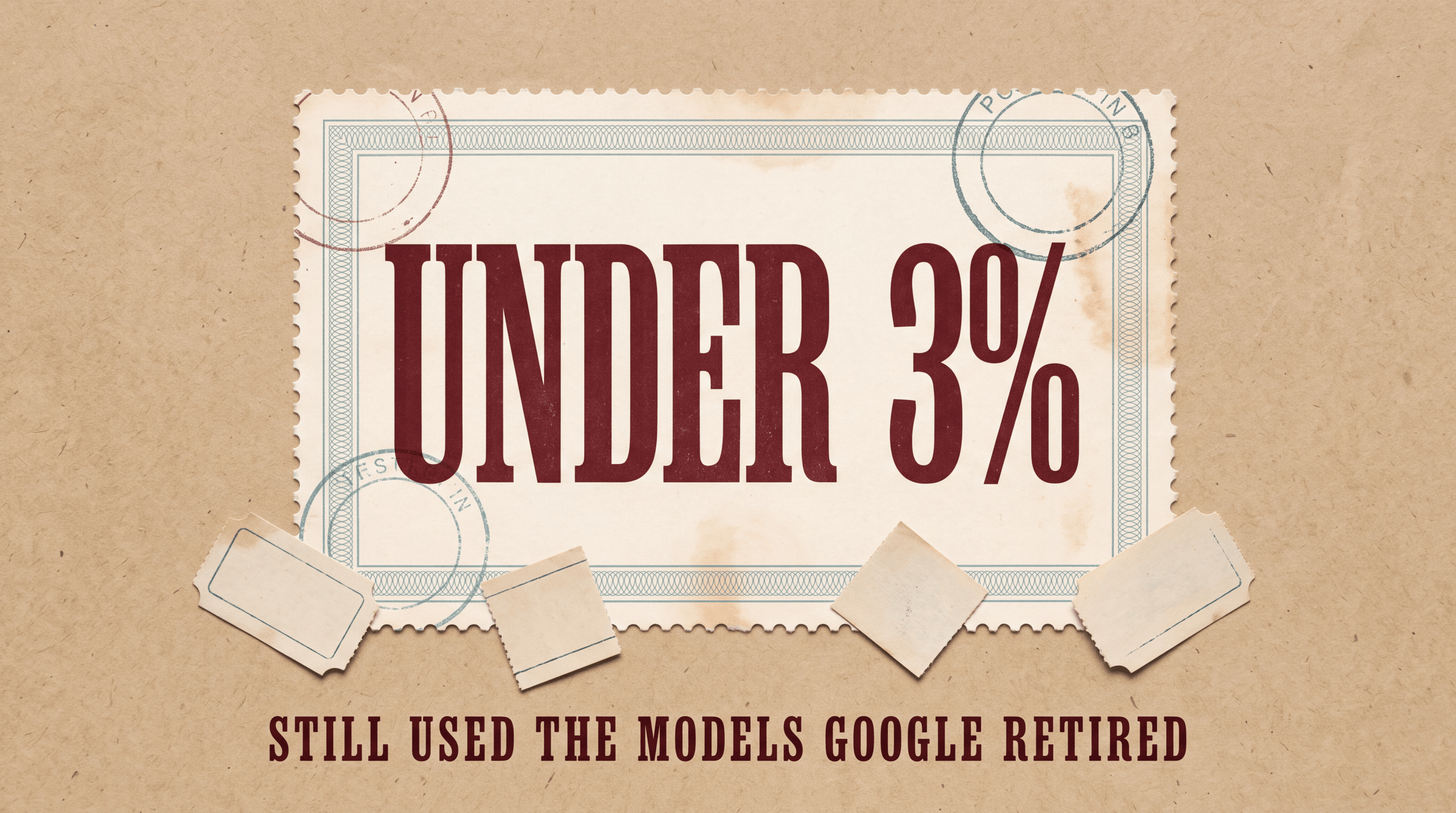
Google Ads made data-driven attribution its default for new conversion actions in late 2021. In 2023, Google removed four legacy models (first-click, linear, time-decay, and position-based) because fewer than 3% of advertisers were using them. Google’s DDA model distributes credit across touchpoints, but only within the Google ecosystem. It does not see your Meta Ads clicks, your email opens, or your TikTok impressions. From Google’s perspective, every conversion that involved a Google touchpoint at any stage gets counted. This is not malicious. It is a structural limitation of a walled-garden system.
Meta Ads operates with a 7-day click, 1-day view attribution window. Before Apple’s iOS 14.5 update, Meta used a 28-day click window. The shorter window means Meta cannot count conversions that happen more than 7 days after an ad click. For businesses with longer sales cycles, this makes Meta’s numbers look worse than reality. It also means Meta’s attribution is essentially a short-window last-click model: if your customer clicked a Meta ad within the last 7 days before purchasing, Meta claims it.
Both platforms count conversions within their own walls. Neither platform shows you the full cross-platform picture. If a customer clicked a Google ad on Day 1 and a Meta ad on Day 6, both platforms will claim the conversion. Your total attributed revenue will exceed your actual revenue. This double-counting is invisible unless you have an independent attribution system that sits outside both platforms.
Universal Analytics (the predecessor to GA4) used a “last non-direct click” model (not pure last-click). This meant if a customer arrived via a Google Ads click on Monday and then returned via a direct visit on Wednesday to purchase, Google Ads still got the credit. The “non-direct” qualifier prevented direct visits from overwriting paid channel attribution. GA4 replaced this default with data-driven attribution, which requires sufficient conversion volume to function and silently falls back to last-click when the data isn’t there.
What Should You Use Instead of Last-Touch?
I built Hyros specifically because last-touch attribution was costing me money in my own ad accounts. When I couldn’t scale them because the attribution was wrong, I built the tool I needed. Here are the practical alternatives, ranked from simplest to most complete.
1. Position-based (U-shaped) attribution. Gives 40% credit to the first touchpoint, 40% to the last, and distributes 20% across the middle. This is the simplest multi-touch model that still acknowledges top-of-funnel. It requires basic multi-touch tracking but doesn’t need machine learning or massive conversion volume.
2. Time-decay attribution. Assigns more credit to touchpoints closer to the conversion. Good for businesses where the most recent interactions are genuinely more influential. Less useful for businesses where the initial discovery touchpoint is the hardest to replicate. See our linear vs time-decay comparison for a detailed breakdown.
3. Data-driven attribution. Uses your own conversion data to calculate which touchpoints statistically contribute most to conversions. Google Ads and GA4 offer built-in DDA, but it is limited to their own ecosystem. For cross-platform DDA, you need a tool like Hyros that ingests data from all channels.
4. Full-funnel, cross-platform attribution. This is the gold standard. An independent attribution system tracks every touchpoint across every channel (paid search, paid social, email, organic, direct, phone calls, even offline events) and applies a data-driven model to the complete journey. This eliminates platform bias, double-counting, and the walled-garden problem.
The right choice depends on your budget, your sales cycle length, and how many channels you are running. For a broader overview of attribution approaches, see our guide to ad attribution.
How Does Hyros Go Beyond Last-Touch?
Hyros was built specifically to solve the problems that last-touch attribution creates for advertisers spending real money across multiple channels.
Cross-platform tracking from the start. Hyros doesn’t sit inside one ad platform’s walled garden. It tracks every touchpoint across Google Ads, Meta Ads, TikTok Ads, email, organic search, direct visits, and phone calls, all tied to a single user profile. When a customer’s journey spans four channels over three weeks, Hyros records the complete path instead of only seeing the last click within one platform.
Server-side data collection. Hyros captures conversion data server-side, which means it doesn’t lose data to ad blockers, browser cookie restrictions, or iOS App Tracking Transparency opt-outs. Independent analysis from CheckThat.ai found that Hyros typically reports 29-33% more conversions than native platform reporting (conversions that actually happened but that platform-side tracking missed).
Long attribution windows. Unlike Meta’s 7-day click window or Google’s configurable-but-limited lookback, Hyros can maintain attribution over extended sales cycles. For businesses selling high-ticket products with 30, 60, or 90-day sales cycles, this is the difference between seeing the truth and making decisions based on incomplete data.
Independent revenue verification. Hyros operates as a neutral third party. It compares what Google says it generated against what Meta says it generated against what actually happened in your payment processor. This eliminates the double-counting problem that plagues businesses relying on multiple platform dashboards simultaneously.
Real results. According to a published Hyros case study, Dan Henry became 300% more profitable within 72 hours of implementing Hyros. The visibility into which ads were actually converting allowed immediate reallocation from underperforming to high-performing campaigns. That kind of speed is only possible when you can see the full picture instead of just the last touch.
Hyros is rated 4.8 out of 5 on Trustpilot from 600+ reviews. The platform has tracked over $3.5 billion in revenue across 4,000+ customers. Pricing starts at $230/month on an annual plan or $379/month on a monthly plan for the Business pricing tier.
For a comparison of how Hyros stacks up against Google Analytics 4 specifically, see Hyros vs GA4. For a deeper look at what makes ad tracking different from analytics, see our dedicated breakdown.
FAQ
Is last-touch attribution the same as last-click attribution?
Not exactly. Last-click credits the final click before a conversion, excluding impressions and views. Last-touch credits the final interaction of any type, which could include ad impressions or video views. In practice, most ad platforms implement last-click, so the terms get used interchangeably. The distinction matters when you are comparing platforms with different definitions of what counts as a touchpoint.
Why is last-touch attribution still so common?
Three reasons. First, it is the default or near-default in most ad platform dashboards, so many advertisers use it without actively choosing it. Second, it requires zero additional tracking infrastructure (no cross-platform pixel setup, no server-side integration, no multi-touch data pipeline). Third, it produces clean, simple reports. Every conversion maps to exactly one channel. This makes it easy to understand, even if the simplicity comes at the cost of accuracy.
When should I stop using last-touch attribution?
When any of these are true: you are spending over $10,000/month on ads, you are running ads on more than one platform, your average sales cycle is longer than 7 days, or you are investing in brand-building channels (YouTube, podcasts, influencer marketing) that don’t produce direct last-click conversions. Once any of these conditions apply, last-touch will consistently misrepresent which channels are driving your revenue.
How much revenue am I losing by using last-touch?
The amount varies, but the pattern is consistent. Last-touch overvalues bottom-of-funnel channels (retargeting, branded search) and undervalues top-of-funnel channels (prospecting ads, content, brand campaigns). Over time, businesses relying on last-touch cut the campaigns that generate demand and over-invest in the campaigns that capture it. According to LayerFive, nearly half of marketing spend is wasted due to poor attribution. Last-touch is one of the primary drivers of that waste because it systematically hides the campaigns responsible for creating the demand in the first place.
Can I use last-touch for some campaigns and multi-touch for others?
Yes, and this is actually a reasonable approach for teams transitioning away from last-touch. You might keep last-touch for simple, single-channel campaigns where there is genuinely one meaningful touchpoint, while applying multi-touch or data-driven attribution to your cross-channel campaigns. The key is making a deliberate choice about which model to use for which campaign (not defaulting to last-touch because it is the easiest option). Platforms like Hyros let you view the same conversion data through multiple attribution lenses simultaneously, so you can compare what last-touch says against what the full-journey data reveals.
Does Google still use last-click attribution?
Google Ads no longer uses last-click as its default. Google made data-driven attribution (DDA) the default for new conversion actions in late 2021, and in 2023 it removed first-click, linear, time-decay, and position-based models entirely because fewer than 3% of advertisers were using them. However, Google’s DDA only distributes credit across Google touchpoints. It does not see interactions on other platforms, which means it still functions as a walled-garden model with significant blind spots for cross-platform campaigns.
Standalone Summary
Last-touch attribution assigns 100% of conversion credit to the final marketing touchpoint before a purchase. It is the simplest attribution model and requires no multi-touch tracking infrastructure. Last-touch works well for short sales cycles, single-touchpoint direct-response funnels, and retargeting-focused strategies where the converting channel is the primary concern. It fails in multi-channel environments, high-ticket funnels with extended sales cycles, and any strategy that includes brand-building channels. Google Ads now defaults to data-driven attribution, and Meta operates on a 7-day click, 1-day view window. Both still function within walled gardens. Businesses spending over $10,000/month across multiple channels need cross-platform attribution that tracks the full customer journey. Hyros provides server-side, cross-device attribution using first-party data, reporting 29-33% more conversions than native platforms and operating independently of any single ad network.
See how Hyros tracks every touchpoint beyond last-touch -> Book a demo